
RIB, IBAN and SWIFT/BIC: Legal Framework and Operational Implications for Cross-Border Payments in the CEMAC and WAEMU Regions
Introduction
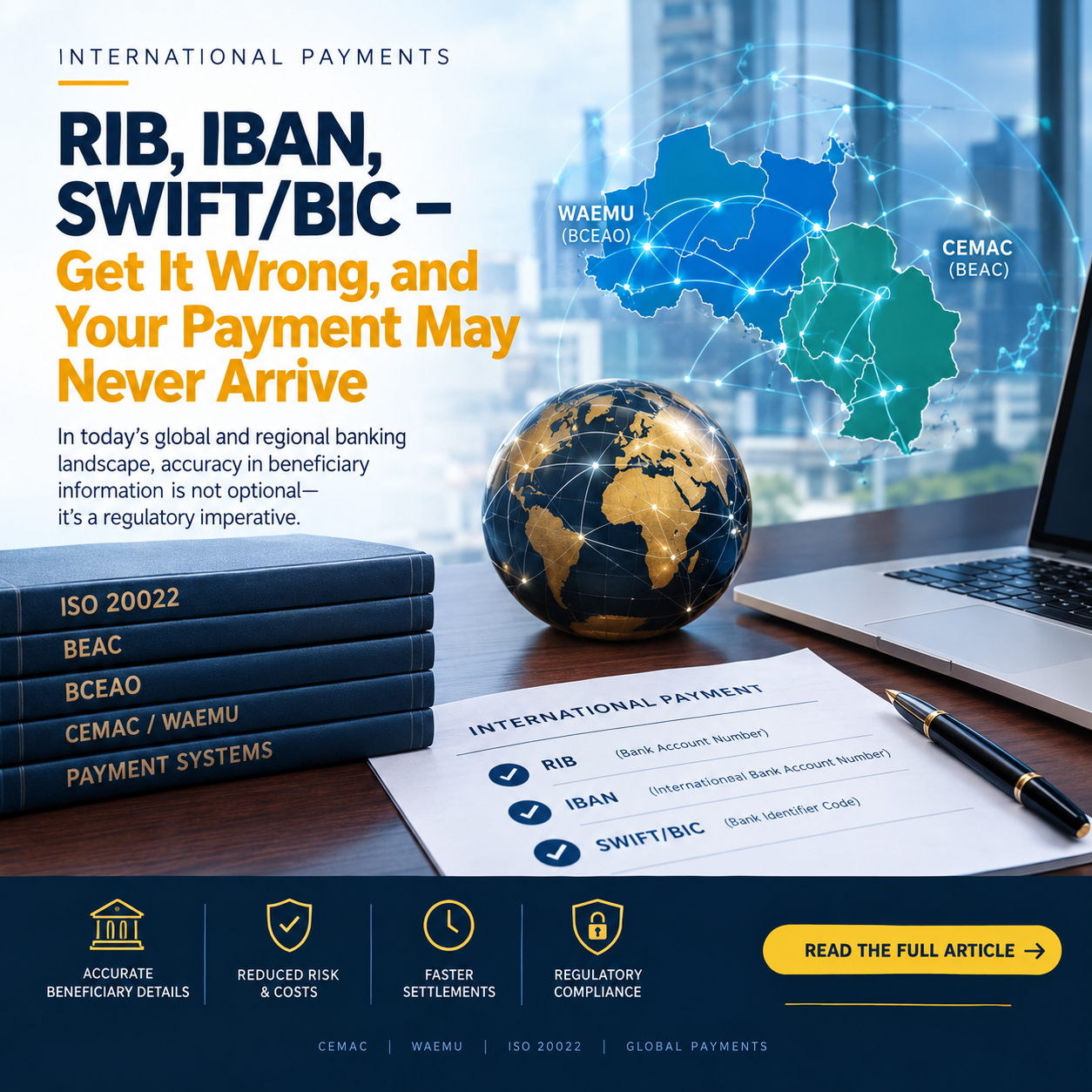
In the landscape of modern banking operations, the accurate identification of beneficiary accounts and financial institutions stands as a cornerstone of payment security and operational efficiency. Within the Central African Economic and Monetary Community (CEMAC) and the West African Economic and Monetary Union (WAEMU), three identifiers—RIB, IBAN, and SWIFT/BIC—constitute the essential triad for securing payment transactions, whether domestic or international.
The regulatory frameworks governing these identifiers have undergone significant evolution in recent years. In CEMAC, the Bank of Central African States (BEAC) has mandated the standardization of payment and escrow accounts to IBAN/RIB formats, while the broader migration to the ISO 20022 messaging standard, enacted through Instruction N° 001/GR/2025, represents a fundamental recalibration of the region’s payment systems. Similarly, in WAEMU, the Central Bank of West African States (BCEAO) oversees payment systems including the STAR-UEMOA real-time gross settlement (RTGS) system and the SICA-UEMOA retail payment system.
This article provides a comprehensive legal and operational analysis of these three identifiers, their distinct functions, and the critical importance of their accuracy in international payment operations.
I. The RIB (Relevé d’Identité Bancaire) – Domestic Account Identification
The RIB is a document that consolidates all information necessary to uniquely identify a bank account. It serves as the foundational identifier for domestic payment operations, enabling banks to correctly route funds to the intended beneficiary.
Structure and Format in the WAEMU Region
Within the WAEMU zone, the RIB consists of 24 alphanumeric characters, structured as follows:
| Component | Length | Description |
| Bank Code | 5 characters | Identifies the bank and its country of residence (e.g., “BF” for Burkina Faso followed by 3 digits) |
| Branch/Agency Code | 5 characters | Identifies the specific branch where the account was opened |
| Account Number | 12 characters | Distinguishes the client code (6 characters) and account type (6 characters) |
| RIB Key | 2 characters | Control key used to verify account validity |
Example (WAEMU format): BF555 01001 011556677899 22
Legal Significance
The RIB is the primary instrument for domestic payment instructions. For any local transfer, the client must provide their RIB to enable the bank to correctly identify the beneficiary account. Its accuracy is paramount; errors in any component can result in payment rejection, delays, or misrouting.
In CEMAC, the BEAC’s 2022 Report on Payment Services confirms that the standardization of payment accounts to RIB formats has been implemented across the region, reinforcing the legal obligation of financial institutions to maintain accurate account identification systems.
II. The IBAN (International Bank Account Number) – International Account Standardization
The IBAN is an internationally standardized bank account identifier that enables precise identification of a bank account for cross-border payments. It was developed to facilitate automated processing of cross-border payments and reduce the risk of transcription errors.
Relationship with the RIB
The IBAN is derived from the domestic RIB. In WAEMU, where the RIB comprises 24 characters, the IBAN extends to 28 characters, incorporating:
- A two-letter country code (e.g., “BF” for Burkina Faso, “SN” for Senegal)
- Two control digits
- The 24-character RIB
Example (WAEMU IBAN): BF00 5550 1001 0115 5667 8992 2
Regulatory Developments in CEMAC
The BEAC’s Instruction N° 001/GR/2025, which mandates the migration to the ISO 20022 standard, has profound implications for IBAN usage in the CEMAC region. Under Article 3 of the Instruction, a tripartite framework for message formats has been established:
- International Flows: The SWIFT CBPR+ rulebook
- Domestic High-Value Flows: The BEAC_SYGMA_ISO20022 rulebook
- Domestic Retail Flows: The BEAC_SYSTAC_ISO20022 rulebook
This regulatory framework means that financial institutions in CEMAC must prepare to operate different technical specifications for cross-border, domestic large-value (via the SYGMA RTGS system), and domestic retail payments, all under the overarching ISO 20022 umbrella.
III. The SWIFT/BIC (Bank Identifier Code) – Institutional Identification
The BIC (Bank Identifier Code), commonly referred to as the SWIFT code, uniquely identifies financial institutions in international interbank exchanges. It serves a fundamentally different function from the IBAN: while the IBAN identifies a specific account, the BIC identifies the bank that holds that account.
Structure and Format
A BIC is typically composed of 8 or 11 characters:
- 4 letters: Bank code
- 2 letters: Country code (ISO alpha-2)
- 2 letters or digits: Location code
- 3 letters or digits (optional): Branch code (XXX for head office)
Example: BHIFBFFXXX
Operational Role
For international payments, the sending bank uses the BIC/SWIFT code to identify the recipient’s bank and correctly route the payment. This institutional identification is distinct from, but complementary to, the account-level identification provided by the IBAN.
In CEMAC, international transfers utilize SWIFT message formats, with financial institutions completing fields relating to the identification of the ordering party in accordance with central bank requirements.
IV. Comparative Legal Analysis: Functions and Interdependencies
| Identifier | Primary Function | Scope | Regulatory Basis |
| RIB | Identifies the account | Domestic | National/Banking regulations |
| IBAN | Identifies the account (international standard) | International | ISO 13616 standard |
| SWIFT/BIC | Identifies the bank | International | SWIFT organization |
The three identifiers serve complementary but distinct functions in the payment chain:
- RIB = Identify the account (domestic context)
- IBAN = Identify the account (international standard)
- SWIFT/BIC = Identify the bank
This tripartite structure facilitates the work of both clients and banks: fewer errors, faster processing, and better payment routing.
V. Critical Question: Can an International Payment Be Correctly Executed with an Accurate IBAN but an Incorrect SWIFT/BIC?
This question goes to the heart of payment operations and carries significant legal and financial implications.
Legal Analysis
An international payment cannot be reliably executed with an accurate IBAN but an incorrect SWIFT/BIC. While modern banking systems often derive the BIC from the IBAN in the background, this does not eliminate the critical importance of BIC accuracy.
Practical Consequences
Errors in either identifier can result in:
- Payment delays – Funds may be routed to the wrong intermediary bank
- Payment rejection – The receiving bank may reject the transfer
- Misrouting – Funds may be credited to the wrong account
- Additional costs – Correction fees or reversal charges may apply
- Regulatory non-compliance – Particularly relevant in the context of AML/CFT obligations
Jurisprudential and Regulatory Context
In the CEMAC region, Regulation N° 15/2002/CM/UEMOA concerning payment systems in WAEMU member countries defines the provisions applicable to wire transfers. Under these provisions, the accuracy of beneficiary identification is a fundamental requirement.
Furthermore, in the context of anti-money laundering and counter-terrorist financing (AML/CFT) regulations—including CEMAC Regulation No. 01/CEMAC/UMAC/CM of 2016 and the WAEMU Uniform Law on Combating Money Laundering and Terrorist Financing (adopted in 2015)—the accurate identification of both the account (IBAN) and the bank (BIC) is essential for compliance with Know Your Customer (KYC) obligations.
Conclusion on the Question
An incorrect SWIFT/BIC, even with a correct IBAN, creates significant risk of payment failure or delay. The two identifiers serve complementary functions: the IBAN identifies the specific account, while the BIC identifies the institution that must receive and process the payment instruction. A mismatch between the two undermines the integrity of the payment instruction and exposes the sending institution to operational and regulatory risks.
For high-value transactions processed through RTGS systems such as SYGMA in CEMAC or STAR-UEMOA in WAEMU, the accuracy of both identifiers is particularly critical.
VI. Best Practices and Recommendations
Based on my years of legal and regulatory compliance practice in the CEMAC and WAEMU regions, I offer the following recommendations:
For Financial Institutions
- Implement robust verification protocols – Verify both IBAN and BIC before processing international payments
- Maintain updated BIC directories – Ensure access to current SWIFT BIC data
- Train staff on identifier functions – Ensure operational staff understand the distinct roles of each identifier
- Prepare for ISO 20022 migration – In CEMAC, comply with BEAC Instruction N° 001/GR/2025 requirements
- Document compliance – Maintain records of verification procedures for audit and regulatory purposes
For Corporate Clients
- Always verify beneficiary details – Confirm both IBAN and BIC with the beneficiary before initiating payments
- Use official bank documents – Obtain RIB/IBAN from official bank statements rather than informal communications
- For high-value transfers, seek confirmation – Consider requesting confirmation from the beneficiary’s bank
- Understand the distinction – Recognize that IBAN identifies the account, BIC identifies the bank
Conclusion
The triad of RIB, IBAN, and SWIFT/BIC constitutes the essential framework for secure payment operations in the CEMAC and WAEMU regions. Each identifier serves a distinct and complementary function: the RIB for domestic account identification, the IBAN for international account identification, and the SWIFT/BIC for institutional identification.
The accuracy of all three identifiers is not merely an operational convenience but a legal and regulatory imperative. As the CEMAC region undergoes its mandatory migration to the ISO 20022 standard, and as payment systems across both regions continue to evolve, the importance of accurate beneficiary identification will only increase.
Financial institutions, corporate clients, and legal practitioners must remain vigilant in ensuring the accuracy of these identifiers. An error in any one—particularly in international transactions where the consequences are magnified—can result in payment delays, financial loss, and regulatory exposure.
This article is provided for informational purposes only and does not constitute legal advice. For specific legal guidance on payment operations or regulatory compliance in the CEMAC or WAEMU regions, please consult a qualified legal professional.
Banyong Fonyam Jonie Jr.
Managing Partner, Fonyam & Partners Law Firm
Douala, Cameroon