
Understanding COBAC Regulation R-2023/02
By Banyong Fonyam Jonie Jr
Managing Partner, Fonyam and Partners Law Firm, Douala
The financial sector in the CEMAC zone has reached a decisive milestone in its harmonization and modernization journey. With the adoption of a dedicated regulatory framework for Banking Operations Intermediaries (IOBs) by the Central African Banking Commission (COBAC), the sub-region now possesses a clear legal regime governing banking brokers, agents, and business introducers.
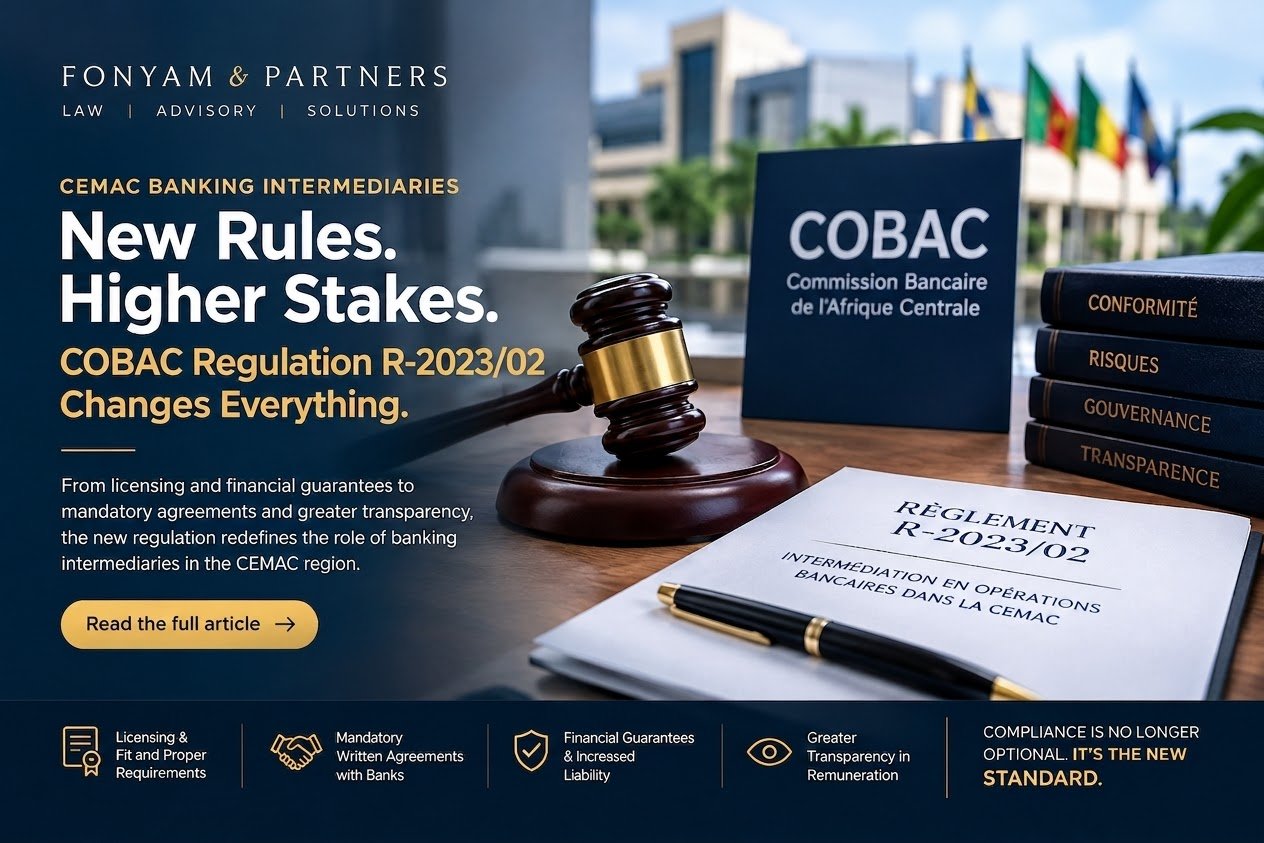
COBAC Regulation R-2023/02 of December 23, 2023, relating to the practice and supervision of the activity of banking operations intermediary in the Economic and Monetary Community of Central Africa, fills a historical legal void. It structures a rapidly expanding activity driven by the growth of financial inclusion and digital banking services. For years, this profession operated in a legal vacuum despite being anticipated in the 1992 Convention harmonizing banking regulations in Central African states. That uncertainty has now come to an end.
Status and Conditions of Practice
The regulation defines the scope of the IOB profession and imposes strict access requirements that fundamentally reshape how intermediaries operate.
Licensing and Registration: Conducting intermediary activities is now subject to prior authorization granted by the competent authorities, effectively ending informal practice. The authorization procedure, required documents, processing timelines, and the conditions regarding experience and qualifications are all clearly specified. Importantly, the national monetary authority can only grant this authorization after obtaining the conformity opinion of COBAC.
Fit and Proper Requirements: Directors and professionals concerned must demonstrate adequate professional qualifications and meet rigorous integrity criteria. For legal entity intermediaries, COBAC assesses financial capacity, the quality of internal control systems, and the qualifications, experience, and integrity of directors. For natural person intermediaries, similar diploma, experience, and integrity conditions apply.
Actor Typology: The text clarifies the categories of intermediaries, including brokers and exclusive or non-exclusive agents, and defines the perimeter of their respective mandates with credit institutions. An IOB is defined as any person who, on a habitual basis, brings together parties interested in a banking operation without acting as a guarantor, where at least one party is a credit institution. Their activity consists of presenting, proposing, or assisting in the conclusion of banking operations, as well as carrying out preparatory work and advisory services.
Credit institutions, microfinance institutions, and payment institutions cannot, in addition to their own authorization, be authorized to exercise the IOB profession. This preserves the distinct nature of the intermediary function.
Customer Protection and Contractual Transparency
To protect users and prevent abuse, the regulation introduces enhanced transparency and disclosure obligations that elevate professional standards.
Duty of Care and Warning: IOBs are subject to a strict obligation to inform themselves about their clients’ financial situations and offer solutions tailored to their needs. This duty reflects the broader consumer protection objectives that COBAC has been advancing since its 2020 regulation on consumer protection in banking services.
Regulation of Remuneration: Fees, commissions, and compensation structures for IOBs must be clearly and transparently disclosed to clients in advance. The regulation explicitly provides that intermediary remuneration is fixed in the mandate contract binding them with the mandating credit institution, and must correspond to actual work performed. Credit institutions are prohibited from paying lump-sum commissions to intermediaries.
Mandatory Written Agreements: All intermediary relationships must be formalized through a written contract outlining the nature of services and party obligations. The internal control framework of the mandating credit institution applies to the IOB within the context of their contractual relationship. Transactions carried out with IOBs must be distinctly identified in the institution’s accounting, and the audit trail must allow uninterrupted tracing from each commission recorded to the banking operation that generated it.
Financial Guarantees: Natural person IOBs and legal entity IOBs not mandated to hold funds must provide a security deposit with a credit institution licensed in a CEMAC member state, in an amount fixed by instruction of the COBAC President. Alternatively, they may provide a civil liability insurance policy.
Strategic Recommendations
For Intermediaries and Business Introducers: Immediately initiate an audit of your corporate structure and contracts to launch compliance procedures and secure the required authorizations. The era of informal practice has ended. Those who fail to regularize their status risk being unable to operate legally.
For Credit Institutions and Microfinance Institutions: Review your commercial partner networks and banking agency agreements to align with COBAC’s regulatory requirements. The regulation imposes obligations not only on intermediaries but also on mandating institutions regarding internal control, transaction identification, and audit trail maintenance.
Our firm assists financial institutions, fintechs, and banking intermediaries with regulatory compliance and the legal structuring of their activities in the CEMAC region