
Establishing a Branch in Cameroon: A Strategic Entry Route Under OHADA Law
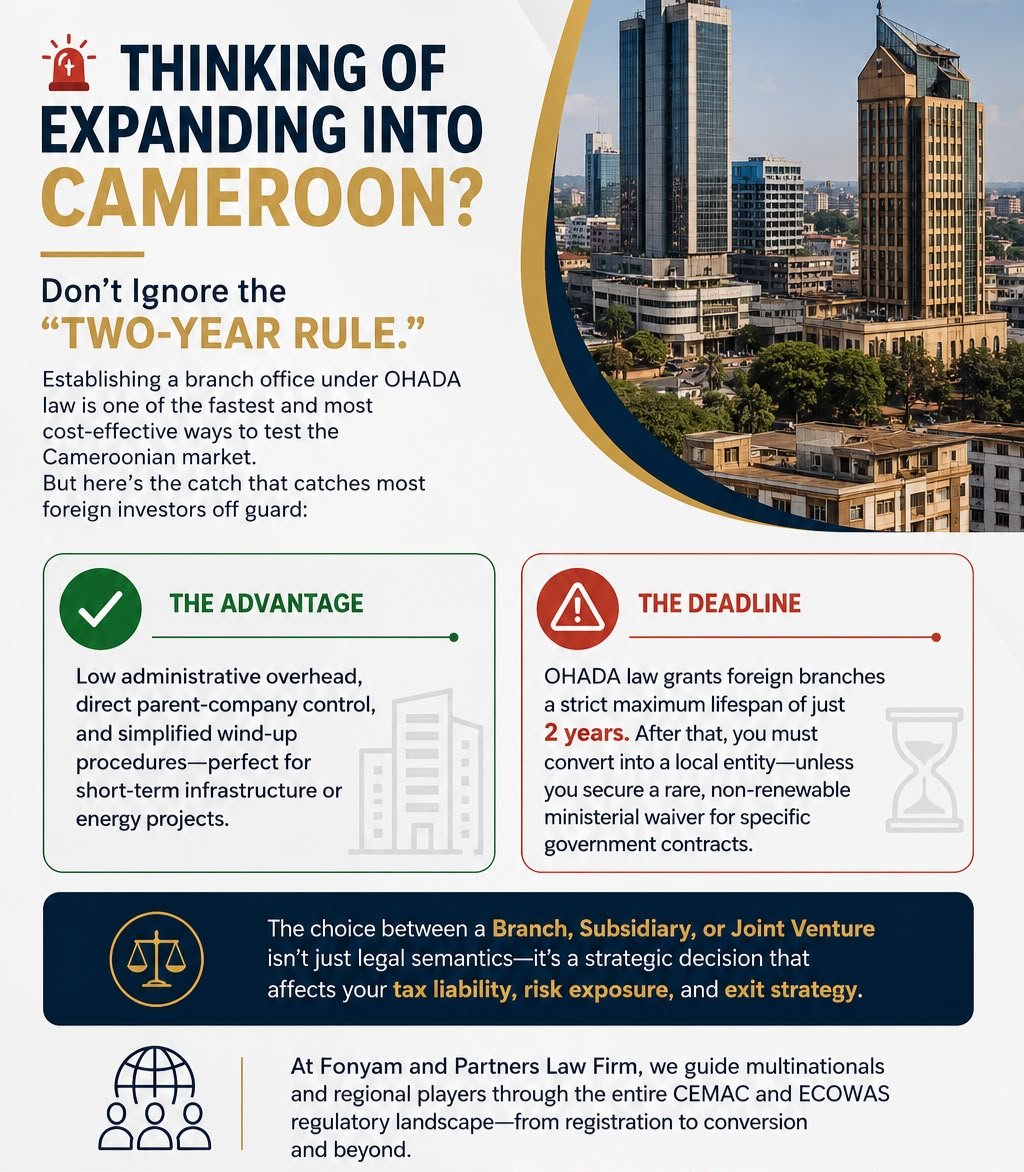
Expanding into Central Africa presents a unique set of opportunities and challenges. For businesses seeking to test the waters or execute specific projects in Cameroon without the immediate burden of full corporate incorporation, establishing a Branch Office under the OHADA Uniform Act remains one of the most efficient and low-friction entry strategies.
However, navigating the nuances of OHADA corporate law requires a clear understanding of the legal framework, operational limitations, and the critical “Two-Year Rule” that governs foreign entities.
What is a Branch Office Under OHADA Law?
Under the OHADA Uniform Act on Commercial Companies and Cameroon’s Law N° 2015/018 on Commercial Activities, a branch is defined as an operational unit owned by a parent company or individual.
While it serves as a physical presence in Cameroon, it is not a separate legal entity. The key legal features include:
• Autonomy without Separate Legal Personality: The branch enjoys operational independence to conduct business (e.g., signing contracts, invoicing clients). However, its legal personality remains entirely tied to the parent company, meaning the parent is fully liable for the branch’s obligations.
• Direct Management: The parent entity retains direct control over the branch’s operations. Unlike a subsidiary, a branch does not require distinct governing organs (like a Board of Directors) to function.
Strategic Advantages of a Branch
For many multinational corporations and regional players, the branch structure offers specific strategic benefits:
1. Cost-Effective Market Entry: The registration process for a branch is faster and significantly less expensive than incorporating a subsidiary. This makes it an ideal vehicle for testing market appetite and validating a business model before committing to heavier investments.
2. Simplified Governance & Winding Up: Without a separate legal entity, administrative overhead is minimal. Should the project scope change or the market conditions shift, the dissolution process is far simpler and less costly than liquidating a subsidiary.
3. Ideal for Short-Term Projects: Foreign contractors executing specific infrastructure, energy, or development projects find the branch structure highly advantageous. It allows them to operate seamlessly without going through the hassle of a full corporate incorporation and subsequent liquidation upon project completion.
Critical Compliance: The “Two-Year Rule”
One of the most crucial regulatory requirements for foreign entities in Cameroon is the Two-Year Rule, strictly imposed by OHADA law:
• Base Duration: A foreign company’s branch is granted a maximum lifespan of two (02) years from the date of registration.
• Mandatory Conversion: At the end of the initial two-year period, the branch must generally be converted or restructured into a locally incorporated company in Cameroon (e.g., a subsidiary or SARL).
• Ministerial Exemption: The Minister of Commerce may grant a one-time, non-renewable waiver extending the branch status for an additional two (02) years. This exemption is typically reserved for special circumstances, such as long-term government contracts or major infrastructure projects with fixed completion schedules exceeding two years.
Key Documentation Required for Registration
To successfully register a branch in Cameroon, the parent company must prepare and submit the following documentation:
1. Formal Board Resolution approving the creation of the branch.
2. Official appointment deed for the Branch Manager(s).
3. Manager’s identification documents and police clearance/criminal record.
4. Parent Company’s Certificate of Incorporation and Articles of Association (legalized and translated if necessary).
5. Branch office location plan (leasing contract or proof of address).
Final Considerations
Choosing between a Branch, Subsidiary, or Joint Venture is a strategic decision that depends heavily on your tax liability, project duration, and risk profile. While a branch offers agility, the mandatory conversion requirement necessitates long-term planning from day one.
At Fonyam and Partners Law Firm, we specialize in providing tailored legal and regulatory guidance to help businesses navigate market entry across Cameroon, the CEMAC region, and the ECOWAS region.
Contact our Corporate & Business Law team today to ensure your market entry strategy is compliant, efficient, and aligned with your business goals.