Cameroon Land Tenure Reform: New Rules on Advisory Commission Costs and Site Visits
By Banyong Fonyam Jonie Jr.
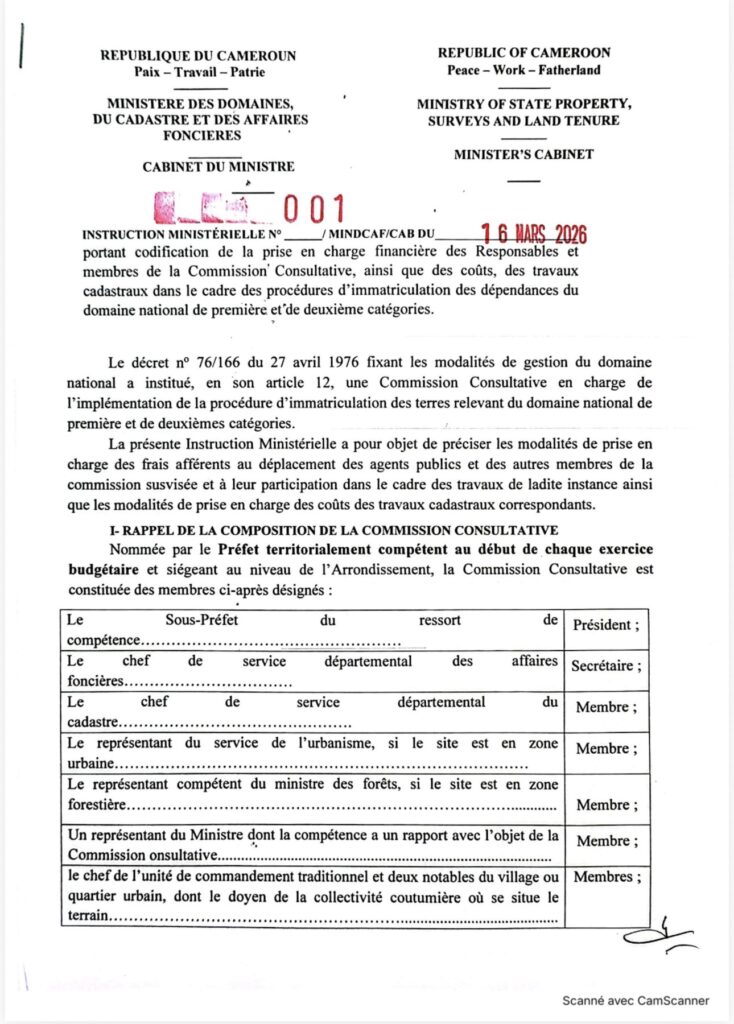
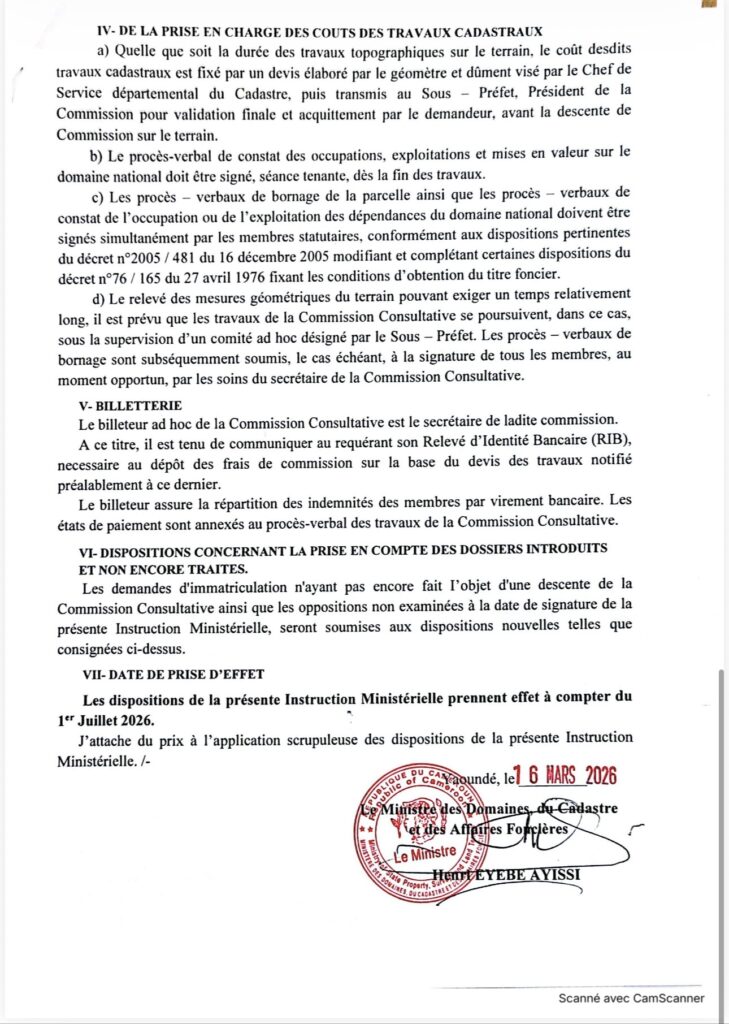
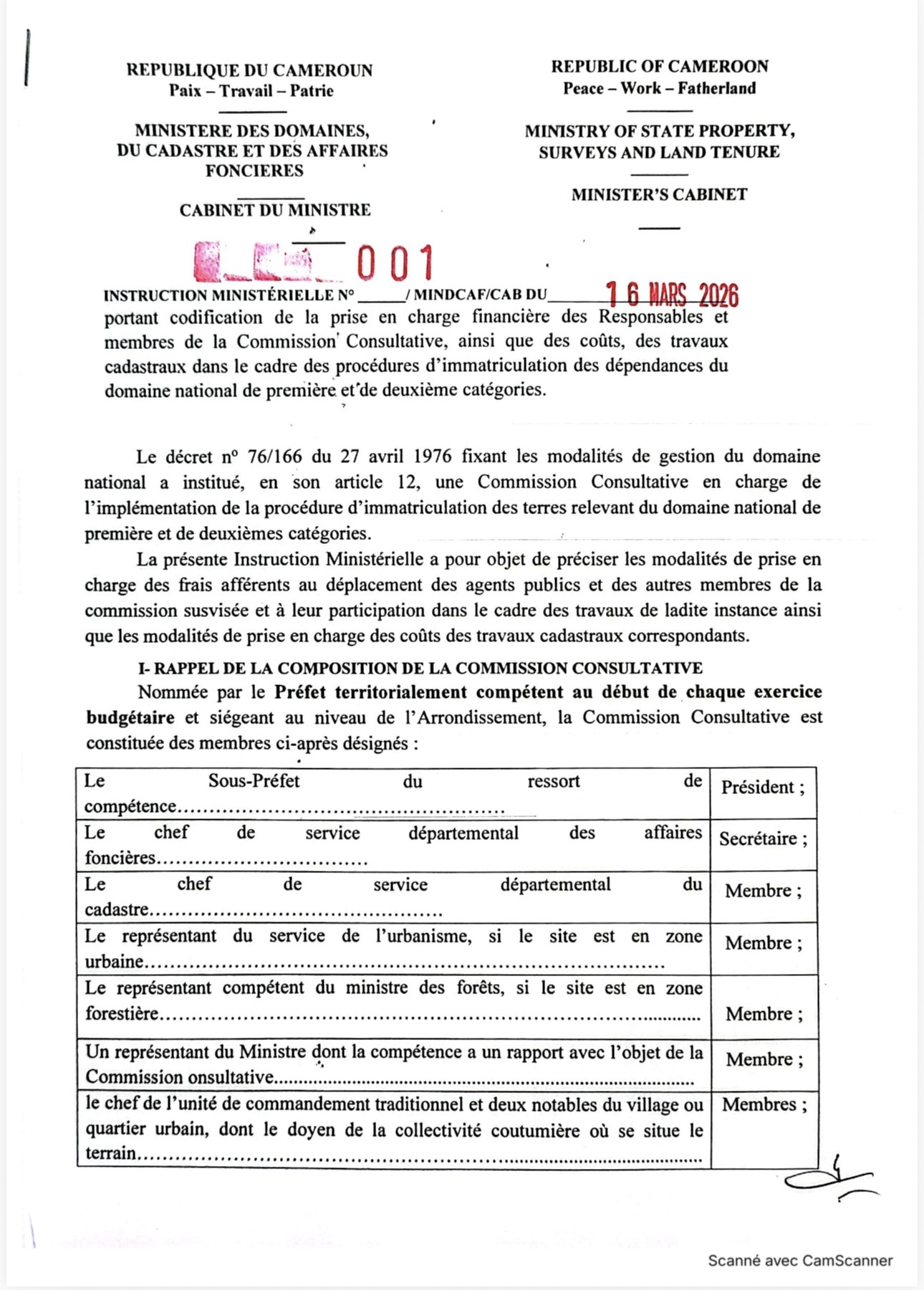
The Ministry of State Property, Surveys and Land Tenure has issued a landmark decision to regulate the financial aspects of land registration procedures. Ministerial Instruction No. 001/MINDCAF/CAB of March 16, 2026, establishes a clear framework for the financial responsibilities of applicants and opponents in the process of obtaining land titles (immatriculation) for land classified under the National Domain.
For practitioners and the public, this text provides much-needed clarity on a process that has often been a source of contention and delay: the funding of the Commission Consultative (Advisory Commission) and cadastral works.
I. The Legal Context and the Role of the Advisory Commission
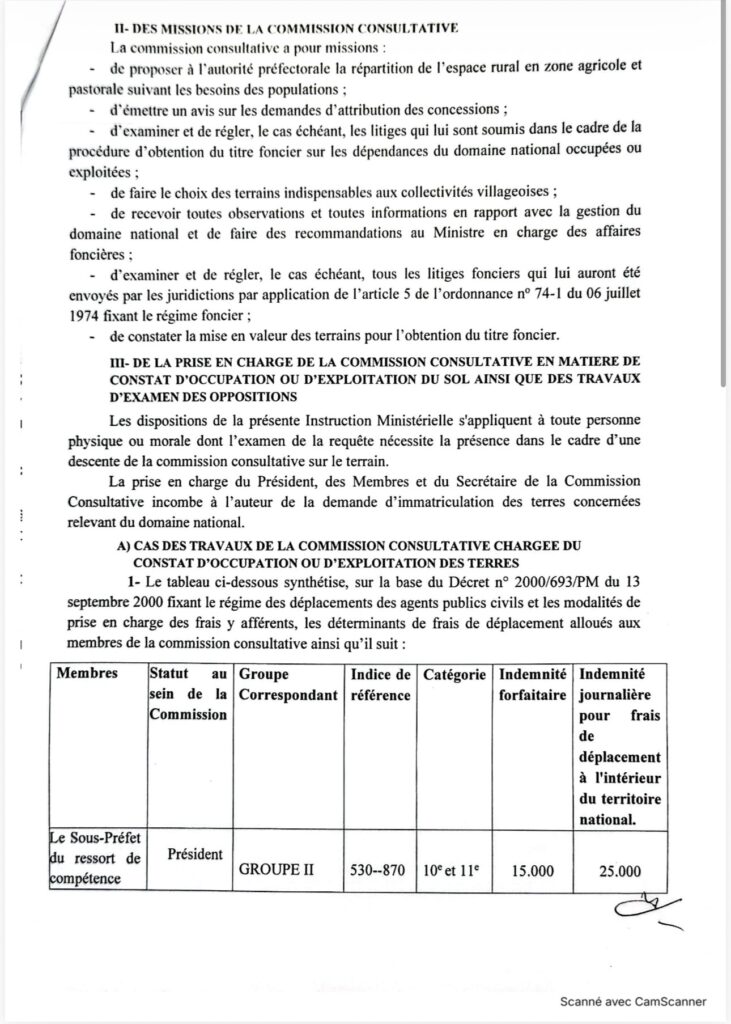
The Cameroonian land tenure system, governed by Ordinance No. 74-1 of July 6, 1974, and Decree No. 76-166 of April 27, 1976, establishes the Commission Consultative as a key body. This commission, chaired by the competent Sub-Divisional Officer (Sous-Préfet), is responsible for:
– Verifying the occupation or development of land (constat d’occupation or d’exploitation).
– Examining oppositions to land applications.
– Resolving land disputes.
Historically, the costs of convening this commission and conducting the mandatory site visit have been a gray area, often leading to disputes between applicants, local administrations, and customary authorities. This new instruction aims to codify these financial obligations.
II. Who Pays and How Much?
(A) Site Visits for Occupation/Exploitation
The instruction is explicit: the cost of the site visit falls entirely on the applicant seeking to register the land.
1. Per Diem and Allowances for Members
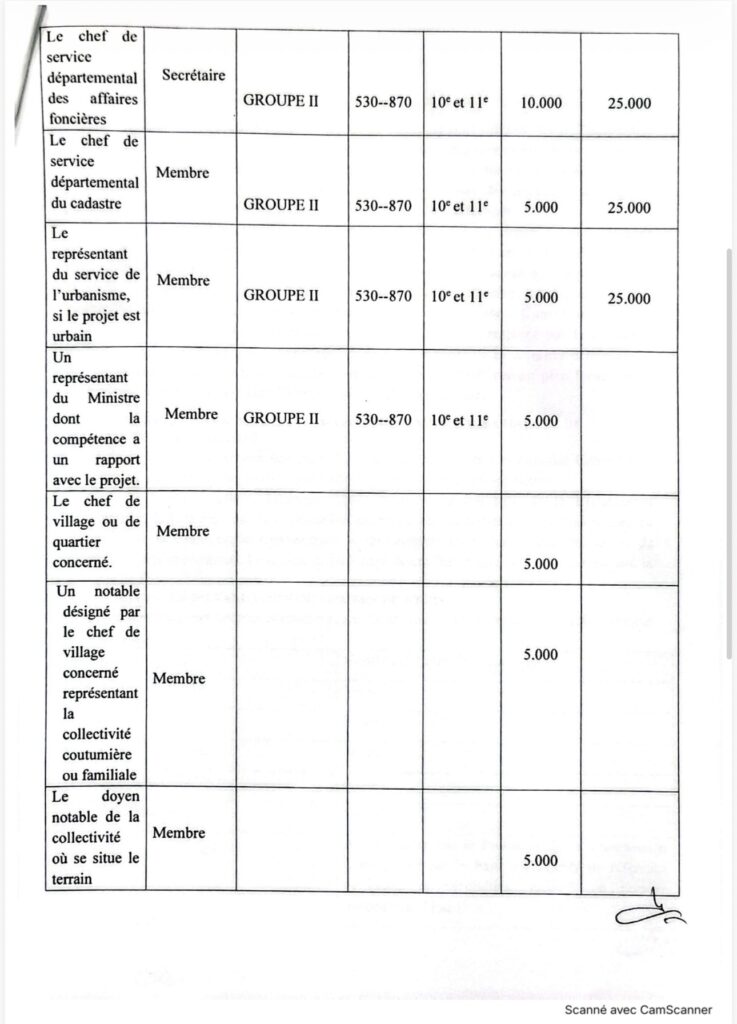
The text sets out the specific indemnities for commission members, based on the official government travel decree (Decree No. 2000/693/PM).
– The President (Sub-Divisional Officer): Entitled to a lump sum (indemnité forfaitaire) of 15,000 FCFA and a daily travel allowance of 25,000 FCFA.
– Other Statutory Members (e.g., Cadastre, Urbanism, Forestry representatives): Aligned with the rates for public agents of their respective categories.
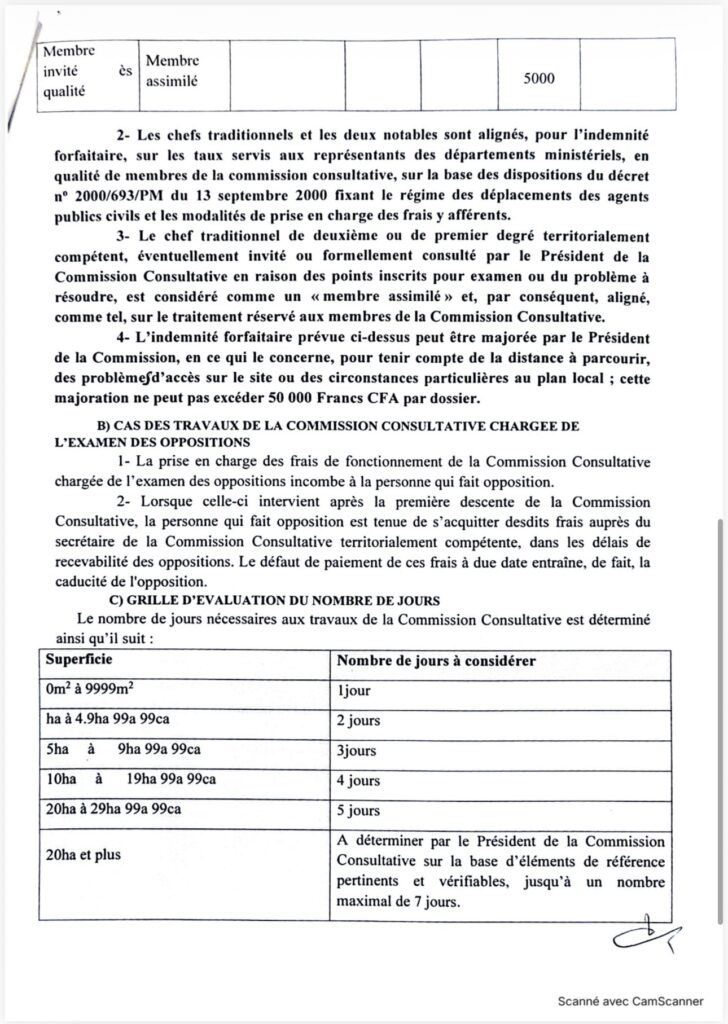
– Traditional Authorities (Chiefs and Notables): For the first time, they are explicitly aligned with the rates paid to ministerial representatives. A traditional chief who is formally consulted is considered an “assimilated member” and is entitled to similar compensation.
A critical provision allows the Commission President to increase the lump sum by up to 50,000 FCFA per file to account for difficult access, distance, or local circumstances.
2. Duration of Work and Cadastral Costs
The number of days for which these costs are calculated is now tied to the size of the land:
| Surface Area | No of days |
| 0 to 9,999 m² | 1 day |
| 1 ha to 4.99 ha | 2 days |
| 5 ha to 9.99 ha | 3 days |
| 10 ha to 19.99 ha | 4 days |
| 20 ha to 29.99 ha | 5 days |
| 30 ha and above | To be determined by the President (max 7 days) |
It is important to note that the costs of cadastral surveys (by a licensed surveyor) are separate and are established by a quote validated by the departmental Cadastre service and the Sub-Divisional Officer.
III. Who Pays and How Much?
(B) Examination of Oppositions
A significant innovation of this instruction is the clear handling of costs when a third party opposes a land application.
– The financial burden of the commission’s work shifts to the opponent.
– If the opposition is filed after the initial site visit, the opponent must pay the fees to the commission’s secretary within the legal timeframe for filing oppositions.
– Crucially, failure to pay these fees on time renders the opposition null and void (caducité de l’opposition).This is a powerful mechanism to prevent frivolous or dilatory oppositions.
IV. Practical Procedures: Banking and Payment
To ensure transparency and traceability, the instruction modernizes the payment process:
1. Designated Cashier (Billeteur): The commission’s secretary acts as the designated cashier.
2. Bank Transfer: The requester (applicant or opponent) will pay the fees via bank transfer into the secretary’s bank account, using their Bank Identification Number (RIB). This eliminates informal cash payments.
3. Receipts: Payment records must be attached to the final minutes of the commission’s proceedings.
V. Key Takeaways for Lawyers and the Public
This Ministerial Instruction, effective July 1, 2026, carries several important implications:
For Legal Practitioners:
1. Due Diligence: You must advise clients to budget accurately. The costs are no longer negotiable but are based on a fixed grid.
2. Opposition Strategy: When representing an opponent, you must ensure your client is prepared to pay the commission’s fees immediately. Failing to do so could result in the opposition being automatically dismissed, regardless of its merits.
3. Transitional Cases: The instruction applies to all pending files that have not yet had a site visit. You must review ongoing cases to ensure compliance with the new fee structure.
For the General Public:
1. Cost Certainty: The cost of the mandatory site visit is now predictable. It depends on the size of the land and the travel conditions. You should request a detailed quote from the surveyor and the commission secretary before any work begins.
2. Banking, Not Cash: Be prepared to make payments via bank transfer. Always request and keep the payment receipts as proof.
3. Rights of Opponents: If you wish to oppose a land application, you must act quickly and be ready to cover the costs of the commission’s review. Your opposition will not be considered if these fees are not paid on time.
Conclusion
Ministerial Instruction No. 001 of March 16, 2026, is a welcome step toward modernizing and sanitizing land registration procedures in Cameroon. By codifying fees, assigning financial responsibility to the parties benefiting from the process (applicants or opponents), and mandating bank transfers, it aims to reduce corruption, streamline procedures, and provide legal certainty.
For both lawyers and the public, understanding this new framework is essential to successfully maneuvering the often-complex path to obtaining a land title in Cameroon.
Banyong Fonyam Jonie Jr. is a legal professional with over 15 years of experience in conveyancing and corporate law in Cameroon.