
🇨🇲 CAMEROON: New Digital Regime for Mobile Phone & Tablet Customs Clearance Takes Effect April 1, 2026
By Banyong Fonyam Jonie Jr
Legal & Tax Professional
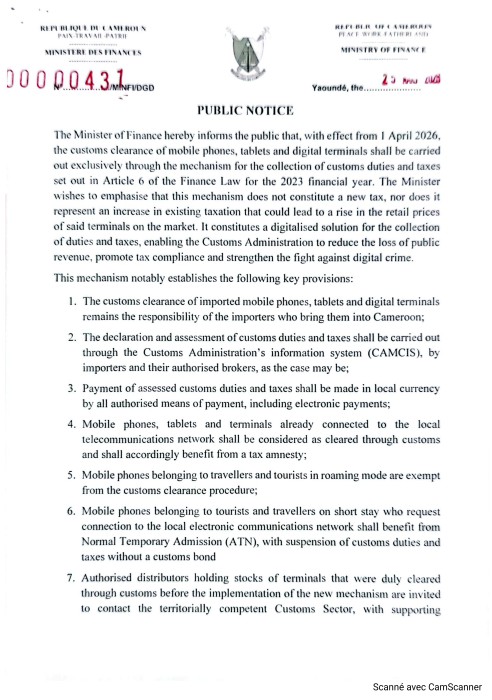
The Minister of Finance has issued Public Notice No. 000 00.43.71/MNFI/DGD, announcing a significant shift in the customs clearance regime for mobile phones, tablets, and digital terminals, effective April 1, 2026.
This reform introduces a digitalized, exclusive mechanism for the collection of customs duties and taxes, as provided for under Article 6 of the 2023 Finance Law. It is important to clarify—this is not a new tax, nor does it increase existing taxes. Rather, it is a modernized collection solution aimed at securing public revenue, improving tax compliance, and reinforcing the fight against digital crime.
🔍 Key Provisions for Stakeholders:
· Exclusive Digital Clearance: Clearance must now be processed exclusively through the Customs Administration’s information system (CAMCIS) by importers or authorized brokers. Payment is to be made in local currency via authorized means, including electronic payments.
· Tax Amnesty for Active Devices: Mobile phones already connected to local telecommunications networks are deemed cleared and benefit from a tax amnesty.
· Roaming & Short-Stay Exemptions: Devices in roaming mode are exempt. Tourists and short-stay travelers requesting local connection may benefit from Normal Temporary Admission (ATN) with suspension of duties.
· Regularization Window: Authorized distributors holding pre-existing stock must regularize with the competent Customs Sector within two (2) months, supported by proper clearance documentation.
· Consumer Protection: The public is advised to verify the customs status of any device prior to purchase via Customs consultation tools (SMS, web link, etc.). Vendors must facilitate this verification or risk liability.
· Simplified Process for Small Quantities: Small quantities of uncleared devices found locally may be declared using a simplified procedure via Customs or a dedicated web portal.
⚖️ Legal & Practical Implications
This move aligns with global trends toward digital trade facilitation and revenue assurance. For businesses, particularly distributors and vendors, the key risks now lie in liability for non-compliance and the obligation to ensure traceability of customs status.
For consumers, due diligence is no longer optional—verification of customs status before purchase is now a safeguard against acquiring non-compliant devices.
The government is counting on civic-mindedness to ensure the success of this reform. From a legal standpoint, compliance infrastructure—both digital and procedural—will determine whether this mechanism achieves its stated objectives of transparency, security, and fiscal efficiency.