
Divorce Proceedings in Cameroon
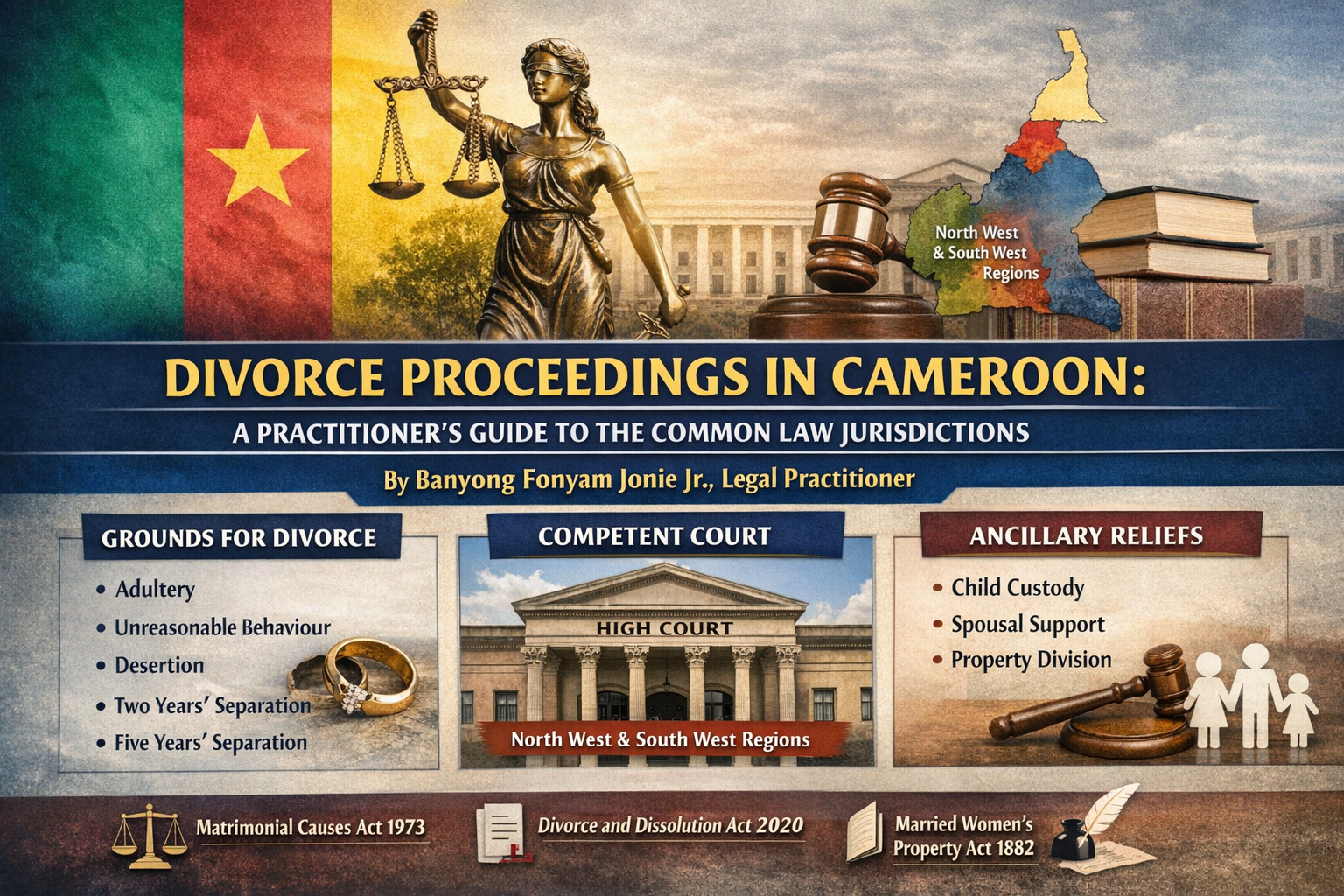
Cameroon’s unique bi-jural legal system—combining English common law in the North West and South West regions with French civil law in the other eight regions—creates distinct pathways for divorce. This enhanced article provides authoritative guidance on matrimonial proceedings specifically for practitioners and parties navigating divorce in Cameroon’s common law jurisdictions, with particular attention to the North West and South West regions.
DIVORCE PROCEEDINGS IN CAMEROON: A PRACTITIONER’S GUIDE TO THE COMMON LAW JURISDICTIONS
By Banyong Fonyam Jonie Jr., Legal Practitioner specialising in Matrimonial Proceedings
1.0 INTRODUCTION
The dissolution of marriage in Cameroon presents unique complexities arising from our bi-jural legal heritage. For legal practitioners in the North West and South West Regions, navigating matrimonial causes requires mastery of the Matrimonial Causes Act 1973, the Matrimonial and Family Proceedings Act 1984, and crucially, the Divorce and Dissolution Act 2020, which has introduced significant reforms to our matrimonial jurisprudence. This article provides a comprehensive examination of divorce law and practice applicable in Cameroon’s common law jurisdictions, offering practitioners authoritative guidance on procedure, grounds, and ancillary reliefs.
2.0 JURISDICTIONAL FRAMEWORK
2.1 The Competent Court
Under the laws applicable in the English-speaking regions of Cameroon, the High Court of the place where the parties reside or where the marriage was celebrated has exclusive jurisdiction to hear and determine petitions for divorce . The High Court exercises this jurisdiction in accordance with the Matrimonial Causes Act 1973, as modified by subsequent legislation including the Divorce and Dissolution Act 2020.
2.2 Preliminary Requirements
Before instituting proceedings, counsel must ensure:
Validity of Marriage: There must exist a valid marriage. The parties must have capacity to marry, be of age, of sound mind, not be within prohibited degrees of consanguinity or affinity, and have consented to the marriage. Where these prerequisites are absent, the marriage is void ab initio .
Duration Requirement: No petition for divorce shall be presented to the Court before the expiration of one year from the date of celebration of the marriage . This mandatory waiting period is jurisdictional and cannot be waived.
3.0 GROUNDS FOR DIVORCE UNDER THE MATRIMONIAL CAUSES ACT 1973
The sole ground for divorce in our common law jurisdictions is the irretrievable breakdown of marriage. However, Section 1(2) of the Matrimonial Causes Act 1973 requires that irretrievable breakdown be proved by establishing one or more of five factual situations .
3.1 Adultery and Intolerability
Definition: Adultery consists of consensual sexual intercourse between a married person and a person of the opposite sex (not being the other spouse) during the subsistence of the marriage. Proof requires evidence of:
· Opportunity and inclination
· Full penetration (emission need not be proved)
· The petitioner finds it intolerable to live with the respondent
Practice Note: The petitioner must satisfy the court both that adultery occurred AND that he or she finds it intolerable to live with the respondent. These are separate requirements .
3.2 Unreasonable Behaviour
The petitioner must prove that the respondent has behaved in such a way that the petitioner cannot reasonably be expected to live with the respondent .
Categories of Behaviour:
· Physical, mental, and psychological violence
· Cruelty (following the former matrimonial offence)
· Evasion of matrimonial responsibilities
· Vile abuses and false accusations
· Influence of third parties undermining the marriage
Evidential Requirement: The behaviour must be “grave and weighty” – trivial matters will not suffice .
3.3 Desertion
Definition: Desertion is the unjustifiable withdrawal from cohabitation without the consent of the other spouse and with the intention of remaining separated permanently .
Essential Elements:
- Factual separation
- Animus deserendi (intention to desert)
- Absence of consent by the petitioner
- Continuous period of two years immediately preceding the petition
Constructive Desertion: Where the respondent’s conduct forces the petitioner to leave the matrimonial home, the respondent may be held to have constructively deserted the petitioner .
3.4 Two Years’ Separation with Consent
Where the parties have lived apart for a continuous period of two years immediately preceding the presentation of the petition, AND the respondent consents to a decree being granted .
Practice Note: The respondent’s consent must be formally signified. The court retains discretion to inquire into the genuineness of consent.
3.5 Five Years’ Separation without Consent
Where the parties have lived apart for a continuous period of five years immediately preceding the presentation of the petition, divorce may be granted even without the respondent’s consent .
4.0 BARS AND DEFENCES
Counsel must be alert to statutory bars:
Ground Bar/Defence
Adultery Condonation by continuing to live with respondent for 6 months after discovery
Behaviour Condonation by continuing cohabitation after the incident relied upon
Desertion Forgiveness or resumption of cohabitation before expiration of 2-year period
All grounds Collusion, connivance, or conduct conducting
5.0 THE CONCILIATION PROCESS
A distinctive feature of our procedure is the mandatory conciliation attempt. Upon filing a petition, the judge seized of the matter shall attempt conciliation between the parties .
· Successful Conciliation: The petition is not entertained further
· Unsuccessful Conciliation: The respondent files a reply and the matter proceeds to hearing
6.0 ANCILLARY RELIEFS
Upon granting a decree of divorce, the High Court is empowered to make several ancillary orders .
6.1 Financial Provision (Alimony)
The Court may order either party to make to the other:
· Periodical payments for such term as may be specified
· Lump sum payment as specified
· Maintenance orders for children of the marriage
6.2 Property Adjustment
Matrimonial Regimes: The court’s powers regarding property adjustment depend entirely on the matrimonial regime chosen at marriage .
Separate Property: Where the parties elected separate property, the court issues no property adjustment orders. Each spouse retains their own property .
Joint Property: Where parties opted for joint property, the court divides assets acquired during marriage, including:
· Landed property
· The matrimonial home
· Movable property
Protection of Spousal Rights: It is imperative to note that under Section 17 of the Married Women’s Property Act 1882 (applicable in Cameroon), a woman is a co-owner of the matrimonial home. In Ntarikon Cooperative Union Ltd v. Pamela Sirri Longtcha and Fon Festus (Suit No HCB/05S/2012), the High Court of Mezam held that where a property is the matrimonial home, both spouses have rights of co-ownership, and any disposition requires the consent of both .
6.3 Custody of Children
Statutory Obligation: After granting a decree of divorce, the court is obliged to make custody orders in respect of children of the marriage who are under 18 years .
The Paramount Consideration: The welfare of the child is the paramount consideration . This principle, derived from the Matrimonial Causes Act, has been consistently applied by our courts.
Factors in Determining Welfare :
· Age of the child
· Sex of the child
· Wishes of the child (if of sufficient age and understanding)
· Educational and religious considerations
· Conduct of the parties
· Adequacy of arrangements for the child
· Medical and psychological factors
Types of Custody Orders :
· Divided Custody: Child lives with each parent for part of the year
· Split Custody: Custody to one parent, care and control to the other
· Joint Custody: Both parents share responsibility and authority
7.0 UNCONTESTED VERSUS CONTESTED DIVORCE
7.1 Uncontested Divorce
An uncontested divorce occurs when both spouses agree on custody, property division, and support .
Advantages:
· Faster proceedings
· Less expensive
· Consent judgment issued
· Minimal court appearances
· Preservation of amicable relations
Requirements :
- Mutual consent to dissolution
- Agreement on all ancillary matters
- Written settlement agreement
- Both parties represented by counsel
7.2 Contested Divorce
Where parties cannot agree, contested proceedings involve:
· Extensive documentation
· Witness testimony
· Cross-examination
· Multiple court hearings
· Increased costs
8.0 THE DIVORCE AND DISSOLUTION ACT 2020
Practitioners in the North West and South West Regions must be conversant with the Divorce and Dissolution Act 2020, which has introduced important modifications to our matrimonial jurisprudence:
· No Fault Elements: While retaining the five facts, the Act emphasizes non-adversarial resolution
· Child Arrangements Orders: Introduction of modern terminology and provisions
· Financial Remedy Proceedings: Streamlined procedures for financial relief applications
· Digital Filing: Provisions for electronic filing of petitions (where court infrastructure permits)
9.0 PROCEDURAL GUIDE
9.1 Steps in Divorce Proceedings
- Pre-filing Conference: Take comprehensive instructions, verify grounds, gather evidence
- Drafting Petition: Plead specific facts establishing jurisdiction and ground
- Filing: File petition at the High Court with jurisdiction
- Conciliation: Attend before judge for conciliation attempt
- Service: Serve petition on respondent
- Respondent’s Reply: Filed within time limited
- Hearings: Attend court hearings for determination
- Decree Nisi: Provisional decree granted
- Decree Absolute: Final decree after statutory period
- Ancillary Relief Orders: Custody, property, and maintenance determinations
9.2 Required Documents
· Divorce Petition (drafted by counsel)
· Marriage Certificate
· National Identification Cards/Passports
· Settlement Agreement (if uncontested)
· Birth Certificates of Children
· Proof of Residence
· Evidence of grounds (where applicable)
10.0 CUSTOMARY LAW CONSIDERATIONS
While this article focuses on statutory divorce, practitioners must be aware that customary law marriages may be dissolved either judicially or extra-judicially:
· Non-judicial divorce: Parties agree to separate after fruitless reconciliation attempts by family
· Judicial divorce: Customary Law Courts have jurisdiction at first instance
The interplay between statutory and customary systems requires careful navigation, particularly regarding property rights and child custody.
11.0 COSTS AND PROFESSIONAL FEES
Divorce costs in Cameroon comprise two components :
Court Fees: Statutory fees including filing fees, which may vary between High Courts
Professional Legal Fees: Determined by factors including:
· Complexity of the case (contentious grounds increase complexity)
· Presence of children (requires additional court scrutiny)
· Reliefs sought (property division, maintenance claims)
· Experience of counsel
· Number of hearings required
12.0 CONCLUSION
Divorce practice in Cameroon’s common law jurisdictions demands mastery of multiple statutes, procedural rules, and case law. The Matrimonial Causes Act 1973 remains foundational, but must now be read together with the Divorce and Dissolution Act 2020, the Matrimonial and Family Proceedings Act 1984, and applicable provisions of the Married Women’s Property Act 1882.
For practitioners in the North West and South West Regions, understanding the bi-jural context while applying common law principles is essential to protecting clients’ rights. The welfare of children remains paramount, property rights must be vigorously defended, and cultural pressures must be navigated without compromising statutory protections.
Disclaimer: This article provides general legal information and does not constitute legal advice. Practitioners should consider specific facts and circumstances before advising clients. The law may have changed since the time of writing.
Banyong Fonyam Jonie Jr. is a seasoned legal practitioner specialising in matrimonial proceedings in Cameroon’s common law jurisdictions. He has particular expertise in complex financial remedy proceedings and international child custody matters.
This article draws upon the Matrimonial Causes Act 1973, the Divorce and Dissolution Act 2020, the Married Women’s Property Act 1882, and relevant case law including Ntarikon Cooperative Union Ltd v. Pamela Sirri Longtcha and Fon Festus (Suit No HCB/05S/2012).