
The Rise of RegTech: A Legal Compliance Guide for Cameroon, CEMAC, and WAEMU Markets
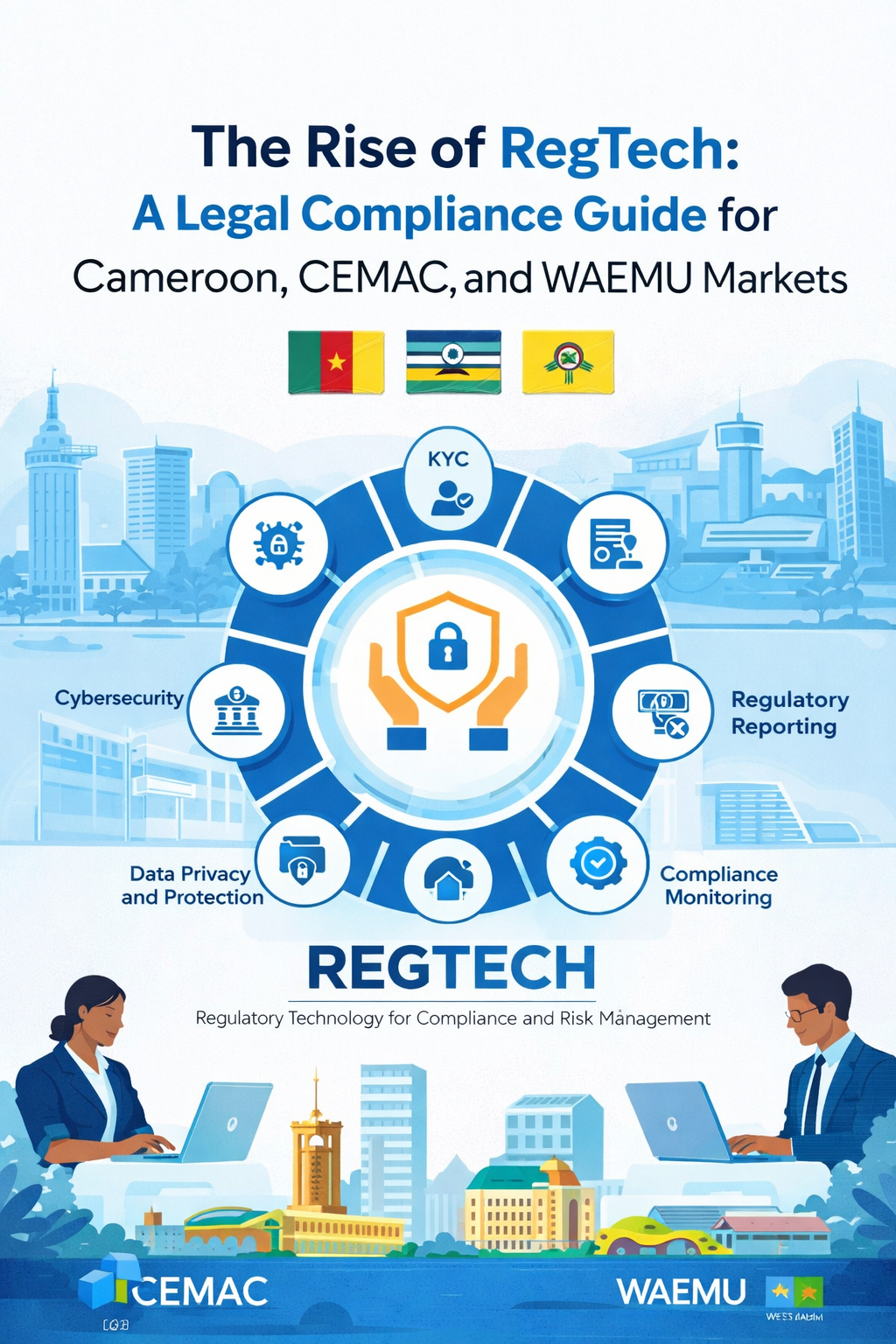
RegTech, or Regulatory Technology, refers to software designed to automate and streamline compliance, risk management, and regulatory reporting. For legal practitioners and businesses operating within the complex, dual-layered frameworks of Cameroon, the CEMAC zone, and the WAEMU zone, this is not just a tech trend—it’s the future of sustainable business.
As regulatory landscapes become more intricate and global standards like those of the FATF become more stringent, manual compliance is no longer viable. We are moving toward a world where compliance isn’t something you build from scratch, but a sophisticated system you plug into. The concept of “RegTech-as-a-Service” (RaaS) is on the horizon.
This guide provides a comprehensive overview of the legal and regulatory imperatives driving RegTech adoption in our region.
1. The Core Regulatory Drivers for RegTech in Central & West Africa
The adoption of RegTech in the CEMAC and WAEMU regions is not merely a matter of operational efficiency; it is a direct response to a binding and evolving legal framework.
– CEMAC (Central Africa): The regulatory backbone is formed by CEMAC Regulation No. 01/CEMAC/UMAC/CM of 2016, which harmonizes AML/CFT standards across all six member states, including Cameroon . This is enforced by the Banking Commission of Central Africa (COBAC) and the Bank of Central African States (BEAC). In Cameroon, these are supplemented by national laws such as Law No. 2016/014 on AML/CFT and enforced by the National Financial Investigation Agency (ANIF) .
– WAEMU (West Africa): Similarly, the WAEMU Commission enforces competition and compliance regulations, creating a harmonized market where automated compliance is key for cross-border operations .
– Cameroon’s Data Protection Revolution: A landmark development is the enactment of Law No. 2024/017 of December 23, 2024, relating to the protection of personal data. This new law grants individuals extensive rights over their data (access, rectification, erasure) and establishes an independent Data Protection Authority (APDP) . Businesses have an 18-month transitional period—until June 23, 2026—to achieve full compliance, making RegTech solutions for data mapping, consent management, and breach notification essential .
2. Where RegTech Meets the Law: Key Functional Areas
For businesses and financial institutions, RegTech provides the tools to meet specific legal obligations outlined by our regulators.
Legal/Compliance Area
Key Regulatory Requirements in Cameroon/CEMAC
Role of RegTech Solutions
KYC & Digital Identity
Mandatory Customer Due Diligence (CDD) & Enhanced Due Diligence (EDD) . Law No. 2010/012 mandates identity verification .
eKYC platforms for biometric verification (DGSN cards) and remote onboarding. Automated screening against sanctions lists .
Anti-Money Laundering (AML)
Real-time transaction monitoring, mandatory reporting to ANIF. STRs must be filed within 24 hours of suspicion . Cash Transaction Reports (CTR) for transactions over XAF 2 million . Record keeping for a mandatory 10-year period .
AI-powered transaction monitoring, automated STR generation, and immutable audit trail record-keeping .
Data Privacy & Protection
Full compliance with Law No. 2024/017 by June 2026, including data localization for financial records and breach notification within 72 hours .
Data mapping, Privacy Impact Assessment (PIA) tools, breach notification protocols, and “Privacy by Design” frameworks
3. Regional Nuances and Enhanced Due Diligence
Standard compliance is no longer sufficient. As I have previously discussed, the region demands “Enhanced Due Diligence” that goes beyond traditional PEP checks . RegTech facilitates this through:
– Intelligence-led methods: Using Open Source Intelligence (OSINT) and AI-powered analytics for a holistic risk assessment .
– Cross-border cooperation: Aligning with the GABAC (Central African action group against money laundering) action plan and the upcoming beneficial ownership registry .
– Cybersecurity: Implementing robust systems for dark web monitoring and fraud prevention, as recommended by recent CEMAC workshops on mobile money interoperability .
4. The Cost of Non-Compliance
Failure to leverage technology to meet these obligations carries severe legal and financial penalties. Under the new data protection law, administrative fines can reach up to XAF 50 million, with potential prison sentences of 1 to 5 years for severe breaches . For AML failures, COBAC can impose fines of up to XAF 100 million, revoke licenses, and pursue criminal liability against directors .
Conclusion: Compliance as a Competitive Advantage
The message is clear: manual processes are a liability. For fintechs, banks, and even traditional businesses in Cameroon, CEMAC, and WAEMU, compliance is a core business enabler. The future lies in partnering with RegTech providers who offer the agility, local regulatory depth, and technological sophistication to turn legal complexity into a foundation for growth. We are indeed moving toward a standardized, plug-in future for compliance—and the time to prepare is now.
Banyong Fonyam Jonie Jr