
THE PORT OF DOUALA SCANNING DISPUTE – A CRISIS OF CONTRACT, GOVERNANCE & ECONOMIC STABILITY.
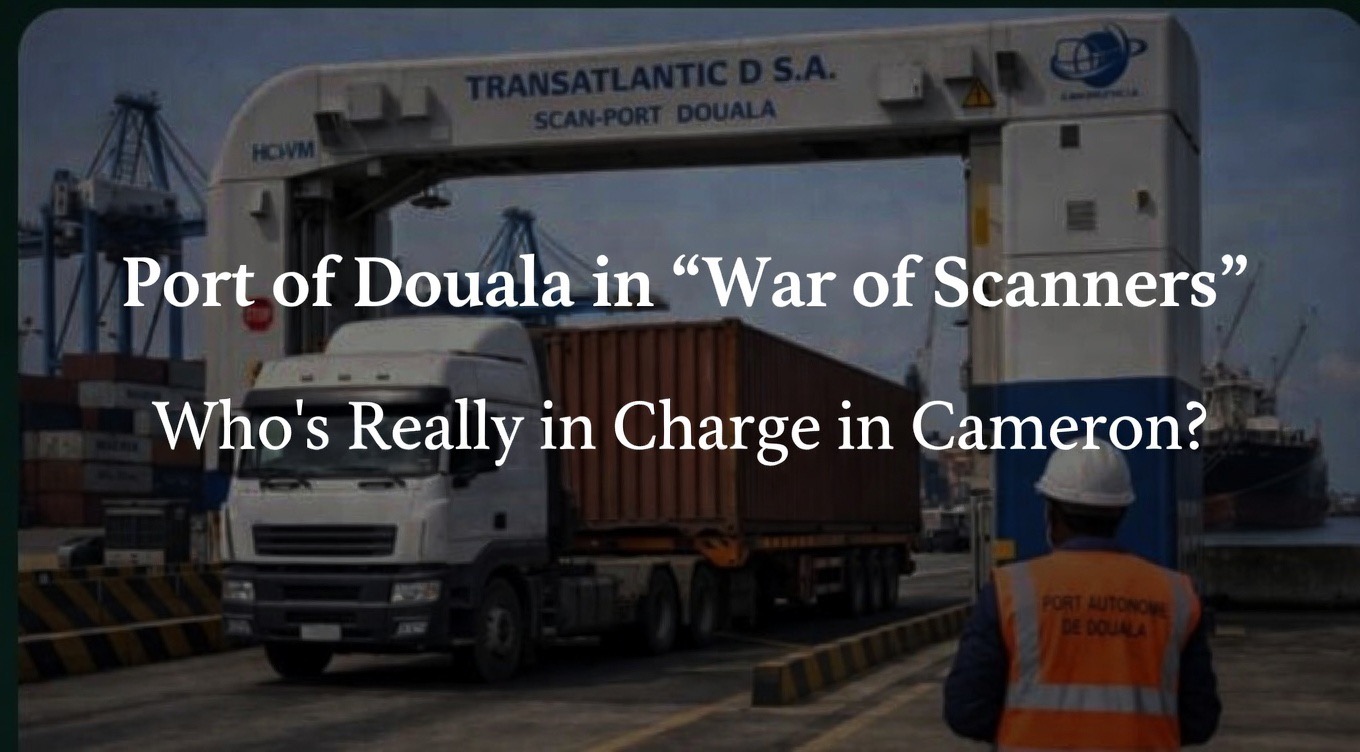
Clarifying the Standoff at the Port of Douala-Bonabéri Between SGS, the Port Authority (PAD), and the Government of Cameroon.
By Banyong Fonyam Jonie Jr
A critical contractual and operational dispute over the control of cargo scanning services at the Port of Douala-Bonabéri has escalated into a full-blown institutional and economic crisis. The clash between the long-standing operator SGS Scanning Cameroun SA and the state-owned Autonomous Port of Douala (PAD)management has paralyzed cargo clearance, inflicted severe financial losses on businesses, and exposed alarming fissures in government decision-making. This briefing synthesizes the legal arguments, chronological events, and dire economic consequences of this “war of scanners.”
1. The Core of the Dispute: Two Irreconcilable Legal Positions
– SGS’s Position (Supported by the Prime Minister & Ministry of Finance):
The 2015 Build-Operate-Transfer (BOT) contract remains valid until 2032. This is based on the argument that the 10-year operational period began only after the delayed installation of the fourth and final scanner in 2022.
SGS holds that the delays were caused by PAD’s failure to provide the necessary land on time.
As per the contract, their mandate can only be discussed with their official counterpart: the Government of Cameroon, represented by the Ministry of Finance.
– PAD’s Position (As inferred from actions and legal stance):
The contract ended normally on December 31, 2025, ten years after the initial completion deadline stipulated in the 2015 agreement (Annex III).
PAD argues SGS did not formally enforce the schedule for 7 years, did not invoke force majeure, and continued performing the contract, thus forfeiting the right to claim a new timeline.
PAD has proceeded to award the scanning contract to a new operator, Transatlantic D SA, and has restricted SGS’s access.
2. Chronology of Key Events: From Contract to Chaos
– March 2015:Government signs a 10-year BOT contract with SGS for four scanners, to be fully operational by December 31, 2015.
– 2015-2017: Only three scanners are installed. The fourth is delayed.
– 2018: SGS formally requests PAD to provide land for the fourth scanner, which is already stored in the port.
– 2022: SGS installs the fourth scanner and asserts the contract now runs until 2032. PAD rejects this interpretation.
– December 31, 2025: PAD declares the contract terminated.
– Early January 2026: PAD engages Transatlantic D SA and restricts SGS’s operations.
– January 26, 2026: The Presidency’s Chief of Staff signals a political decision to replace SGS.
– January 29-30, 2026: Prime Minister Joseph Dion Ngute intervenes, ordering the halt of the transition and the immediate resumption of SGS’s operations to avoid economic disruption.
– February 2, 2026:The Director General of PAD, Cyrus Ngo, invites SGS to a meeting with a broad agenda including SGS’s new operating authorization and potential collaboration with Transatlantic D SA.
– February 4, 2026: In a sharp response (Ref: DG/085/02-26/RS/PN), SGS’s Director General, Patricia Nzondjou, rejects PAD’s agenda. She states that only the Prime Minister’s directive on the “practical organization of the resumption of scanning operations by SGS” can be discussed, as other points fall under the exclusive prerogative of the Government (Ministry of Finance).
3. Current State of Paralysis & Economic Impact
The situation on the ground is one of administrative “bicéphalism” or dual power, resulting in chaos:
1. Operational Deadlock: Transatlantic D SA physically controls the scanners, but the national customs software (managed by the Ministry of Finance) remains integrated with and locked to the SGS system. This makes legal, automated clearance impossible.
2. Economic Carnage:
– Stranded Cargo: Hundreds of containers are stuck, incurring massive and accruing demurrage and storage fees.
– Double Payment Threat: Importers are reportedly being pressured to pay both operators.
– Industrial Stagnation: Factories in Douala and landlocked partner countries (Chad, C.A.R.) face critical raw material shortages, threatening production and employment.
– Inflationary Pressure: Supply chain bottlenecks will inevitably lead to increased prices for goods across Cameroon and the sub-region.
3. Governance Crisis: The PAD management’s apparent defiance of the Prime Minister’s “high instructions” reveals a severe breakdown in the chain of command, suggesting competing directives from different power centers within the state.
4. Risks and Potential Outcomes
– Immediate Economic Loss: The Cameroonian economy and its neighbors are losing millions daily.
– Legal Escalation: The contract provides for international arbitration at the ICC in Paris. Either party could initiate this long and costly process.
– Loss of Competitiveness: The reputational damage and operational unreliability risk permanently diverting regional trade to rival ports in West Africa, undermining Douala’s and Cameroon’s strategic economic position.
– Security Implications: Inefficient scanning creates vulnerabilities in cargo security and border control, a key sovereignty issue highlighted in presidential correspondence.
Conclusion & Call for Resolution
This dispute has transcended a commercial contract disagreement. It has become a test of Cameroon’s governance, rule of law, and commitment to economic stability.
– For Business Owners, Importers, and Exporters: You are the primary victims of this institutional failure. Your losses highlight the urgent need for a coherent and legally sound resolution.
– For the Government of Cameroon: A clear, unified, and authoritative decision must be communicated and enforced to end the current paralysis. The conflicting signals between the Presidency, Prime Minister’s Office, Ministry of Finance, and PAD management must be resolved.
– For the International Community: This situation affects regional trade stability and investment climate perceptions in Central Africa. A transparent and rules-based resolution is critical.
The path forward requires either a legally negotiated exit with SGS or the full and unequivocal reinstatement of its operations as per the Prime Minister’s directive, followed by a orderly transition plan if needed. The current state of conflicting mandates is unsustainable and is sinking the economy.
Banyong Fonyam Jonie Jr.
(Legal Analysis & Public Interest Perspective)