
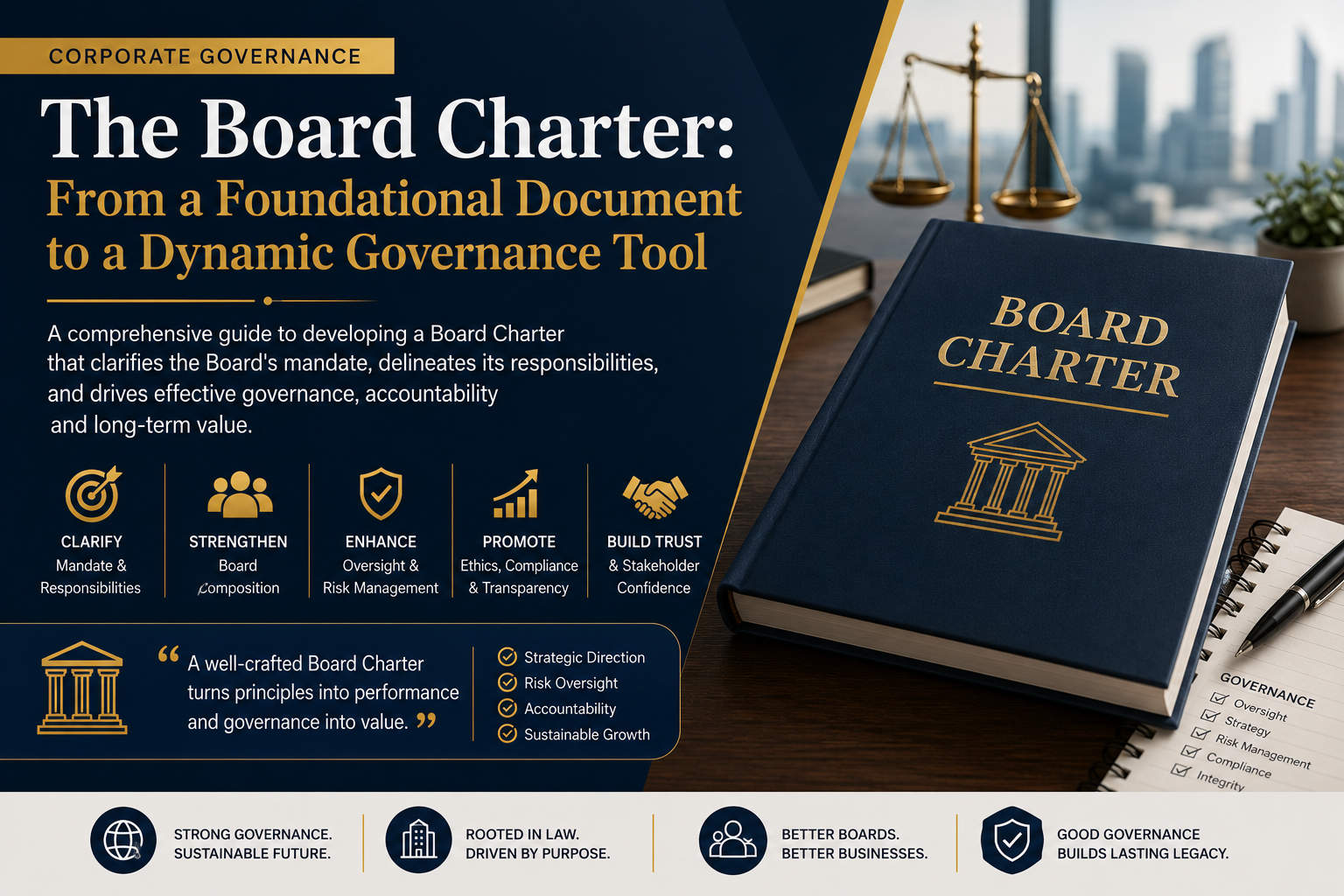
The Board Charter: From a Foundational Document to a Dynamic Governance Tool
By Banyong Fonyam Jonie Jr., Managing Partner, Fonyam and Partners Law Firm, Douala
In the complex and rapidly evolving regulatory landscapes of the CEMAC and WAEMU regions, effective corporate governance is not merely a best practice; it is a prerequisite for sustainable growth, investor confidence, and legal compliance. At the heart of a robust governance framework lies the Board Charter. However, its true value is realized not when it is treated as a static, procedural document, but when it is elevated into a dynamic, living governance tool that actively shapes the behaviour, accountability, and effectiveness of the Board of Directors.
This article provides a comprehensive guide for developing or reviewing a Board Charter, ensuring it serves as a strategic asset that clarifies the Board’s mandate, delineates its responsibilities, and provides a clear roadmap for its operations.
Defining the Charter’s Foundation: Legal Basis & Key Duties
A Board Charter must begin by grounding itself in the applicable legal and regulatory framework. This includes a clear reference to the relevant Companies Act, national corporate governance codes, and the company’s own constitutive documents (Memorandum and Articles of Association).
This is a critical distinction: the Charter must state that its objectives are to operationalize these legal obligations, not to supersede or replace them. It should explicitly reference the directors’ fiduciary duties—their duty of care and duty of loyalty—and the standard of care expected of them by law. This foundational section sets the tone for the entire document, reminding directors of their primary allegiance to the company and its shareholders.
A Comprehensive Framework: Structuring the Board Charter
A well-structured Board Charter is comprehensive yet precise, covering the full spectrum of governance responsibilities. While the document must be tailored to the specific organisation, the following core areas should be addressed:
1. Board Mandate & Responsibilities
The Charter must clearly articulate the Board’s overarching role. It is accountable for:
• Strategic Direction: Approving and monitoring the company’s strategy and long-term objectives.
• Financial Oversight: Approving budgets, monitoring financial performance, and ensuring the integrity of financial reporting.
• Risk & Compliance: Defining the company’s risk appetite, overseeing enterprise risk management, and ensuring compliance with all applicable laws and regulations.
• ESG & Stakeholder Oversight: Integrating Environmental, Social, and Governance (ESG) considerations into the strategy and managing relationships with key stakeholders (customers, employees, regulators, communities).
• Organisational Culture & Succession: Setting the tone for ethical culture and overseeing succession planning for the Board and senior management.
2. Board Composition & Appointment of Directors
A high-performing board requires the right balance of skills, experience, and perspectives. The Charter should define:
• Size & Balance: The optimal number of directors and the balance between executive and non-executive directors, ensuring a strong, independent presence.
• Independence & Diversity: Criteria for director independence and a commitment to diversity (gender, nationality, professional background) to enhance decision-making.
• Tenure & Rotation: Policies on term limits or director rotation to bring in fresh perspectives and avoid entrenchment.
• Appointment Process: A clear, transparent, and rigorous process for identifying, vetting, and appointing new directors, including a formal induction process.
3. Leadership Roles & Delegation
To avoid confusion and ensure accountability, the Charter must clearly delineate the roles of the Board, its committees, and the executive management.
• Leadership Roles: Specific responsibilities for the Chairperson (primarily governance and leadership), the CEO/MD (executive management and execution of strategy), and the Company Secretary (governance advisor, ensuring procedural compliance).
• Matters Reserved for the Board: This is a critical section. It explicitly lists major decisions that are the exclusive prerogative of the full Board and cannot be delegated, such as: major acquisitions and divestitures, significant capital investments, approval of financial statements, declaration of dividends, appointment of the CEO, and changes to the company’s constitution.
• Delegation & Committees: Defines the authority granted to Board Committees (e.g., Audit, Risk, Remuneration, Nomination) and the executive management, with clear limits, reporting obligations, and accountability frameworks. This includes a Delegation of Authority Matrix.
4. Operational Effectiveness & Meeting Protocols
The Charter serves as a procedural guide for how the Board conducts its business.
• Meetings & Information: It sets the frequency of meetings, an annual calendar, quorum requirements, and protocols for agendas, board papers, minutes, and action tracking. This ensures directors receive timely, high-quality information to enable informed decision-making.
• Board Effectiveness: A commitment to annual evaluations—of the full Board, its committees, the Chairperson, and individual directors—is essential. The Charter should mandate a process with clear follow-up actions to address identified weaknesses.
• Succession & Continuity: It should address not only CEO succession but also Board succession, identifying skills gaps and ensuring leadership continuity through a robust succession plan and emergency protocols.
5. Specialized Governance Domains
Modern governance requires attention to specific and increasingly complex areas:
• Risk, Audit & Internal Control: A comprehensive overview of the enterprise risk management framework, internal and external audit functions, financial controls, and anti-fraud measures.
• IT & Digital Governance: Given the rise of cyber threats and digital transformation, the Charter must address cybersecurity, data protection (in compliance with regional and international standards), IT risks, critical systems, and third-party technology provider risks.
• HR & People Governance: Beyond CEO succession, this encompasses talent management, remuneration philosophy, organizational culture, and workforce risk.
• Ethics & Conflicts of Interest: A robust framework requiring a code of conduct, declarations of conflicts of interest, whistleblowing policies, and anti-bribery and corruption protocols.
6. Stakeholder Relations & Communication
• Shareholder Relations: The Charter should define how the Board engages with shareholders, including conduct at the Annual General Meeting (AGM), voting rights, and disclosure obligations.
• External Communications: It must specify who is authorised to speak publicly on behalf of the company (Chair, CEO, or others) and under what circumstances, to ensure a clear and consistent external voice.
7. Crisis & Emergency Decision-Making
• Interim Authority: The Charter must provide a mechanism for taking decisions between scheduled meetings, such as through circular resolutions or an emergency committee. It should outline the escalation protocols for significant crises.
8. Governance Architecture & Final Provisions
• Hierarchy of Governing Documents: This is a crucial legal clause that establishes the primacy of documents. It should clarify that the Board Charter operates subject to the company’s constitution and applicable law, and that it takes precedence over committee charters and the delegation of authority matrix in the event of a conflict.
• Review & Approval: The Charter should specify its approval authority (typically the Board), effective date, and version control. It must mandate a periodic review mechanism (e.g., annually) to ensure it remains relevant and effective.
The Real Test: Moving from Theory to Practice
A truly effective Board Charter answers the most important questions:
• Why does the Board exist? To provide strategic leadership, oversight, and accountability for the benefit of the company and its stakeholders.
• What is the Board accountable for? From financial performance to culture, risk management to succession planning.
• What must remain with the Board? The “Matters Reserved” section ensures that the most critical decisions are made by the collective wisdom of the Board.
Furthermore, a robust Charter forces the organization to consider:
• How does it ensure transparency and accountability? By clearly defining roles, responsibilities, and decision-making authority.
• How does it support strategic objectives? By aligning governance practices with the company’s mission and long-term vision.
• How does it adapt to change? By being a living document subject to regular review, allowing it to anticipate and respond to shifts in the regulatory and market environment.
• How does it empower the Board in a crisis? By providing clear authority and decision-making protocols for emergencies, enabling swift and decisive action.
• How does it foster a culture of innovation and inclusion? By promoting diversity of thought, ethical leadership, and a culture where new ideas are encouraged within a framework of sound risk management.
Conclusion
In the dynamic business environment of the CEMAC and WAEMU regions, a Board Charter is not a luxury but a necessity. It is the foundational document upon which strong governance is built. By moving beyond a generic template and developing a Charter that is comprehensive, legally sound, and tailored to the organisation’s specific needs, a company can significantly enhance its governance, mitigate risk, build stakeholder trust, and ultimately, secure its long-term success.
For any Board Chair, Company Secretary, or Director, the Charter should be the first point of reference. It is the rulebook, the roadmap, and the benchmark for excellence in corporate governance. As such, it demands careful attention, regular review, and a commitment to making it a dynamic part of the Board’s culture and operations.