
Illuminating Global Payments and Financial Networks: Reality vs Myths
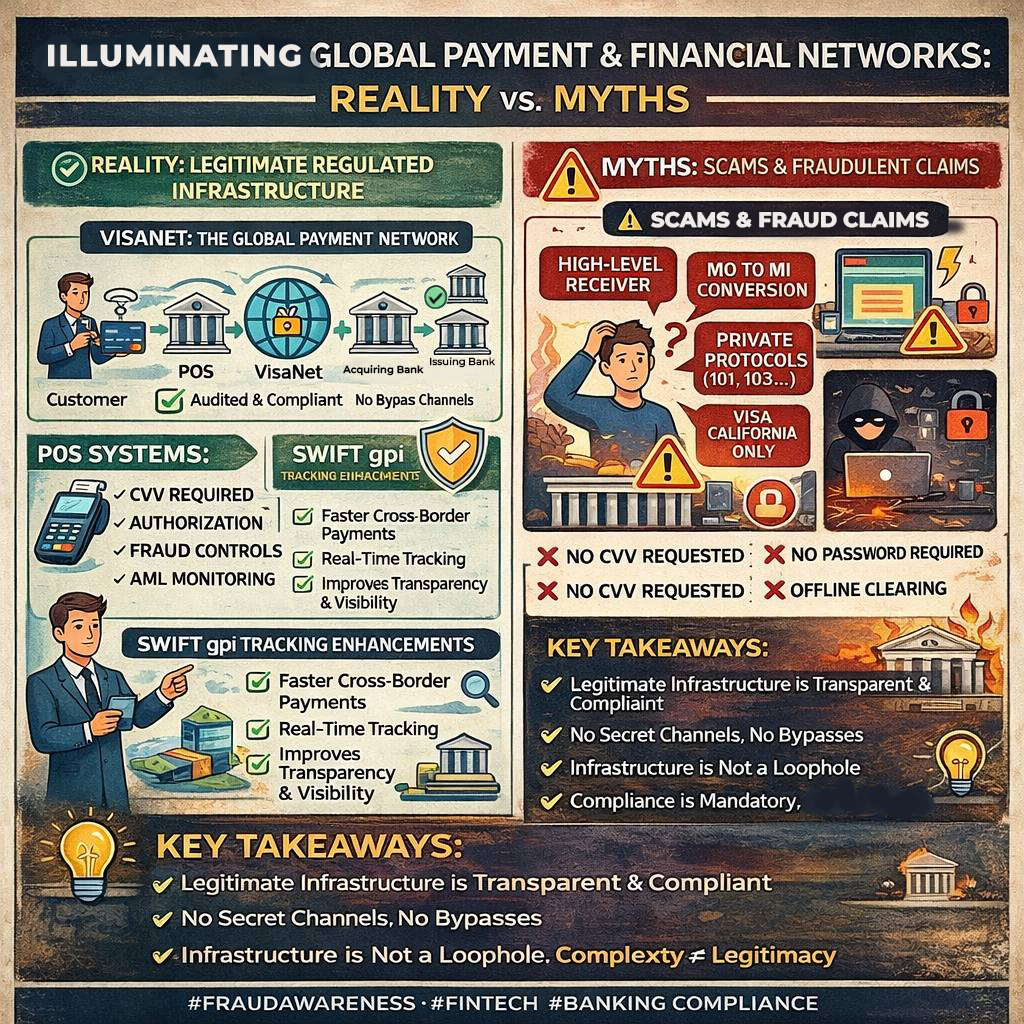
When “High-Level Protocols” Are Just Low-Level Fraud: A Compliance Perspective
There is a recurring theme in my DMs and inbox lately. It involves pitches filled with jargon that, on the surface, sounds like sophisticated financial engineering.
Phrases like:
- “We have a high-level receiver at Visa.”
- “We convert M0 to M1 monetization.”
- “We route via Protocol 101.3, not VisaNet.”
- “The POS machine must NOT request a CVV.”
To the untrained ear, this might sound like exclusive access to hidden liquidity. To a compliance professional, it sounds like a blaring alarm.
Let’s demystify the infrastructure and cut through the noise.
VisaNet is not a “Monetization Engine.”
VisaNet is the backbone of authorized card payments. It connects issuers and acquirers. It does not hold funds for “release,” nor does it have a “bypass mode” for high-value clearing. When someone tells you they can route around VisaNet to “California Visa only,” they are describing a fictional workaround, not a feature of the network.
POS Systems are Fortresses, Not Loopholes.
A Point-of-Sale terminal is the front line of banking security. It requires CVV2, authorization codes, and real-time fraud monitoring.
If a “deal structure” requires the terminal to have security protocols disabled—no CVV, no authorization request—it is not a payment innovation. It is a compliance red flag. Legitimate commerce does not fear the security it was built upon.
SWIFT gpi is Tracking, Not a Trust Escrow.
SWIFT gpi (Global Payments Innovation) is a fantastic upgrade for speed and transparency. However, it is not a holding pen for funds. It does not operate as a “parallel clearing channel” that overrides KYC/AML checks. If someone tells you funds are “stuck” in a gpi corridor awaiting a code, you are likely looking at a advance-fee fraud scheme, not a settlement delay.
The Legal Reality Check
As someone who reviews transaction structures for a living, I apply a simple rule: If it requires disabling standard security to work, it is not a valid instrument.
Real financial infrastructure is boring. It is structured, audited, and compliant. It relies on transparency, not secrecy. Scams rely on complexity and jargon to distract you from the fact that they are asking you to bypass the very controls that keep the banking system safe.
If you are in trade finance or capital markets, stay vigilant. If you can’t explain it using standard banking logic, don’t sign it.