
Fintechs in the CEMAC Region: Balancing Innovation, Data Sovereignty, and the Urgency of Regulatory Compliance
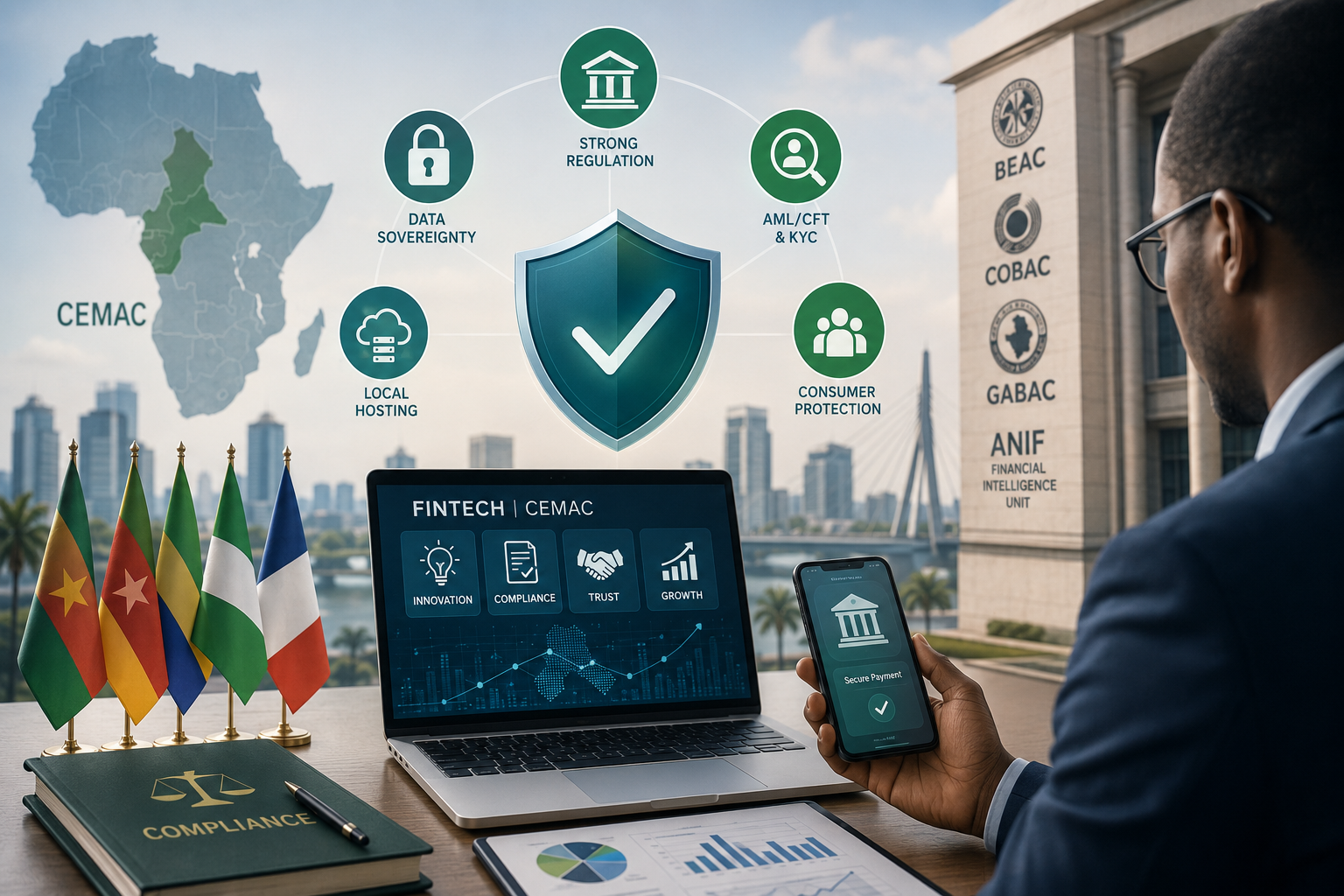
The conversation around financial technology in Cameroon and the broader CEMAC region has evolved significantly. It is no longer a debate about whether Fintechs will face stricter oversight. The critical question now is how we can collectively construct a regulatory framework that effectively protects consumers, preserves the integrity of the financial system, and simultaneously fosters innovation.
This paradigm shift was palpable at the recent PROMOTE 2026 trade fair, where key state actors, including the National Agency for Information and Communication Technologies (ANTIC), the National Financial Investigation Agency (ANIF), and the Customs Administration, gathered to outline the priorities that will shape the future of digital finance. The discussions underscored a clear message from regulators: the era of unsupervised innovation is over, and compliance is no longer a secondary consideration but a prerequisite for survival and growth.
A Multi-Layered Regulatory Architecture
Understanding the regulatory landscape is the first step for any Fintech operator in the region. Cameroon operates within a dual-layered system that combines supranational CEMAC-wide institutions with national enforcement bodies . At the regional level, the Bank of Central African States (BEAC) holds primary authority over payment systems and sets the prudential rules, while the Banking Commission of Central Africa (COBAC) enforces these regulations, conducts inspections, and has the power to impose sanctions, including license revocations . These are complemented by the Groupe d’Action contre le Blanchiment d’Argent en Afrique Centrale (GABAC), the FATF-style regional body that sets AML/CFT standards . At the national level, the Agence Nationale d’Investigation Financière (ANIF) acts as the financial intelligence unit, receiving and analyzing suspicious transaction reports (STRs) .
Key Pillars of the Emerging Framework
The discussions at PROMOTE 2026 brought three interconnected subjects into sharp focus, each representing a pillar of the future regulatory regime.
1. Data Sovereignty: Rethinking Local Hosting
The first pillar concerns data sovereignty. A representative from ANTIC highlighted the need for digital actors to move beyond the automatic assumption that international cloud solutions are inherently superior. In his remarks, he encouraged entrepreneurs to better evaluate the capacities of local hosting solutions before turning to international providers. He argued that many local options offer a significant level of security, but are often overlooked due to misconceptions about their existence or robustness. This call for a “benchmark” approach is a strategic move to strengthen local digital infrastructure and assert greater control over the data generated within the national and regional ecosystem. It aligns with the growing global trend of data localization, a principle that is becoming increasingly important for regulatory compliance.
2. A Nascent Regulatory Framework: The Need for Specific Rules
The second pillar addressed the current legal environment. In the absence of a specific Fintech law in Cameroon, authorities currently rely on existing community texts, such as the BEAC’s Regulation No. 02/18/CEMAC/UMAC/CM, which governs the circulation of currency and strictly controls movements of foreign exchange and capital outside the region. However, as highlighted during the panel, there is a clear consensus that more structured and specific regulations are required. The authorities are now actively engaged in a reflection on how to build a bespoke framework for Fintechs. It is crucial to note that this regulatory gap is not a void of inaction. On the contrary, the existing regulations are being strictly applied, and institutions like BEAC have been issuing updated directives, such as Circular No. 000002, which imposes new obligations for dematerialization and e-procurement .
3. The AML/CFT Imperative: The Gray List as a Catalyst for Change
The third and most urgent pillar is the fight against money laundering and terrorist financing. The retention of Cameroon on the FATF’s “grey list” serves as a stark reminder that financial innovation must be accompanied by robust customer due diligence (KYC), transaction monitoring, and traceability of flows. An official from ANIF, speaking at PROMOTE, explicitly pointed to cryptocurrencies, which still operate outside the control of central banks, as a factor fueling this risk.
The grey list status is a powerful catalyst for change. It has spurred a concerted, time-bound effort to address identified deficiencies. To date, Cameroon has only validated part of its action plan with the FATF, but the target to exit the list by the end of 2026 or the first quarter of 2027 remains ambitious yet achievable. To this end, significant steps have been taken. These include the adoption of CEMAC Regulation No. 04/24/CEMAC/UMAC/CM on targeted financial sanctions and the operationalization of a national commission to implement these sanctions, with the support of the International Monetary Fund .
The Role of Compliance in the Fintech Revolution
So, what does all of this mean for Fintechs and the finance professionals who support them? The days of viewing compliance, risk, AML/CFT, and governance as administrative burdens are over. These functions are now strategic imperatives.
Compliance is not just about avoiding sanctions; it is about building trust. As a seasoned legal and regulatory compliance professional, I see the need for Fintechs to embed compliance into their business model from the very beginning. This involves a number of critical actions:
- Implementing Robust KYC and KYB: Fintechs must go beyond simple identity collection and implement risk-based profiling and continuous verification of their customers (KYC) and business partners (KYB) . COBAC and ANIF expect a comprehensive programme to be in place.
- Automating Transaction Monitoring: Given the scale of digital transactions, manual monitoring is no longer viable. Fintechs must leverage RegTech solutions to monitor transactions in real-time and generate Suspicious Transaction Reports (STRs) for ANIF .
- Ensuring Data Protection Compliance: The enactment of Law No. 2024/017 on the protection of personal data represents a “landmark development” . Businesses have until June 23, 2026, to comply, and this is an area where RegTech tools for data mapping and breach notification will be indispensable .
- Adopting a Risk-Based Approach: Regulatory enforcement is becoming more stringent. COBAC has raised minimum capital thresholds and intensified its supervisory activities . Fintechs must adopt a risk-based approach, applying enhanced due diligence to high-risk sectors and clients .
Conclusion: A Future Built on Trust
The future of digital finance in Central Africa will not be built solely on new technologies. As the discussions at PROMOTE 2026 powerfully demonstrated, it will be built on better rules, better governance, and above all, better trust. The path forward requires a proactive, collaborative, and strategic partnership between regulators, innovators, and compliance professionals. By embracing this reality, the CEMAC region can create a resilient, inclusive, and trustworthy financial ecosystem that truly unlocks the potential of the digital economy.