
CEMAC BANKING REFORM: COBAC Accelerates Regulatory Overhaul with Landmark Legislative Recruitment
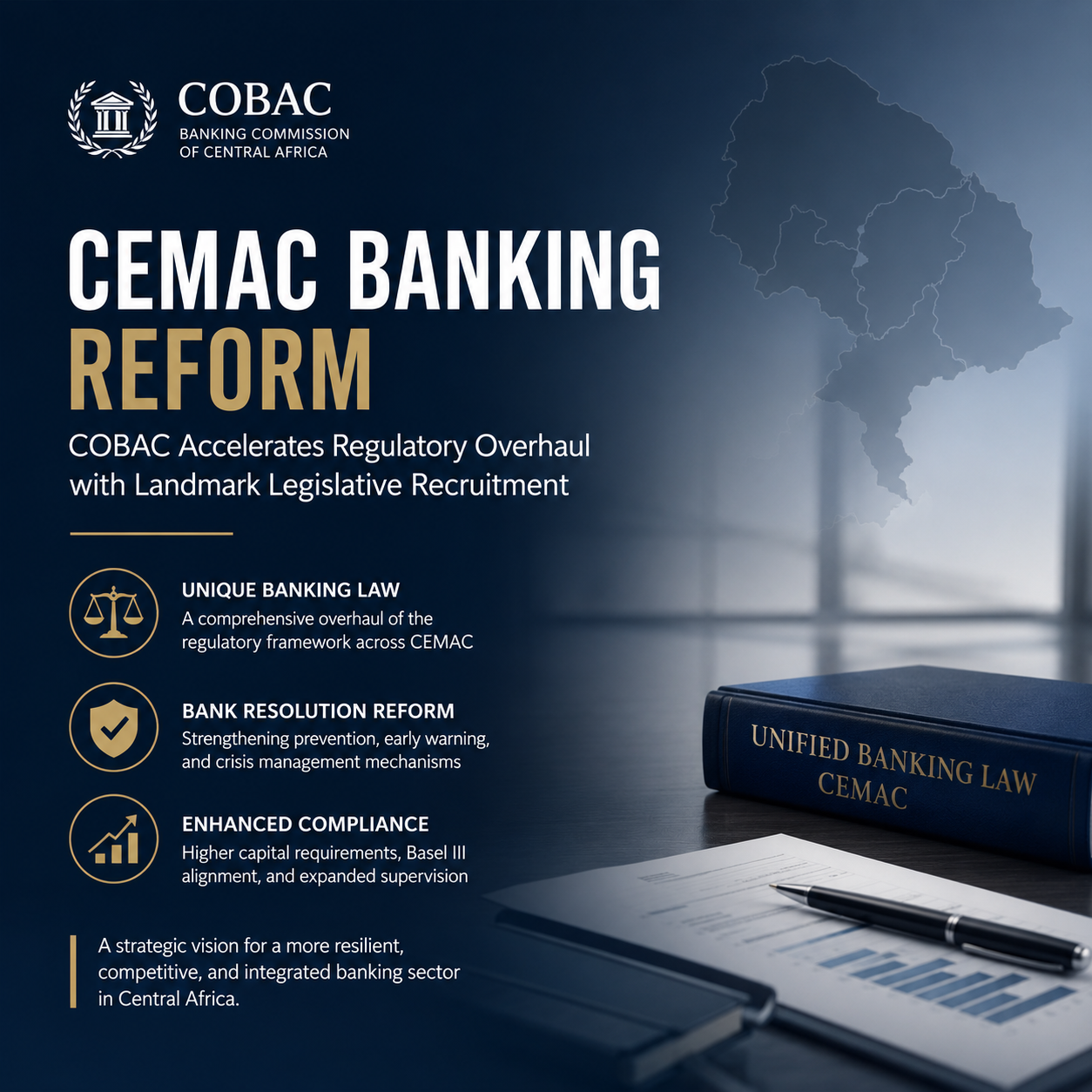
The Central African banking landscape is undergoing a transformation of unprecedented scale. The Banking Commission of Central Africa (COBAC) has launched a strategic international recruitment for a legal expert to spearhead the completion of its ongoing legislative reforms—a move that signals the regulator’s determination to modernize the subregion’s financial architecture.
This initiative, embedded within COBAC’s “OWALI” Strategic Plan 2025-2029, comes at a critical juncture as the financial ecosystem of the CEMAC zone grapples with rapid digitalization, the emergence of new FinTech players, and the imperative to align with international prudential standards.
Two Pillars of Reform
1. The Unique Banking Law: A Comprehensive Normative Overhaul
Contrary to what its name might suggest, the “Unique Banking Law” does not refer to a single legislative text. According to the selection dossier published by COBAC, it encompasses a coherent and hierarchical body of norms designed to replace the current regulatory architecture.
The new framework will rest on three levels of standards:
- A single CEMAC Regulation consolidating all fundamental principles governing institutions subject to COBAC supervision, thereby replacing all existing CEMAC regulations.
- A new COBAC Convention abrogating the Convention of 16 October 1990 and its Annex, as well as the Convention of 17 January 1992 on banking regulation harmonization.
- Implementing regulations, particularly concerning banking resolution and the treatment of troubled institutions.
The reform aims to harmonize the legal framework for banking supervision across all six CEMAC states and bring it into compliance with international standards, including the progressive transposition of Basel III requirements on capital adequacy, risk management, and financial transparency.
2. Banking Restructuring Reform: Strengthening Prevention and Resolution Mechanisms
The second major reform focuses on overhauling the framework for dealing with distressed credit institutions. The consultant to be recruited will be tasked with establishing early warning indicators for monitoring supervised institutions and defining preventive measures and implementation modalities in the event of alert threshold breaches—including corrective, conservatory, and police measures.
These reforms also integrate enhanced crisis prevention and management mechanisms, including vulnerability early detection systems and stress-testing exercises. A parallel regulatory project is addressing the governance, internal control, and prudential standards applicable to Deposit Funds, alongside the treatment of inactive accounts and unclaimed assets.
Implications for Banking Governance and Compliance
For banking institutions operating in the CEMAC zone, these reforms carry significant compliance implications:
Enhanced Capital Requirements: As of 1 January 2026, the minimum share capital for banks increased from 10 billion to 25 billion FCFA. Financial institutions must now meet a 4 billion FCFA threshold. This measure aims to strengthen institutional resilience against systemic risks.
Expanded Supervisory Scope: COBAC is adapting its regulatory framework to cover payment services, FinTechs, microfinance institutions, and monetary oversight bodies. New liquidity rules for microfinance establishments are also under development.
Modernized Payment Systems: Reforms are underway for payment service provider licensing, Know Your Customer (KYC) requirements, international fund transfers, and regulatory sandboxes for FinTech innovation.
Strengthened Internal Control: COBAC is reinforcing internal control requirements across the banking and microfinance sectors.
What This Means for Compliance Professionals
As a legal and regulatory compliance professional in the CEMAC region, this is the moment to:
- Prepare for a new regulatory paradigm as the Unique Banking Law consolidates and replaces existing texts.
- Review governance frameworks to align with enhanced prudential standards and Basel III convergence.
- Strengthen early warning and risk management systems in anticipation of stricter supervisory oversight.
- Monitor the litigation currently before the CEMAC Community Court of Justice regarding the regulatory scope applicable to Deposit Funds—a case that could set a significant precedent.
The COBAC’s regulatory offensive is not merely a technical exercise. It is a strategic vision to build a more resilient, competitive, and integrated banking sector capable of supporting the economic development of Central Africa. For banks, FinTechs, and financial institutions, the message is clear: adaptation is no longer optional—it is imperative.