
The Future of Cross-Border Payments is Here: HSBC and Standard Chartered Pioneer Tokenized Deposits
The financial world often speaks of “blockchain disruption,” but what happens when the establishment actually adopts the technology without blowing up the existing system? We just witnessed a major milestone.
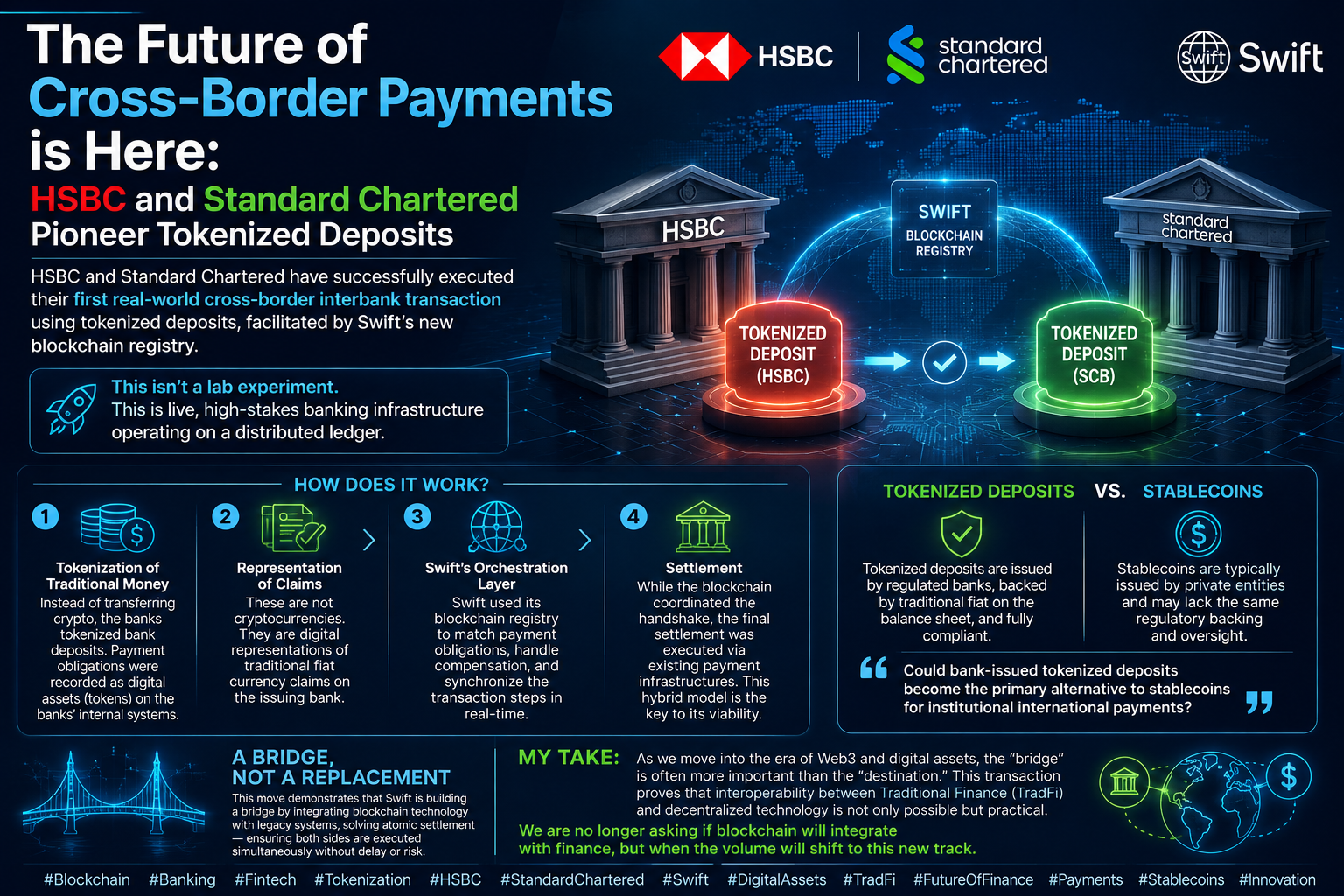
HSBC and Standard Chartered have successfully executed their first real-world cross-border interbank transaction using tokenized deposits, facilitated by Swift’s new blockchain registry.
This isn’t a lab experiment. This is live, high-stakes banking infrastructure operating on a distributed ledger.
How Does It Work?
1. Tokenization of Traditional Money: Instead of transferring crypto, the banks tokenized bank deposits. This means payment obligations were recorded as digital assets (tokens) on the banks’ internal systems.
2. Representation of Claims: It is crucial to note that these are not cryptocurrencies. They are digital representations of traditional fiat currency claims on the issuing bank.
3. Swift’s Orchestration Layer: Swift used its blockchain registry to match payment obligations, handle compensation, and synchronize the transaction steps in real-time.
4. Settlement: While the blockchain coordinated the handshake, the final settlement was executed via existing payment infrastructures. This hybrid model is the key to its viability.
A Bridge, Not a Replacement
This move demonstrates that Swift isn’t looking to replace current banking networks overnight. Instead, they are building a bridge. By integrating blockchain technology with legacy systems, they are solving the issue of atomic settlement; ensuring that both sides of a transaction are executed simultaneously without delay or risk.
The Big Question: Tokenized Deposits vs. Stablecoins?
This development raises a critical question for the industry: Could bank-issued tokenized deposits become the primary alternative to stablecoins for institutional international payments?
Given the regulatory compliance, trust, and backing of a regulated balance sheet, tokenized deposits offer a compelling “safe” option compared to unregulated stablecoins.
My Take:
As we move into the era of Web3 and digital assets, the “bridge” is often more important than the “destination.” This transaction proves that interoperability between traditional finance (TradFi) and decentralized technology is not only possible but practical.
We are no longer asking if blockchain will integrate with finance, but when the volume will shift to this new track.
#Blockchain #Banking #Fintech #Tokenization #HSBC #StandardChartered #Swift #DigitalAssets #TradFi #FutureOfFinance #Payments #Stablecoins #Innovation