
Visa’s Stablecoin Gambit: What It Means for CEMAC’s Financial Ecosystem
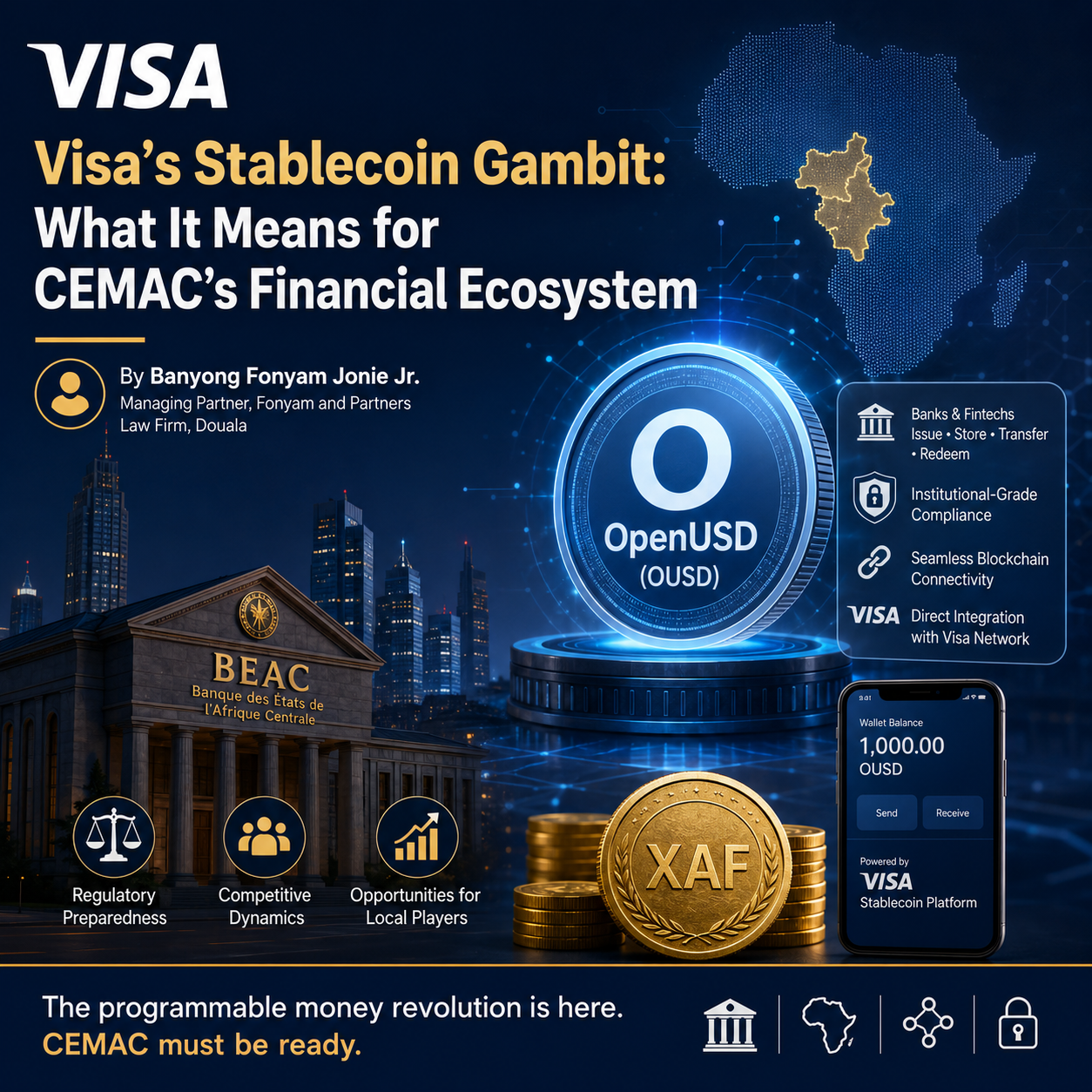
By Banyong Fonyam Jonie Jr.
Managing Partner, Fonyam and Partners Law Firm, Douala
The global stablecoin landscape shifted decisively on July 16, 2026, when Visa unveiled its Visa Stablecoin Platform (VSP), a comprehensive enterprise system that enables banks and fintechs to issue, store, transfer, and redeem digital dollars through a single Visa-managed infrastructure. For financial institutions across the CEMAC region, this development is not merely a distant headline. It is a signal that the programmable money revolution is accelerating, and Africa’s monetary unions must take note.
What VSP Brings to Institutions
The platform offers banks and financial institutions a turnkey stablecoin solution without the operational headaches of blockchain complexity. Key features include:
- Wallet-as-a-Service infrastructure – eliminating the need for institutions to manage private keys or reconcile multi-chain transfers
- Seamless blockchain connectivity with direct minting and burning capabilities
- Dual-approval workflows, audit logs, and transfer allow lists – built for institutional compliance
- Direct integration with Visa’s existing payment network
The message is clear: banks can now plug stablecoins into treasury, settlement, and payment operations without ripping out their current systems.
The Economics That Changes Everything
The more significant story, however, lies in the model behind Open USD (OUSD)- the new stablecoin from the Open Standard consortium, which counts Visa, BlackRock, Alphabet Inc., and Coinbase among its backers, with over 140 participating companies.
Open Standard is rewriting stablecoin economics:
- No minting or redemption fees
- Nearly all reserve income returned to distribution partners
This shifts the profit center away from issuers toward the companies that distribute the coins- a fundamental realignment that explains why Circle, the issuer of USDC, saw its shares drop approximately 5% on the news.
Relevance to the CEMAC Region
For professionals, regulators, and financial institutions in Cameroon and the broader CEMAC zone, several critical questions emerge:
1. Regulatory Preparedness: The BEAC (Banque des États de l’Afrique Centrale) has signaled its intention to publish a sub-regional crypto-asset regulatory framework later this year. The BEAC has also indicated that any future stablecoin would be locked to a strict one-for-one parity with the CFA franc, ruling out dollar-backed tokens to defend monetary sovereignty. This raises a fundamental tension: how will CEMAC institutions engage with dollar-denominated stablecoins like OUSD or USDC when the central bank is charting a CFA-aligned digital path?
2. Competitive Dynamics: Visa has already reported a nearly 60-fold increase in stablecoin settlement volumes across the CEMEA region (Central-Eastern Europe, Middle East, and Africa) since introducing the capability. With VSP now live, the pressure on regional banks to offer stablecoin-enabled services will only intensify.
3. Opportunity for Local Players: The Open Standard model—returning reserve income to distribution partners—could create new revenue opportunities for CEMAC-based financial institutions that partner with or distribute stablecoin products, provided regulatory alignment can be achieved.
A Call to Action
To my fellow legal professionals, regulators, bankers, and fintech innovators across the CEMAC region: the global stablecoin architecture is being rebuilt before our eyes. The question is not whether stablecoins will permeate our financial systems, but how and on whose terms.
As Jack Forestell, Visa’s chief product and strategy officer, aptly stated: “Stablecoins are opening up a new layer of programmable money, but for most institutions, the hard part isn’t the concept, it’s the operational reality.”
The operational reality for CEMAC now demands proactive engagement—with the BEAC’s forthcoming regulatory framework, with emerging global standards, and with the strategic decisions that will shape our region’s financial future.