
The Infrastructure Is Shifting. The Opportunity Is Wider.
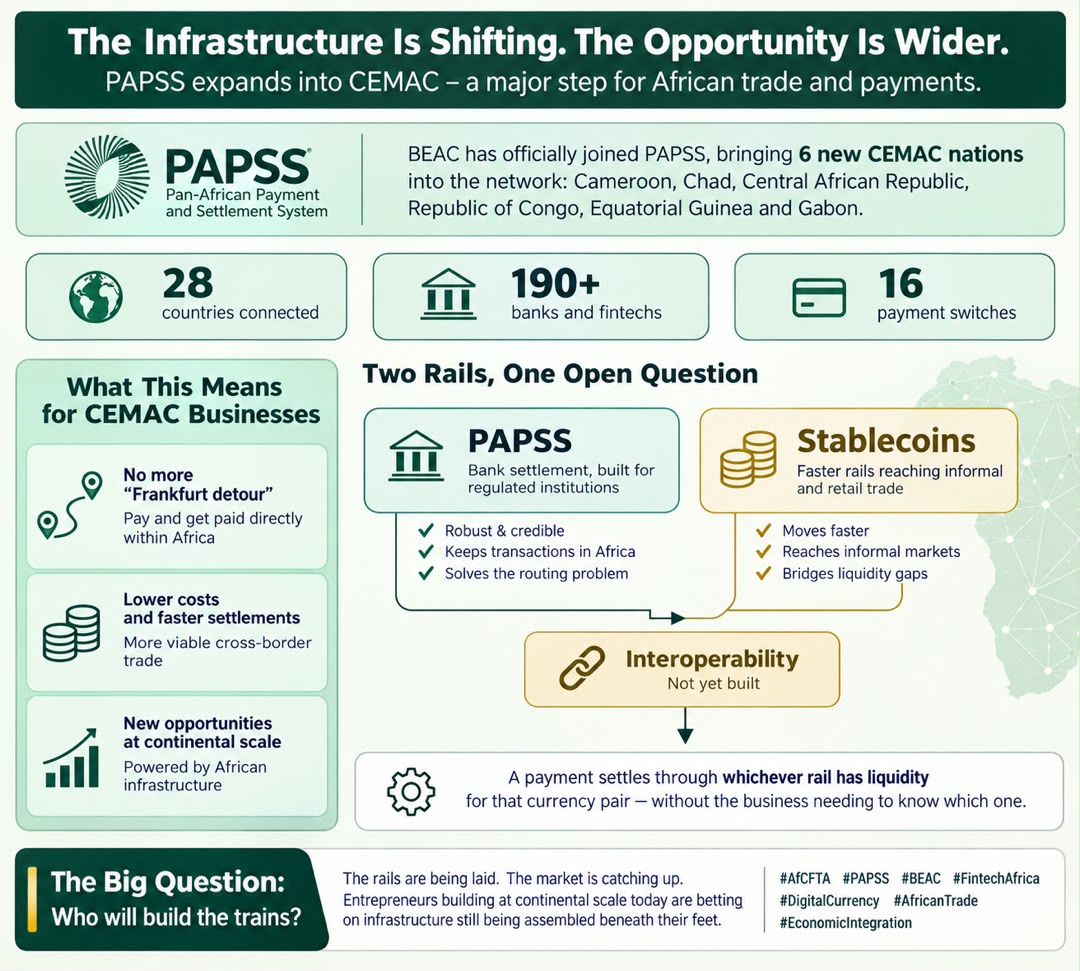
The Pan-African Payment and Settlement System (PAPSS) just expanded its footprint in a major way. This month, the Bank of Central African States (BEAC) officially joined the network, bringing six new CEMAC nations : Cameroon, Chad, the Central African Republic, the Republic of Congo, Equatorial Guinea, and Gabon into the fold.
This isn’t just a bureaucratic milestone; it’s a structural game-changer.
For CEMAC businesses, this means the end of the “Frankfurt detour.” A company in Douala can now pay a supplier in Accra, or invoice a client in Nairobi, without routing that transaction through a European correspondent bank. That shift alone fundamentally alters the economics of what is viable to build at a continental scale.
However, this is where we must address the gap that keeps me up at night.
PAPSS is engineered to settle payments between banks. It moves value from one regulated institution to another without the transaction ever leaving African soil. It solves the routing problem brilliantly.
But let’s be clear: Routing is not the same as liquidity.
If the two currencies involved have thin markets against each other, the transaction cost remains high. Illiquid currency pairs will still drive up the expense of doing business, independent of how the payment is routed.
This is precisely where the convergence of traditional finance and digital assets becomes fascinating. Stablecoins and tokenised settlement are emerging as viable solutions to bridge these liquidity gaps.
The question on the table is whether these two systems will ultimately compete or cooperate.
PAPSS was built by central banks for the formal, regulated financial sector. It is robust, credible, and systemic. Stablecoin rails, on the other hand, move faster and are already reaching into the informal and cross-border retail trade spaces that PAPSS was never designed to touch.
The optimal scenario? Interoperability.
If we can enable a payment to settle through whichever rail actually holds the liquidity for that specific currency pair, without the end-business needing to know which system handled it, we unlock true frictionless trade.
But let’s be honest: nobody has built that bridge yet.
Entrepreneurs building at continental scale right now are placing their bets on infrastructure that is still being assembled beneath their feet. The market itself has not fully caught up to this bet.
We often forget that the AfCFTA began as a tariff agreement, focused on lowering duties between member states. Today, its scope has evolved to include payment infrastructure. That evolution is what finally empowers a business in Accra to deal directly with a business in Kigali without a bank in Frankfurt sitting in the middle.
The rails are being laid. The question is: who will build the trains?