
THE CEMAC PAYMENT SERVICES REFORM 2026: A NEW DAWN FOR FINTECHS AND DIGITAL FINANCIAL SERVICES
INTRODUCTION
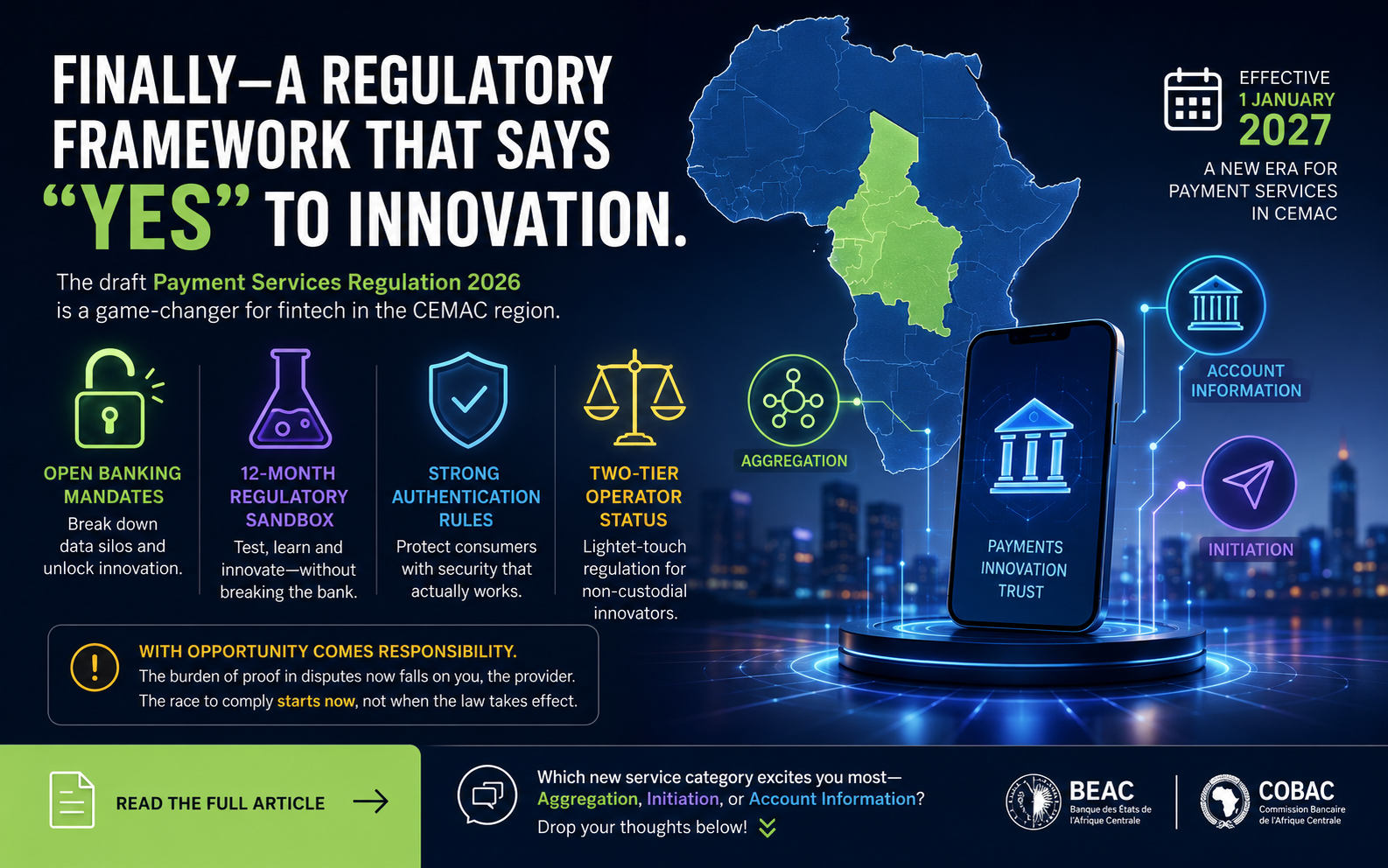
The Central African Economic and Monetary Community (CEMAC) stands on the precipice of a transformative regulatory revolution. The draft Payment Services Regulation 2026, slated for entry into force on 1 January 2027, represents a paradigm shift that will fundamentally reshape the financial services landscape across the six member states. This landmark legislation, which will repeal the existing 2018 Regulation, heralds a decisive turning point—one that opens the door wide to financial technology innovators while simultaneously strengthening security frameworks and consumer protection mechanisms.
As a legal practitioner who has navigated the complexities of CEMAC’s regulatory environment for over a decade and a half, I can attest that this reform is not merely an incremental update but a complete reimagining of how payment services will be conceptualized, delivered, and supervised in our region.
EXPANDING THE REGULATORY HORIZON: NEW PLAYERS, NEW POSSIBILITIES
Recognition of Emerging Service Providers
The draft regulation demonstrates remarkable foresight by officially recognizing categories of service providers that were previously operating in a regulatory grey area. Beyond the traditional pillars of credit institutions, microfinance institutions, and payment institutions, the new framework formally acknowledges:
- Money Transfer Companies – Finally receiving dedicated regulatory attention through specific provisions (Articles 18-23)
- Payment Service Operators – A novel category subdivided into two distinct tiers
This structural evolution acknowledges the reality that modern payment ecosystems are no longer the exclusive domain of traditional banking institutions. The legislator has wisely recognized that innovation often emerges from nimble, technology-driven entities that can respond to market needs with agility that larger institutions sometimes lack.
The Two-Tier Operator Framework
Perhaps one of the most sophisticated aspects of the reform is the creation of a bifurcated operator regime:
Category 1 Operators (Lightweight Regime)
These entities may provide payment order initiation services or account information services without holding customer funds. The regulatory burden is appropriately calibrated to their risk profile, requiring authorization from COBAC after a technical opinion from the BEAC. The one-month review period for the BEAC’s opinion (compared to three months for full approval) reflects the reduced systemic risk these operators present.
Category 2 Operators (Full Regime)
Providers of payment acquiring or aggregation services fall into this category and are subject to the same rigorous standards as payment institutions—including authorization requirements, minimum capital thresholds, and comprehensive oversight. This proportionate approach ensures that activities with greater potential impact on financial stability receive commensurate regulatory attention.
OPEN BANKING: A GATEWAY TO INNOVATION
The Dawn of Account Access Services
The reform introduces provisions that will finally enable open banking to take root in the CEMAC region. Account-holding banks will now be obligated—subject to express customer consent—to provide approved service providers with access to account data in a fair and non-discriminatory manner. This represents a fundamental shift from the current paradigm where customer data remains siloed within individual institutions.
The introduction of payment order initiation services and account information services as distinct regulated activities creates the legal foundation for:
- Third-party providers to initiate payments directly from customer accounts
- Aggregation platforms to present consolidated financial information across multiple institutions
- Innovative financial management tools that leverage comprehensive data access
Customer Consent and Data Protection
The express consent requirement embedded in the framework ensures that the customer remains at the center of the data-sharing ecosystem. This aligns with global best practices while respecting the unique characteristics of our regional market. Financial institutions must now develop robust consent management systems that balance accessibility with security—a challenge that will require significant operational investment but promises substantial long-term benefits in terms of customer empowerment and service innovation.
THE REGULATORY SANDBOX: INNOVATION UNDER SUPERVISION
A Safe Space for Experimentation
The proposed regulatory sandbox represents one of the most progressive elements of the reform. For the first time, the BEAC and COBAC will have the legal authority to establish a regulatory experimentation system allowing innovative payment solutions to be tested with partial exemptions from standard compliance requirements.
Key parameters of the sandbox include:
- Maximum testing period of 12 months, renewable once
- Strict transaction limits and overall outstanding controls
- Requirements for adequate insurance coverage
- Temporary and partial compliance exemptions at COBAC’s discretion
- Detailed modalities to be defined by Instruction of the Governor of the BEAC
Balancing Innovation and Risk
The sandbox framework demonstrates sophisticated regulatory thinking by acknowledging that innovation cannot flourish in an environment of absolute rigidity. By creating controlled spaces for experimentation, the regulators can:
- Observe emerging technologies in real-world conditions
- Identify potential risks before they scale
- Develop evidence-based regulatory responses
- Foster dialogue between innovators and supervisors
This approach positions CEMAC as a forward-thinking jurisdiction that understands the imperative of balancing financial stability with innovation-friendly policies.
SECURITY AND AUTHENTICATION: RAISING THE BAR
Strong Authentication Requirements
The reform introduces mandatory strong authentication for:
- Access to online accounts
- Electronic payment transactions
- Any action presenting heightened risk
Strong authentication is defined as the use of two or more independent elements from the categories of “knowledge” (something the user knows), “possession” (something the user has), and “inherence” (something the user is). The independence requirement is crucial—the compromise of one element should not undermine the reliability of others, ensuring robust multi-factor protection.
Reversal of the Burden of Proof
A significant shift in consumer protection comes through the clarified burden of proof in dispute resolution. Service providers will now bear the responsibility of proving:
- The authentication of the transaction
- The integrity of the operation
- Alternatively, demonstrating customer fraud or gross negligence
This places the evidentiary burden squarely on the shoulders of providers, who possess superior technical information and resources. Customers will benefit from enhanced protection, and providers will have strong incentives to maintain rigorous security systems.
CUSTOMER FUND PROTECTION: STRENGTHENING SAFEGUARDS
The Ring-Fenced Account Evolution
The reform introduces important enhancements to the protection of customer funds held by payment institutions:
Key Features:
- Ring-fenced accounts may now be opened at the Central Bank in addition to CEMAC commercial banks
- Explicit protection against any recourse by other creditors, including in insolvency proceedings
- Mandatory remuneration of ring-fenced accounts by the domiciliary bank
- COBAC’s authority to require additional coverage through insurance contracts or bank guarantees
- Annual validity monitoring requirements
Practical Implications
The remuneration requirement represents a significant evolution—payment institutions will now earn returns on segregated customer funds, recognizing that these balances are not merely passive holdings but actively contribute to the liquidity position of the domiciliary bank. The explicit protection against creditor claims provides enhanced certainty for customers that their funds remain safe even in adverse scenarios.
REGULATORY FLEXIBILITY AND FUTURE-PROOFING
Adaptive Regulatory Powers
COBAC is granted authority to specify or complete the list of payment services by regulation, offering essential flexibility to integrate future innovative services. This provision acknowledges that technological evolution outpaces legislative cycles—empowering the regulator to respond nimbly to emerging developments without requiring complete legislative overhaul.
Digital Asset Considerations
Service providers must now declare to COBAC any activities related to digital assets or enabling their acquisition. COBAC may oppose these activities if they threaten:
- The sustainability of the institution
- The security of deposits
- The integrity of the financial system
This balanced approach neither prohibits digital asset activities outright nor ignores their potential risks, reflecting nuanced regulatory thinking.
SUPERVISORY ARCHITECTURE: COOPERATION AND CLARITY
Enhanced BEAC Competencies
The reform explicitly mandates the BEAC to monitor compliance, security, and availability of technical solutions, with authority to engage the public telecommunications regulatory body regarding mobile telephony services. This cross-sectoral cooperation recognizes the convergence of financial services and telecommunications in the modern payment ecosystem.
Strengthened COBAC-BEAC Cooperation
COBAC will determine, after consulting the BEAC, the list and periodicity of documents to be transmitted and communicated. The provision for granting the BEAC access to documents and information it receives enhances coordination between these critical supervisory bodies.
CNEF’s Expanded Role
The National Economic and Financial Committee (CNEF) systematically replaces the former National Credit Council throughout the text, reflecting the evolution of institutional architecture and the broadening scope of financial sector oversight.
TRANSITIONAL PROVISIONS AND IMPLEMENTATION
Compliance Deadlines
The reform recognizes that existing players require reasonable time to align with new requirements:
- 12 months for companies providing services without authorization to comply
- 3 months for payment institutions providing transfer collections from outside the CEMAC to regularize their operations
These transitional periods demonstrate the regulator’s understanding of the operational complexities involved in regulatory compliance while maintaining appropriate urgency.
Referenced Future Regulations
The draft refers to future regulations on:
- Financial market infrastructures
- Means and payment incidents
- Interbank payment systems
This interconnected approach recognizes that payment services cannot be regulated in isolation—they exist within a broader financial ecosystem that requires coherent, integrated oversight.
CONCLUSION: A VISION FOR THE FUTURE
The Payment Services Regulation 2026 represents more than a regulatory update—it embodies a vision for a more inclusive, innovative, and secure financial services sector in the CEMAC region. By welcoming fintechs, establishing proportionate regulatory regimes, enabling open banking, creating innovation sandboxes, and strengthening consumer protections, the reform addresses the needs of all stakeholders:
- Consumers benefit from enhanced security, clear dispute resolution mechanisms, and greater choice
- Innovators gain regulatory clarity and controlled spaces for experimentation
- Traditional institutions find a level playing field with clear rules of engagement
- Regulators acquire flexible tools to oversee a dynamic sector
- The Region positions itself as a competitive jurisdiction for financial technology investment
As we approach the 1 January 2027 implementation date, stakeholders should begin preparing for the transition. The next 18 months represent a critical window for understanding the new requirements, adapting systems and processes, and engaging with regulators to ensure smooth implementation.
At Fonyam and Partners Law Firm, we stand ready to assist financial institutions, fintechs, and other stakeholders in navigating this regulatory evolution. The reform’s success depends not only on sound legislation but on effective implementation—a process that requires partnership between regulators and regulated entities.
Banyong Fonyam Jonie Jr is Managing Partner at Fonyam and Partners Law Firm and a seasoned legal and regulatory compliance professional with over 15 years of experience in the CEMAC region. He advises financial institutions, fintechs, and regulatory bodies on payment services regulation, compliance frameworks, and financial sector innovation.
Disclaimer: This article provides general information and does not constitute legal advice. Readers should consult qualified legal professionals for advice specific to their circumstances. The draft regulation referenced is subject to change before final adoption.