
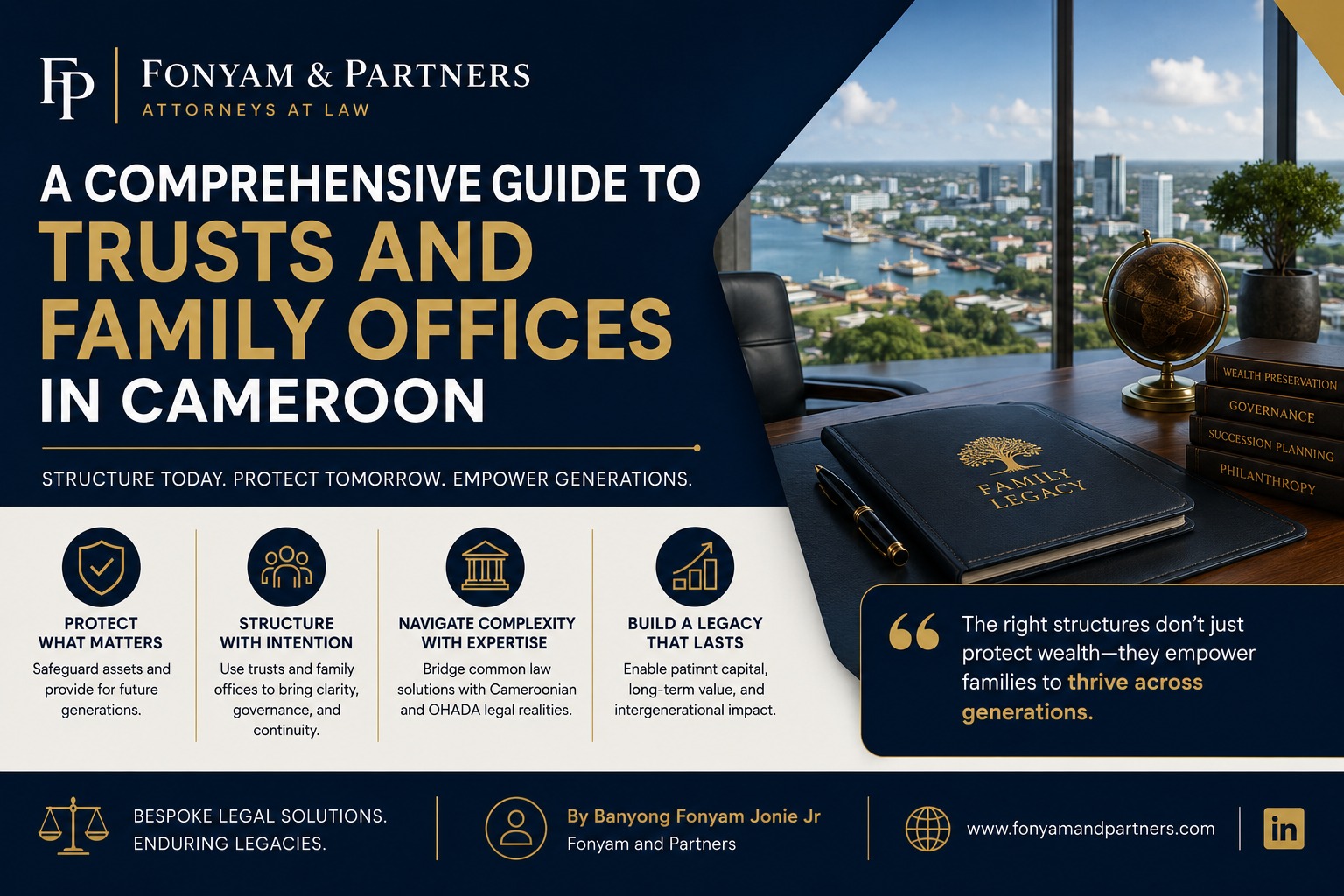
A COMPREHENSIVE GUIDE TO TRUSTS AND FAMILY OFFICES IN CAMEROON
In an increasingly interconnected global economy, high-net-worth individuals (HNWIs) and families with ties to Cameroon face a unique set of challenges when it comes to preserving and managing multi-generational wealth. The desire to protect assets, ensure business continuity, and provide for future generations is universal. However, the legal pathway to achieving these goals in Cameroon requires navigating a complex and bi-jural legal landscape.
At Fonyam and Partners, we are frequently consulted by families seeking sophisticated structures for estate planning and asset protection. Two of the most effective, yet misunderstood, vehicles are the Trust and the Family Office. This guide aims to demystify these concepts within the Cameroonian legal context, outlining the available options, inherent challenges, and the strategic path forward.
A Quiet Shift in Private Capital
Before delving into the mechanics, it is worth observing a broader, global shift in how private capital is being deployed—a shift we are now seeing echoed in conversations with families across Cameroon and Africa. There is a growing move away from purely traditional, opportunistic investment toward something more considered: a private-capital mindset that is patient, partnership-driven, and focused on long-term value rather than quick exits.
What’s changing is not just the volume of capital but the way it is being organised. Many families are beginning to organise capital more deliberately, often through the very structures we will discuss—trusts, holding companies, or investment vehicles. The motivation is often deeply human: “We want this capital to last,” to be steady and to support growth across generations without forcing premature outcomes. This guide is for those who recognise this moment and wish to move with intention.
Part I: The Trust in Cameroon – Navigating a Bi-Jural Framework
The concept of a trust, a fiduciary relationship where one party holds assets for the benefit of another, is not native to Cameroon’s legal system. The key to understanding its application lies in appreciating the country’s dual legal heritage.
1. The OHADA “Fiducie”: A Limited but Useful Tool
Cameroon is a member of the Organisation for the Harmonisation of Business Law in Africa (OHADA). The OHADA Uniform Act on Commercial Companies and Economic Interest Groupings introduced the concept of the “fiducie.” It is crucial to understand that the fiducie is not the common law trust.
– Nature: The fiducie is a contractual arrangement whereby a settlor (the constituant) transfers assets to a fiduciary (the fiduciaire), who holds them in a segregated patrimony for the benefit of one or more beneficiaries.
– Primary Use – The Fiducie-Sûreté: In practice, the fiducie is predominantly used as a security mechanism (fiducie-sûreté). It functions as a sophisticated form of collateral for commercial loans, where a debtor transfers assets to a fiduciary as security for a creditor.
– Limitations for Estate Planning: The fiducie is ill-suited for traditional common law estate planning purposes. It is designed for commercial security, not for the long-term, flexible management of family wealth across generations. It does not, in its current form, offer the same level of protection against forced heirship claims or provide the same flexible dispositive provisions that a common law trust does.
2. The Foreign Trust: The Preferred Path for Estate Planning
For clients seeking genuine estate planning, asset protection, and wealth succession, the most viable option is to establish a trust in a jurisdiction with mature trust laws (such as Mauritius, South Africa, Jersey, or the Cayman Islands) and then structure it for recognition and operation in Cameroon. This approach leverages the principle of comity, under which Cameroonian courts may recognise the legal validity of a foreign trust.
However, this is not a simple “off-the-shelf” solution. It requires meticulous planning to ensure the foreign trust is compatible with, and enforceable under, Cameroonian law. The primary challenges include:
– Forced Heirship Rules: Cameroon’s civil law tradition imposes forced heirship rules, which guarantee a portion of an estate (the “reserved share”) to certain heirs (typically children). A foreign trust that attempts to completely disinherit these heirs is highly vulnerable to legal challenge. The trust must be structured strategically, often in conjunction with a well-drafted will, to manage or mitigate these claims.
– OHADA Law Conflicts: A foreign trust holding shares in a Cameroonian company must operate in a way that does not conflict with OHADA corporate law principles regarding shareholder rights and corporate governance.
– Tax and Exchange Control Regulations: The Central African Economic and Monetary Community (CEMAC), through its central bank BEAC, enforces strict foreign exchange regulations. Any movement of funds or assets into or out of a trust must be fully compliant.
3. Practical Steps for Establishing a Trust
A successful trust structure for a Cameroonian family is a bespoke creation. The process involves:
– Defining Clear Objectives: Is the goal to protect a business from future creditors, provide for a special needs family member, or ensure a smooth generational transfer of wealth?
– Choosing the Optimal Jurisdiction: Selecting a foreign jurisdiction that offers political stability, sophisticated trust law, and a favourable tax treaty network (if any) with Cameroon.
– Selecting the Right Fiduciary: Choosing a professional and reputable trustee in the chosen jurisdiction.
– Integrated Legal Structuring: Drafting a Trust Deed that anticipates and addresses Cameroonian legal challenges, particularly forced heirship. This involves using “governing law” clauses, “exclusion” clauses, and carefully considered Letters of Wishes.
4. The Trust as a Tool for Patient Capital
In the current environment, a trust is more than just an estate planning tool; it is a mechanism for instilling a patient capital mindset. By placing assets in a trust, a family can effectively slow down decision-making, insulating a core pool of wealth from reactive or short-term pressures. It allows the family to answer a fundamental question: What part of our capital is meant to be patient, not reactive? A well-structured trust ensures that capital is deployed not just because an opportunity shows up, but because it fits the long-term vision the family is trying to build.
Part II: The Family Office – A Centralised Solution for Complex Wealth
As a family’s wealth grows and becomes more geographically and structurally diverse—perhaps now involving a foreign trust, several operating businesses, and real assets—a trust alone may not suffice. This is where the concept of a Family Office becomes invaluable.
A Family Office is a private wealth management advisory firm that serves ultra-high-net-worth families. It is a centralised entity dedicated to managing the family’s financial affairs and personal needs. Within the Cameroonian context, a Family Office can be structured to oversee all aspects of a family’s wealth, including assets held within a foreign trust structure.
Key Functions of a Family Office in Cameroon:
– Centralised Asset Management: It provides a holistic view of the family’s entire balance sheet, including real estate, shareholdings in OHADA-zone companies, foreign investment portfolios, and assets held in trust.
– Governance and Succession Planning: It acts as the institutional memory and governance hub for the family. It can facilitate family meetings, draft a family constitution to govern involvement in businesses, and ensure the smooth implementation of succession plans, coordinating with foreign trustees.
– Tax and Regulatory Compliance: It ensures ongoing compliance with Cameroon’s tax laws, BEAC foreign exchange regulations, and OHADA reporting requirements.
– Lifestyle and Philanthropy Management: A Family Office can manage a range of administrative tasks, from property maintenance to coordinating the family’s philanthropic activities.
The Role of Family Offices as Enablers
We are seeing more clarity around the role of family offices. They act as enablers, helping families align how capital is deployed with what actually matters to them: their values, priorities, relationships, and the future they’re trying to build. In many cases, what’s emerging doesn’t look like a textbook family office. It looks more like a family-controlled capital platform—one that evolves as the family evolves. It supports real things like operating businesses, real assets, private credit, and structured co-investment opportunities, ensuring the family’s wealth is actively and purposefully deployed.
Structuring a Family Office in Cameroon:
A Family Office can be structured in several ways:
– Single Family Office (SFO): A dedicated entity created to serve one wealthy family, offering maximum privacy and customisation.
– Multi-Family Office (MFO): An entity that serves multiple families, allowing for the sharing of costs and access to a broader range of expertise.
Legally, a Family Office in Cameroon is typically incorporated as a limited liability company (SARL) or a public limited company (SA) under the OHADA Uniform Act. Its governing documents must clearly define its mandate, decision-making processes, and relationship to any underlying trusts and corporate entities.
Conclusion: A Strategic Partnership for Generational Wealth
Establishing a trust or a family office for a Cameroonian family is not merely a legal transaction; it is a strategic exercise in navigating a complex, bi-jural system. The optimal solution rarely involves a single document, but rather a coordinated architecture of a foreign trust, compliant Cameroonian holding structures, and a well-governed family office.
Looking outward, we have seen versions of this play out elsewhere. In the Middle East, private family capital organised through family-controlled structures helped deepen private capital markets and support the rise of regional champions. The parallels with what is happening across Africa now are becoming clear. As more families in Cameroon structure and deploy private capital intentionally, the impact goes beyond returns. We see stronger businesses, more patient partnerships, better decision-making, and a quieter kind of intergenerational continuity taking shape.
For families beginning to think differently, the shift usually starts with simple, relational questions: Do we have structures that help us slow decisions down? Are we investing based on a plan? Who do we actually trust to build alongside over time?
At Fonyam and Partners, we specialise in designing and implementing these bespoke structures. Our expertise in OHADA law, Cameroonian succession law, and cross-border estate planning allows us to bridge the gap between common law trust concepts and the Cameroonian legal reality. We help you answer those questions, ensuring your wealth is not only protected for today but structured to thrive—quietly, deliberately, and over time—for generations to come.