
Business License Tax Exemption Reaffirmed
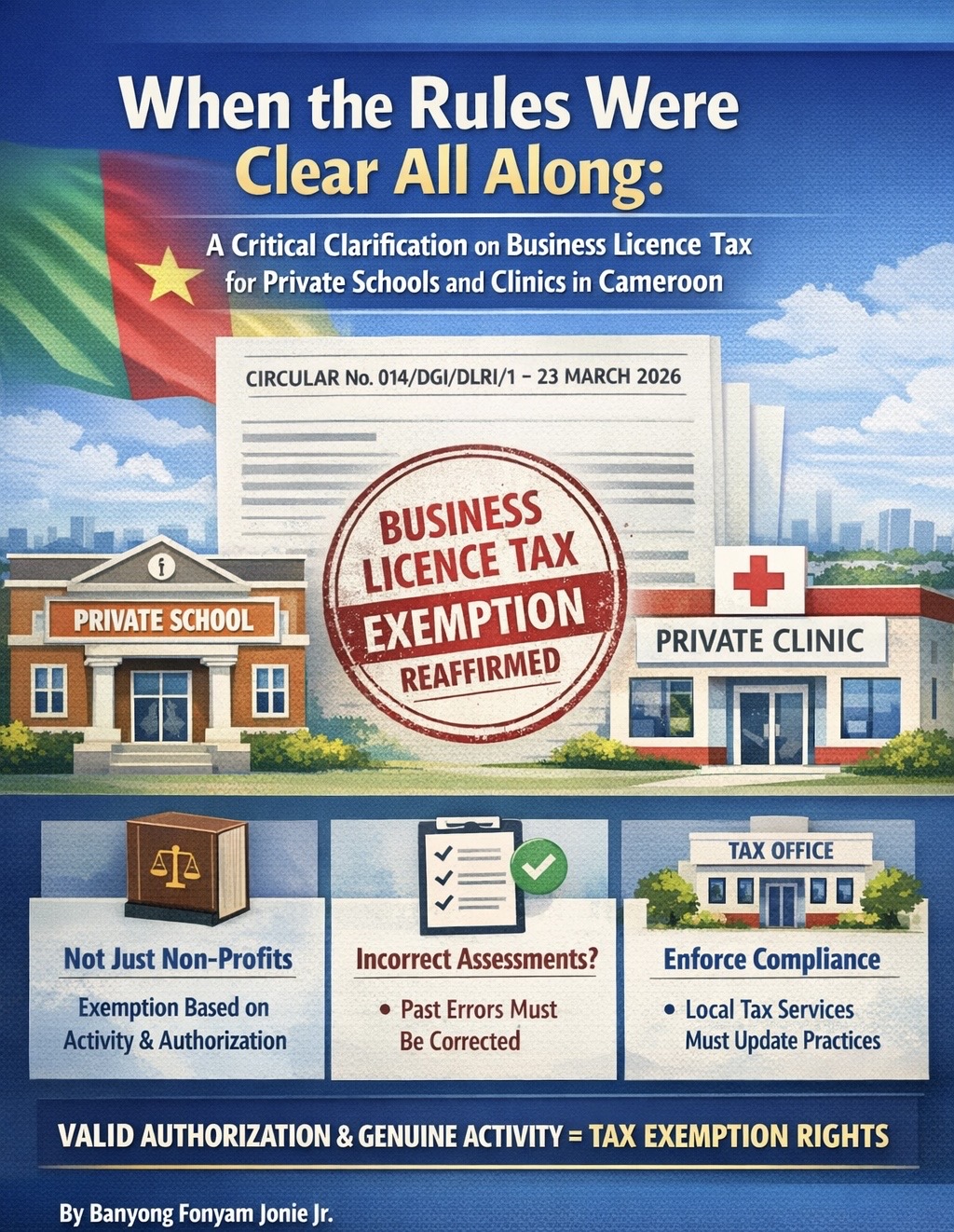
When the Rules Were Clear All Along: A Critical Clarification on Business Licence Tax for Private Schools and Clinics in Cameroon
A recent administrative circular from the Director General of Taxation in Cameroon warrants our attention—not because it introduces new law, but precisely because it reaffirms what the law has always been.
On 23 March 2026, the Director General issued Circular No. 014/DGI/DLRI/1, addressing a growing compliance discrepancy that had quietly exposed numerous private educational and health institutions to undue tax liabilities. The root cause? A fundamental misapplication of the law by some local tax centres, which had been assessing business licence tax (patente) on private secular schools and clinics based on an incorrect interpretation of their exempt status.
The core principle is simple: the exemption was never contingent on an institution being a non-profit. It has always been tied to the nature of the activity performed and the validity of the administrative authorisation.
What the Law Has Always Stated
Section 120 of the General Tax Code provides for an automatic exemption from business licence tax for educational institutions (nursery, primary, secondary, higher, and vocational) as well as for duly authorized health institutions.
The recent circular makes explicit what the legislature intended: this exemption applies regardless of the institution’s legal status, its secular or confessional character, and irrespective of whether it qualifies as a non-profit organisation. The absence of secular private institutions from the non-profit categories elsewhere in the Code was never a valid basis to deny the exemption.Section 120 stands independently—it does not derive its force from any other provision.
Practical Implications for Affected Institutions
This circular is not merely advisory; it carries significant operational weight:
– A Matter of Right, Not Discretion: Private secular schools and clinics holding valid administrative authorisations are entitled to the business licence tax exemption as a matter of law.
– Assessments Issued in Error Must Be Reviewed: Any prior assessments based on the argument that the institution was “not non-profit” are formally repudiated by this circular. Affected institutions now have clear official grounds to seek correction.
– Systemic Compliance by Tax Authorities: Local tax offices are required to update their registers and configure their systems to reflect this clarification. Institutions should no longer need to repeatedly argue for an exemption that is automatic.
– Verification of Genuine Conditions: Tax services are now instructed to focus their verification on the validity of the administrative authorisation and the genuine nature of the activity carried out—the only conditions that legally matter.
A Note on Compliance Maintenance
For institutions that have been incorrectly assessed, this circular provides the clearest official support for seeking a reversal. However, the more critical—and often overlooked—question is whether your underlying authorisations are in order and whether your current operations align with the scope of those authorisations.
Exemptions of this nature are valuable, and with value comes heightened scrutiny. Tax services are now instructed to audit not just whether the exemption applies, but whether the conditions for its application are genuinely met. This is a crucial distinction.
This circular serves as a timely reminder: a sound tax position is not simply about identifying what is exempt. It is about being able to demonstrate—during any audit—that the conditions for that exemption are satisfied, properly documented, and current.
How We Can Help
If your institution has received business licence tax assessments that may have been issued in error, or if you wish to review whether your authorisations and operational structure properly support your exempt status, we are available to provide clarity and assistance.
This is a straightforward area of law. It should not become a source of avoidable cost.
By Banyong Fonyam Jonie Jr.
Disclaimer: This article is for general information purposes only and does not constitute legal advice. Specific advice should be sought in relation to individual circumstances.
#CameroonTax #TaxLaw #BusinessLicenceTax #PrivateSchools #HealthcareCompliance #DGI #TaxExemption #LegalUpdate #ComplianceMatters #CameroonBusiness