
Expert Insight: Corporate Governance Under the OHADA Regime
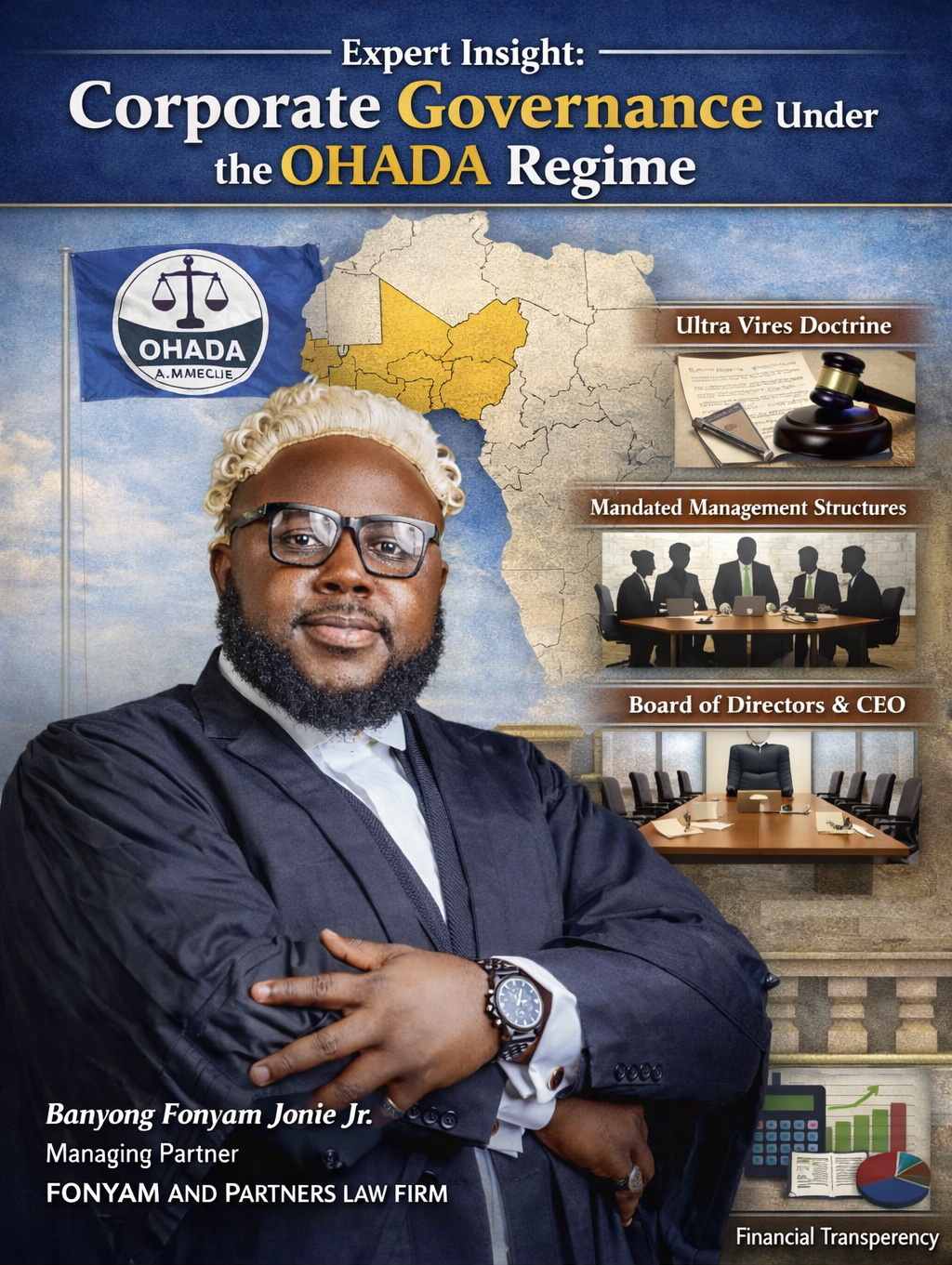
In the dynamic and integrated economic landscape of the OHADA (Organisation for the Harmonisation of Business Law in Africa) member states, the Uniform Act on Commercial Companies and Economic Interest Groups (AUSCGIE) provides the foundational legal framework for corporate entities. As a seasoned corporate attorney and the Managing Partner of Fonyam and Partners Law Firm, I have guided countless national and international investors through the intricacies of this system, ensuring robust corporate structures, compliant governance, and strategic growth. A profound understanding of these rules is not merely academic—it is critical for operational efficiency, legal compliance, and the protection of stakeholder interests.
The strength of the OHADA framework lies in its provision of clear, mandatory rules for company management, delineating powers, responsibilities, and liabilities. It ensures that managers act in the company’s best interest while granting partners and shareholders defined participatory rights. Furthermore, its compulsory audit requirements enhance financial transparency and credibility. This article provides a professional overview of key governance pillars under the AUSCGIE.
I. The Practical Limitation of the Ultra Vires Doctrine
A pivotal feature offering security in commercial transactions is the restriction of the ultra vires doctrine. Under Article 122 AUSCGIE, acts undertaken by a company’s legal representatives are binding on the company, even if they fall outside its corporate object, unless the company can prove the third party was aware of the transgression. The mere publication of the Articles of Association is insufficient proof.
Practical Implication: This underscores the necessity for meticulous due diligence on counterparties and for companies to implement precise internal authorization protocols. It also highlights the significant liability exposure for managers acting beyond their mandate.
II. Mandated Management Structures: A Typology
The AUSCGIE prescribes distinct management models for each company type:
– General Partnership (SNC): Managed by one or several persons, partners or not. Absent a designated manager, all partners are presumed managers (Art. 276).
– Limited Partnership (SCS): Managed by the general partners, unless the articles designate one or more specific managers (Art. 298).
– Private Limited Company (SARL): Managed by one or more managers (gérants), who may be members or non-members, appointed as per the articles or by a majority capital decision (Art. 323).
– Simplified Joint Stock Company (SAS): Enjoys contractual flexibility; its management structure is freely defined in its articles of association (Art. 853-7).
– Public Limited Company (SA): Offers a choice between a Board of Directors or a Managing Director structure, a fundamental choice that must be stipulated in the articles (Art. 415).
III. Governance in a Public Limited Company with a Board of Directors
The board, comprising 3 to 12 (or up to 24 post-merger) members, holds central authority (Arts. 416, 418).
– Appointment & Term: Initial directors are named in the articles; subsequent appointments are made by the Ordinary General Meeting (OGM). Terms are capped at 2 years for initial appointees and 6 years for others (Arts. 419, 420).
– CEO & General Manager: The Board appoints a Chief Executive Officer (CEO) from among its members to chair its meetings and the OGM (Art. 477). It may also appoint a General Manager (DG) to handle day-to-day management and represent the company (Art. 486). Both serve at the Board’s discretion and can be dismissed by it at any time (Arts. 484, 487).
IV. Governance in a Public Limited Company with a Managing Director
This streamlined structure is an option for SAs with fewer than three shareholders (Art. 494).
– Role & Appointment: The Managing Director (Directeur Général) holds comprehensive powers for administration, management, and legal representation (Art. 498). Appointed initially by the articles and subsequently by the OGM, their mandate is limited to 6 years (2 if appointed by the articles) and is renewable (Arts. 495, 496).
– Oversight & Restrictions: Certain contracts between the Managing Director and the company require prior OGM approval (Art. 502). Strict prohibitions exist on obtaining loans or overdrafts from the company for the Managing Director and their relatives (Art. 507). The OGM may dismiss the Managing Director at any time (Art. 509).
Conclusion: The Imperative of Expert Guidance
The OHADA Uniform Act establishes a sophisticated, predictable framework for corporate governance. However, its effective implementation—from selecting the optimal legal structure and drafting airtight articles of association to ensuring ongoing compliance with filing obligations and governance rules—requires specialized legal expertise.
At Fonyam and Partners Law Firm, under my direct supervision, we provide end-to-end corporate legal services across the OHADA region, with a deep specialism in Cameroon. We partner with our clients to handle company registration, corporate filings, governance structuring, and compliance, transforming legal complexity into strategic advantage.
For corporations seeking to establish, manage, or expand their operations within the OHADA zone, professional counsel is not an option; it is a prerequisite for sustainable success.
Banyong Fonyam Jonie Jr.
Managing Partner
FONYAM AND PARTNERS LAW FIRM
Your Trusted Partner for Corporate Law in the OHADA Region