
Legal and Regulatory Analysis of the Structural Proxy War in Francophone African Fintech: The PayPal–Flutterwave Dynamic
I. INTRODUCTION
The African fintech ecosystem is undergoing a tectonic drift. What was once a landscape defined by collaboration and market entry is now giving way to a phenomenon best described as a “Structural Proxy War.” This term, drawn from intelligence gathered by the Aegis Radar at Perpect, encapsulates the escalating friction between global incumbents and regional champions.
At the heart of this tension lies the evolving relationship—or “co-opetition”—between PayPal and Flutterwave. As a legal and regulatory professional monitoring cross-border financial services, I observe that this is not merely a commercial rivalry. It is a battle for Infrastructure Sovereignty, with profound implications for compliance, data governance, and regulatory oversight—particularly in the strategically vital but legally complex region of Francophone Africa.
This memorandum dissects the legal architecture underpinning this conflict and forecasts the regulatory battles that will define the coming year.
II. THE DIRECT PRODUCT CLASH: PAYPAL WORLD VS. FLUTTERWAVE SEND
From a legal standpoint, the direct competition between PayPal’s “PayPal World” and Flutterwave’s “Send App” represents a collision of two distinct regulatory philosophies.
· PayPal’s Approach (The “Global Trust” Model): PayPal operates under a centralized compliance framework, heavily reliant on its historical licenses in the US and EU. Its expansion into Africa is filtered through partnerships that absorb local regulatory risk. This is a “safe but slow” approach, prioritizing anti-money laundering (AML) uniformity over product agility.
· Flutterwave’s Approach (The “Local Agility” Model): Flutterwave, by contrast, has structured its operations to leverage local licenses and partnerships across the continent. Its Send App is designed to navigate the fragmented regulatory terrain of African remittance corridors, offering faster product iteration but carrying a higher burden of multi-jurisdictional compliance.
Regulatory Implication: In Francophone Africa, where the BCEAO (Central Bank of West African States) and BEAC impose stringent currency controls and capital flow restrictions, PayPal’s “one-size-fits-all” compliance may struggle against Flutterwave’s bespoke regulatory engineering.
III. INFRASTRUCTURE CONVERGENCE: THE MONO ACQUISITION AND STRUCTURAL DEPENDENCY
The acquisition of Mono by Flutterwave is a masterstroke in vertical integration, but it raises critical antitrust and data sovereignty concerns.
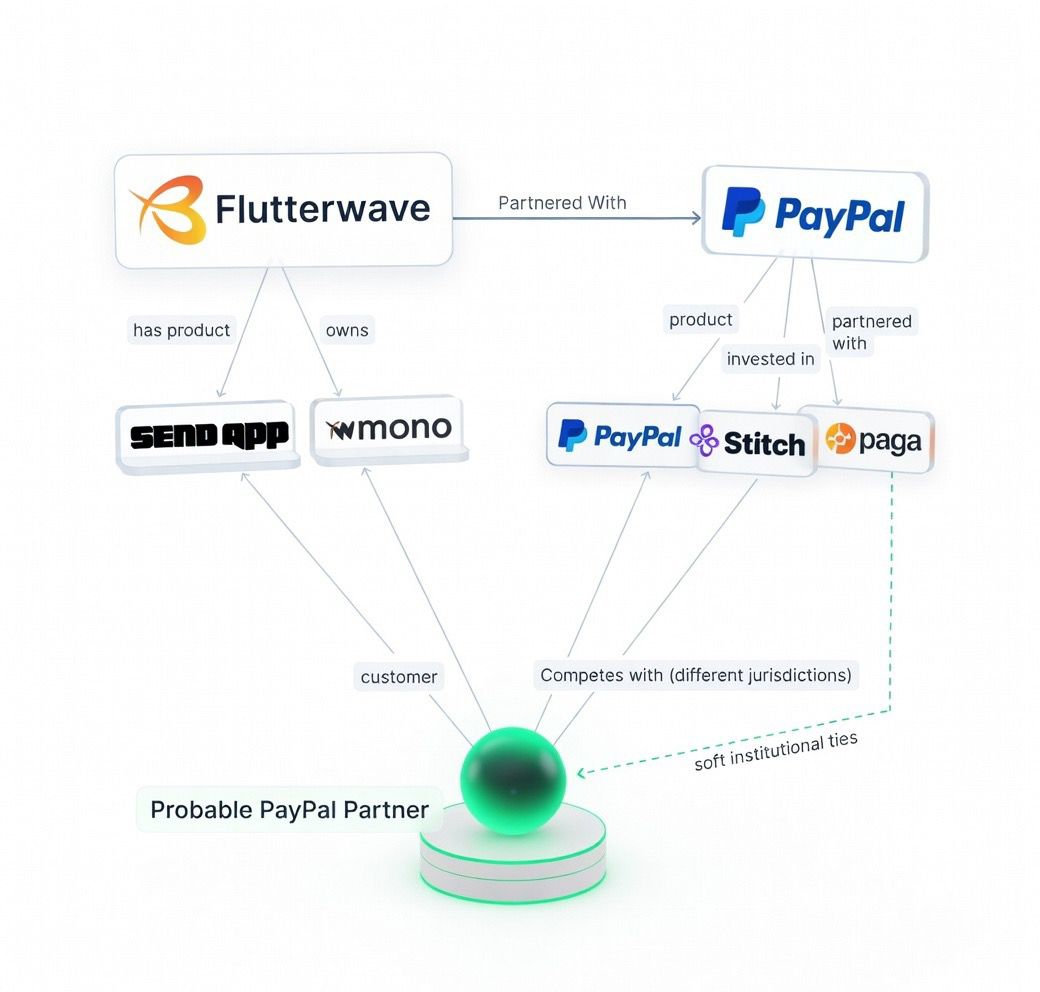
· The Legal Strategy: By owning the “Eyes” (Open Banking data via Mono) and the “Hands” (settlement rails), Flutterwave has created a closed-loop infrastructure. This forces global players like PayPal into a position of Structural Dependency—they must use Flutterwave’s rails to access premium local data.
· Data Protection Law Implications: Under Francophone Africa’s emerging data protection frameworks (inspired by the OHADA Uniform Act and the Malabo Convention), the transfer of customer data through a competitor’s infrastructure creates significant liability. If a global player processes data through Mono’s APIs, who is the “Data Controller” under local law? The answer is often ambiguous, creating regulatory exposure.
Legal Opinion: This dependency may be challenged by competition authorities in the UEMOA region, which are increasingly vigilant about monopolistic control over financial infrastructure.
IV. THE COMPLIANCE ANCHOR: PAGA AS A REGULATORY SHIELD
PayPal’s partnership with Paga is a textbook example of using local compliance infrastructure as a defensive moat.
· The “Safety-First” Infrastructure: Paga provides PayPal with a “boots on the ground” compliance mechanism. It offers the physical liquidity nodes and agent networks necessary to satisfy CBN (Central Bank of Nigeria) and, by extension, BCEAO requirements for financial inclusion and consumer protection.
· Regulatory Arbitrage: By anchoring to Paga, PayPal avoids the lengthy process of obtaining individual money transmitter licenses in every African jurisdiction. Instead, it leverages Paga’s existing regulatory goodwill.
Risk Analysis: While this serves as a shield, it also caps PayPal’s upside. It remains dependent on Paga’s regulatory standing; any compliance failure at Paga would directly infect PayPal’s operations.
V. THE MYSTERY FACTOR: SOFT INSTITUTIONAL TIES AND THE PROBABLE PARTNER
The dossier highlights a “Probable PayPal Partner” (the green node) that is both a customer of Mono (Infrastructure dependency) and has “Soft Institutional Ties” to PayPal.
· The Legal Tension: This entity sits at the intersection of cooperation and conflict. If PayPal partners with this entity, it may inadvertently be financing a competitor (Flutterwave) through Mono’s API fees.
· Due Diligence Imperative: From a compliance perspective, any such partnership demands rigorous Enhanced Due Diligence (EDD) . The “Soft Institutional Ties” must be mapped to ensure no cross-shareholding or common directorship violates competition laws or creates undisclosed related-party transactions.
Forecast (70% Probability): Should PayPal formalize this partnership by Q2, we will likely see a legal challenge from Flutterwave based on unfair competition or abuse of market position, particularly if Mono’s data services are used to facilitate the partnership.
VI. THE BATTLE FOR FRANCOPHONE AFRICA: A REGULATORY HIGHLIGHT
The note concludes with a warning: “The battle for Francophone Africa will be a highlight between local giants and expansionists this year.” As a legal practitioner, I interpret this through the lens of the following regulatory flashpoints:
1. Currency Convertibility and Capital Controls: Francophone Africa’s CFA Franc peg to the Euro creates unique regulatory hurdles. Any fintech operating here must navigate the complex guarantee mechanisms of the French Treasury. Flutterwave’s experience in this area gives it a distinct legal advantage over PayPal, which is accustomed to free-floating currency environments.
2. OHADA and Commercial Law Harmonization: The Organization for the Harmonization of Business Law in Africa (OHADA) provides a uniform legal framework. However, digital finance often outpaces these statutes. The question of whether a digital wallet constitutes a “commercial instrument” under OHADA is still murky, leaving room for judicial activism.
3. The Rise of “Infrastructure Sovereignty”: We are moving from mere market entry to control over the rails. In legal terms, this means the next frontier is licensing of Payment Service Providers (PSPs) under the new BCEAO regulations. The entity that controls the data and settlement infrastructure effectively writes the rules of engagement, forcing competitors to become tenants on their platform.
VII. CONCLUSION AND STRATEGIC RECOMMENDATIONS
The PayPal-Flutterwave dynamic is a harbinger of the future. We are witnessing the transition from a cooperative fintech ecosystem to a proprietary infrastructure battlefield.
For stakeholders operating in or entering Francophone Africa, I recommend the following:
· Regulatory Audits: Assess whether your operations are dependent on a competitor’s infrastructure (Structural Dependency) and what exit strategies exist.
· Data Localization Compliance: Ensure that any Open Banking integration (like Mono) complies with emerging data residency laws in the UEMOA zone.
· Antitrust Preparedness: As vertical integration increases, be prepared for scrutiny from regional competition commissions.
The era of simple market entry is over. The era of Infrastructure Sovereignty has begun.
Banyong Fonyam Jonie Jr.
Managing Partner
Fonyam & Partners Law Firm