
CAMEROON TIGHTENS GRIP ON ELECTRICITY NETWORK: A New Legal Framework for Intervention
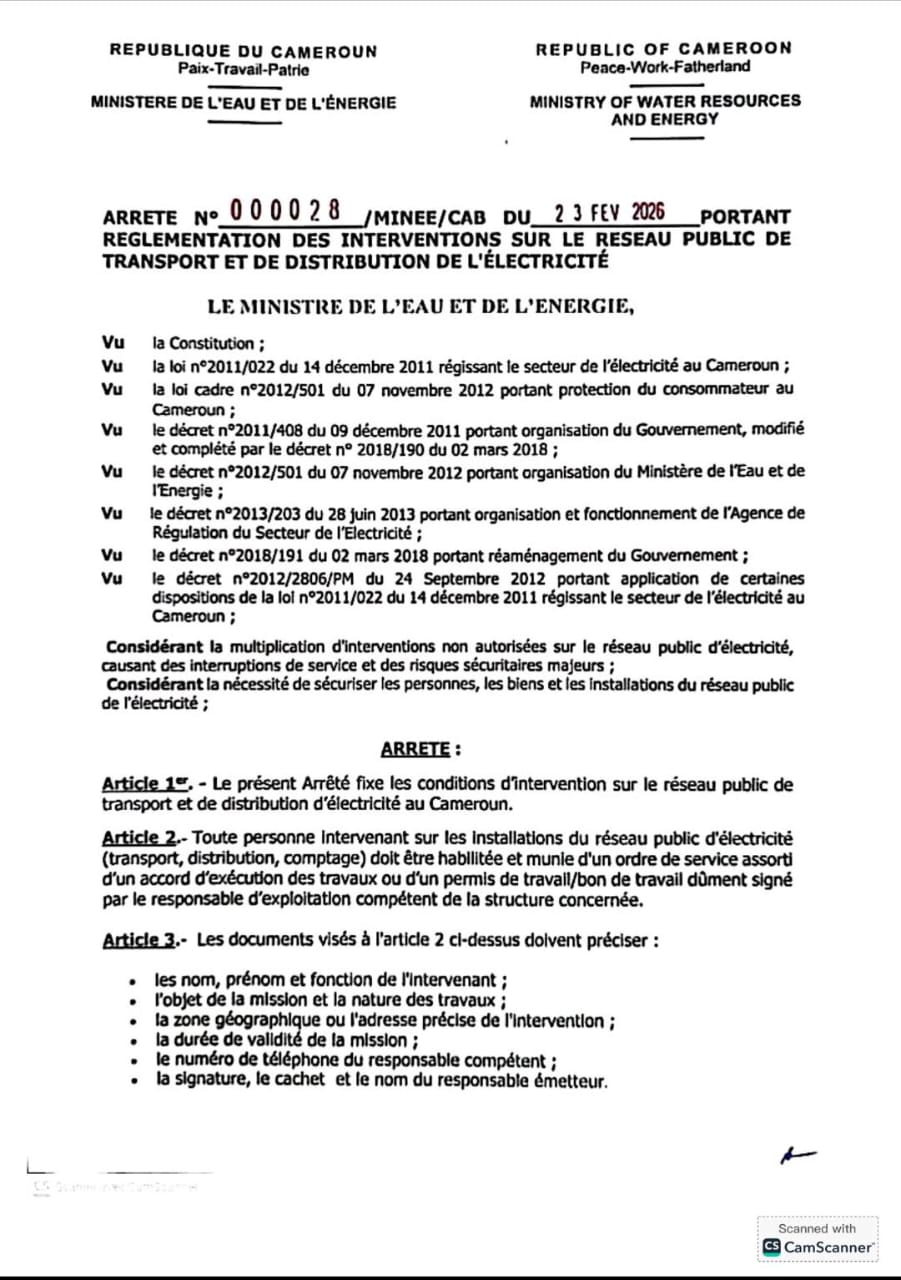
The Cameroonian government, through a landmark decision by the Minister of Water and Energy, has officially promulgated Order No. 000028/MINEE/CAB of February 23, 2026, establishing a strict regulatory framework for all interventions on the public electricity transmission and distribution network. This move signals a robust commitment to safeguarding the nation’s critical energy infrastructure and ensuring the rule of law within a vital economic sector.
As legal professionals and stakeholders in Cameroon’s development, it is imperative to dissect this new regulation and understand its profound implications for public order, economic stability, and individual responsibility.
The Core Objective: Protecting Public Order and Economic Security
The Order is a direct legislative response to a pressing national challenge: the increasing frequency of unauthorized and illegal acts on the electricity grid. It targets three specific, damaging practices:
- Curbing Illegal Connections: The fight against clandestine hookups, which bleed revenue from the state and operators.
- Preventing Meter Fraud: The goal is to end the manipulation of metering devices, a practice that distorts consumption and leads to significant financial losses.
- Banning Unauthorized Technical Work: The Order explicitly prohibits any technical intervention performed outside the legally mandated framework.
Beyond the immediate financial prejudice, these acts undermine the continuity of this essential public service and expose both the public and technical personnel to severe safety risks, including electrocution and network instability. This Order, therefore, is a cornerstone of economic and security public policy.
New Requirements and a Strict Liability Regime
The legal architecture introduced by this Order creates a clear, non-negotiable standard for any intervention. Article 2 establishes a triple cumulative condition that must be met before any work can commence. An individual is legally compliant only if they possess:
- Formal Qualification: The individual must be formally authorized to perform the work.
- A Valid Justificatory Title: They must be in possession of a valid service order, complete with a work execution agreement or a work permit. This document must be duly signed by the competent operations manager of the concerned entity (e.g., ENEO, SONATREL).
- Mandatory Documentation: The document must precisely detail the operative’s identity, the nature and location of the work, and its validity period, as stipulated in Article 3.
Article 4 reinforces this by granting a powerful oversight mechanism: any administrative authority, law enforcement officer, or even a consumer has the right to demand the presentation of the original documents and professional identification.
The consequences of non-compliance are severe. Article 5 is the keystone of the new liability regime. It qualifies any operation conducted without the required original documents as “fraudulent intervention.” This designation exposes the perpetrator to immediate administrative sanctions and, critically, does not preclude criminal prosecution under the Cameroonian Penal Code. This dual-layer sanctioning mechanism underscores the gravity with which the state now views these offenses.
Institutional Architecture and Strategic Vision
The implementation of this Order is not the responsibility of a single entity but a coordinated effort involving all key sector players:
· ARSEL (Agence de Régulation du Secteur de l’Électricité): As the regulatory authority, it will oversee compliance.
· SONATREL (Société Nationale de Transport de l’Électricité): As the transmission network manager, it is responsible for securing the high-voltage grid.
· ENEO Cameroon: As the distribution operator, it must apply these rules at the consumer level.
Article 6 charges the Director Generals of these bodies, alongside Administrative Authorities, with the strict application of this order, creating a cohesive and accountable institutional chain.
This is more than just a punitive measure. It is a strategic move to professionalize the sector. In a context of rising energy demand and infrastructure modernization, this Order establishes a new benchmark for traceability, accountability, and legal conformity.
By clearly delineating legal from illegal intervention, the Order protects strategic national assets, enhances the safety of citizens and workers, and reinforces the legal security of the entire electricity sector. It is a decisive step towards ensuring a stable and reliable power supply for the Cameroonian people and our economy.
The message is clear: In Cameroon, the era of unchecked and illegal interventions on the electrical grid is over. The path forward is paved with compliance, authorization, and collective responsibility for our national infrastructure in Cameroon