Cameroon Fintech Week 2026: What Fintech, Payments and Banking Clients Need to Know.

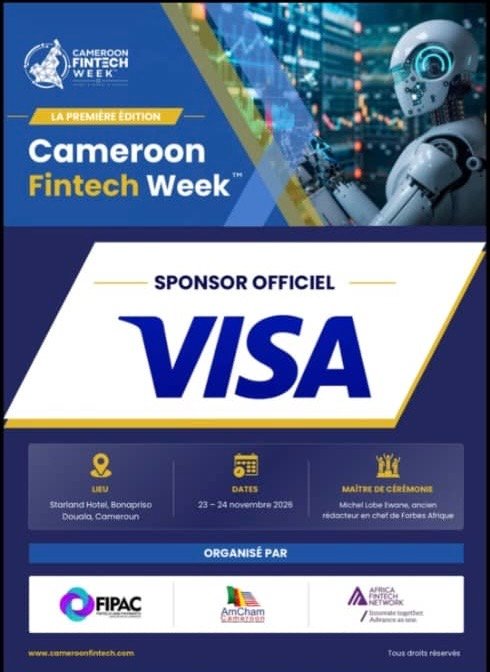
The Cameroon Fintech Week opened this morning at the Star Land Hotel in Bonapriso, Douala, and runs today and tomorrow, 23 and 24 November 2026. It is organised by the Fintech and Payments Association of Cameroon (FIPAC) in partnership with the Africa Fintech Network and the Emerging Technologies Committee of AmCham Cameroon, under the banner “Finance, Technology, Innovation”. The two-day summit brings together regulators, investors, banks and technology innovators, with the stated aim of shaping Central Africa’s financial ecosystem. Visa is the official sponsor, Citi is the banking partner, pawaPay is a silver sponsor and Mobile Money Corporation, MTN Cameroon’s fintech arm, is a bronze sponsor. The event site also lists Tether, Wave, Maviance, Taptap Send and CCA Bank among the participants, and shows the logos of MINFI, BEAC, COSUMAF and the CNEF.
What matters for businesses in the sector is how the themes on the table, mainly stablecoins, open banking, AI-driven payments and cross-border licensing, line up with the rules that apply to them today. In several places the answer is that the conversation is ahead of the law.
- Stablecoins are being discussed as infrastructure, but there is no licensing route yet
Stablecoins and blockchain as payment rails are among the central themes of the event, and the commercial case is easy to understand: faster settlement, lower transfer costs and a way around foreign exchange bottlenecks in trade.
The legal position in CEMAC is more restrictive. Article 42 of Regulation No. 02/24/CEMAC/UMAC/CM of 20 December 2024 prohibits virtual asset service activity without a prior licence, and the COSUMAF General Regulation of 23 May 2023 sets up the licensing regime for digital asset service providers. I have found no public record that COSUMAF has approved any provider, and the instruction setting out the application procedure has not, to my knowledge, been published. BEAC has also signalled a preference for a digital CFA franc over dollar-backed stablecoins.
For clients, the practical effect is that stablecoin use is a legal risk that sits with them. A company that settles, pays out or holds treasury in stablecoins, or that relies on a partner that does, should not assume the arrangement is lawful because large institutions are talking about it.
- The compliance baseline that already applies
Whatever is announced at the event, these rules are in force now:
- AML/CFT: Regulation 02/24 covers virtual asset providers as reporting entities, with customer due diligence, suspicious transaction reporting, enhanced vigilance above 500,000 CFA francs for occasional transactions, and travel rule obligations for virtual asset transfers.
- Foreign exchange: CEMAC foreign exchange regulations continue to govern how funds move in and out of the zone, whatever the payment rail used.
- Data protection: Cameroon’s Law No. 2024/017 of 23 December 2024 has applied since 23 June 2026, with an independent authority, consent requirements and controls on transfers of data abroad. Any open banking, embedded finance or AI-based service has to be built around it.
- Payment and e-money rules: BEAC and COBAC rules on payment services, electronic money and agent banking apply to the licensed entities and to those who work with them.
- Partnerships, platforms and who bears the risk
Banks, mobile money operators and card networks are building integrated ecosystems, and smaller fintechs will often have to work through them. That makes the contract the main protection. Points worth settling in writing include API access and pricing, who holds customer data and on what basis, liability for failed or fraudulent transactions, and what happens to the integration if one party’s licence status changes.
The same applies to AI-driven payments. Where an agent initiates a payment for a customer, the authority of the agent, the authentication of the payer and the allocation of loss for a manipulated instruction are not addressed in CEMAC rules that I am aware of, so the contract and the terms of service carry that risk for now.
- Licensing across borders
The discussion of regulatory passporting is relevant to any company planning to operate in more than one market. Within CEMAC, banking and microfinance licences issued by COBAC already work across the zone, but for payment and other fintech activities, companies can still face several national authorities. Beyond CEMAC, mutual recognition with WAEMU or other blocs would need agreement between supervisors that currently use different rules. Until that exists, expansion plans should be built on licences that can actually be obtained.
- What to listen for
- A timetable from COSUMAF for the instruction on licensing digital asset service providers.
- Any indication from BEAC or the Ministry of Finance of how stablecoin activity will be classified and who will supervise it.
- Whether passporting is tied to a specific licence category or remains a general aim.
- How the new data protection authority will treat open banking and embedded finance.
- Whether commitments come with dates or only with intentions.
- Practical steps for clients
- Map each product and flow against the licence categories that exist today, and identify what is currently unlicensed.
- Get a written legal opinion before launching or continuing any service that involves stablecoins or other virtual assets.
- Update the AML/CFT policy to Regulation 02/24, including virtual asset risk and travel rule procedures where relevant.
- Review compliance with Law 2024/017, including consent, data transfers and the appointment of a data protection officer.
- Review partner and platform contracts for the points in section 3.
- Keep a record of regulator statements made at the event, because they are a useful guide to where enforcement and licensing are heading.