
Mastering Trade Finance: The Essential SWIFT MT Messages for Legal and Compliance Professionals in the CEMAC/WAEMU Regions
Author: Banyong Fonyam Jonie Jr., Managing Partner, Fonyam and Partners Law Firm
In the intricate world of international trade, particularly within the dynamic economic landscapes of the CEMAC and WAEMU regions, the ability to navigate financial instruments is paramount. For legal and regulatory compliance professionals, understanding the mechanics behind these transactions isn’t just an advantage-it’s a necessity.
At the heart of documentary credits, guarantees, and SBLCs lies the SWIFT MT messaging system. These standardized messages form the backbone of global trade finance, dictating the flow of funds and documents between parties across borders.
Knowing the code is merely the first step. The true value lies in understanding who sends it, who receives it, why it is used, and how it connects to the underlying commercial transaction. This knowledge is critical for ensuring compliance, mitigating risk, and fostering smoother trade operations.
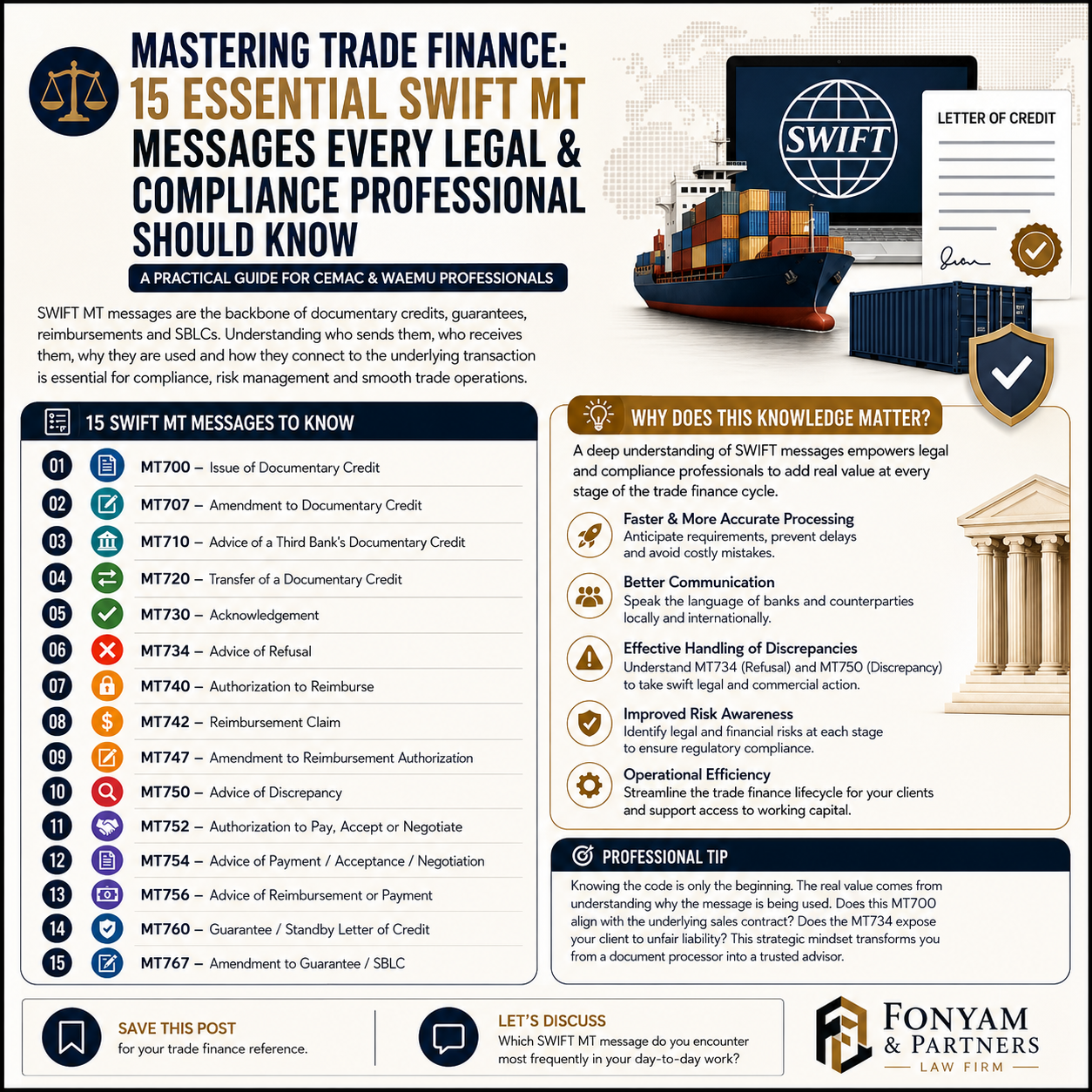
Here are 15 SWIFT MT messages that every serious trade finance professional in West and Central Africa should have at their fingertips:
The Essential SWIFT MT Messages
| Message Type | Purpose |
| MT700 | Issue of Documentary Credit — The instruction to open a Letter of Credit. |
| MT707 | Amendment to Documentary Credit — Modifications to the LC terms. |
| MT710 | Advice of a Third Bank’s Documentary Credit — Notification of an LC from a non-issuing bank. |
| MT720 | Transfer of a Documentary Credit — Used when the LC is transferred to a second beneficiary. |
| MT730 | Acknowledgement — A simple receipt confirming a transaction. |
| MT734 | Advice of Refusal — The formal notification from a bank that documents do not comply (critical for handling discrepancies). |
| MT740 | Authorization to Reimburse — Authority granted to a bank to pay under a reimbursement undertaking. |
| MT742 | Reimbursement Claim — A bank’s formal request for payment under a reimbursement authorization. |
| MT747 | Amendment to Reimbursement Authorization — Changes to a reimbursement authorization. |
| MT750 | Advice of Discrepancy — A specific advisory of discrepancies found in documents. |
| MT752 | Authorization to Pay, Accept or Negotiate — Authority to act on the LC. |
| MT754 | Advice of Payment / Acceptance / Negotiation — Notification that payment has been executed. |
| MT756 | Advice of Reimbursement or Payment — Notification regarding the settlement of funds. |
| MT760 | Guarantee / Standby Letter of Credit — A commitment to back financial obligations. |
| MT767 | Amendment to Guarantee / SBLC — Changes to the guarantee terms. |
Why Does This Matter?
For legal counsel and compliance officers, mastery of these codes translates directly to operational efficacy. A deep understanding allows for:
1. Faster and More Accurate Processing: Prevent delays by preempting documentation requirements and potential pitfalls.
2. Better Communication: Effectively interface with local and international banks and counterparties in your language.
3. Effective Handling of LC Discrepancies: This is particularly crucial in regional trade. Understanding an MT734 (Refusal) or an MT750 (Discrepancy) allows you to take swift legal and commercial action to resolve disputes.
4. Improved Risk Awareness: Recognize the legal and financial risk implications at each stage of the transaction cycle, ensuring robust regulatory compliance.
5. Operational Efficiency: Streamline the trade finance lifecycle for your clients, ensuring access to essential working capital.
Professional Tip
As legal practitioners in the CEMAC and WAEMU zones, we must look beyond the paperwork. The real value comes from understanding why the message is being used. Does this MT700 align perfectly with the underlying sales contract? Does the MT734 from the advising bank expose my client to unfair liability? This strategic mindset transforms a professional from a document processor into a trusted advisor.
At Fonyam and Partners, we believe that effective trade finance starts with clarity, proper documentation, and a strong understanding of transaction structures and applicable regulations.
Which SWIFT MT message do you encounter most frequently in your day-to-day work in the region? Let’s discuss in the comments below.
#TradeFinance #CEMAC #WAEMU #SWIFT #LettersOfCredit #InternationalTrade #LegalCompliance #FonyamAndPartners #AfricaTrade #TradeLaw #RiskManagement #Banking #Africa #Finance