
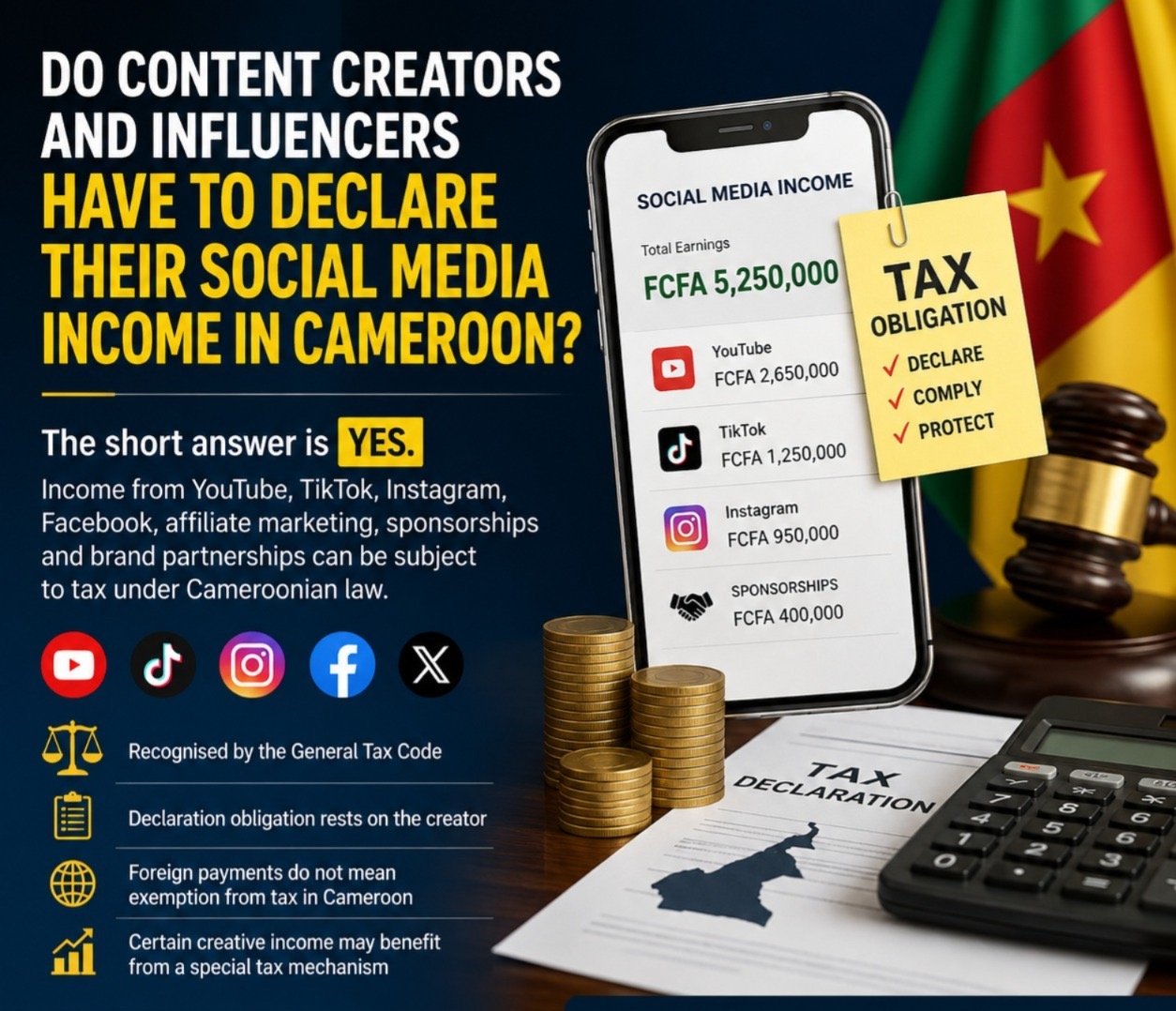
Do Content Creators and Influencers Have to Declare Their Social Media Income in Cameroon?
By Banyong Fonyam Jonie Jr, Managing Partner, Fonyam & Partners Law Firm
The short answer is yes.
The rapid growth of YouTube, Facebook, TikTok, Instagram, X (formerly Twitter), and other digital platforms has created a new class of income earners in Cameroon. Thousands of Cameroonians now generate revenue from sponsored posts, advertising, affiliate marketing, digital services, and brand partnerships. Like any other economic activity, this income can attract tax obligations under Cameroonian law — and many creators are unaware of the extent to which they are exposed.
At Fonyam & Partners, we increasingly advise clients in the creative and digital economy on precisely this question. Below is a summary of the legal framework every content creator, and every brand that works with them, should understand.
The Legal Framework
Taxation in Cameroon is governed principally by the General Tax Code (Code Général des Impôts – CGI), as amended annually by successive Finance Laws.
Article 56(2)(g) of the General Tax Code expressly brings within the category of Non-Commercial Profits (Bénéfices Non Commerciaux – BNC) income generated on digital platforms by individuals engaged in:
the sale of goods;
the provision of services; or
the exchange or sharing of goods.
Depending on the nature of the activity, this can capture YouTube monetisation, Facebook and Instagram sponsored content, TikTok creator earnings, affiliate marketing commissions, influencer advertising contracts, paid digital promotions, online consulting and coaching, and digital content licensing.
Article 56(2)(h) separately governs remuneration received by non-professional taxpayers, particularly where the activity is occasional rather than habitual.
When Does a Content Creator Become a Taxpayer?
Two categories are relevant.
- The professional content creator. Where content creation is carried out on a regular basis with the intention of generating income, the creator may be required to register as a professional carrying on a non-commercial activity. The applicable regime generally turns on annual turnover — either the Impôt Général Synthétique (IGS), where the statutory threshold is met, or the Actual (Real) Tax Regime, where turnover exceeds the prescribed threshold.
- Occasional or supplementary income. Where content creation generates only occasional or supplementary income, the creator may fall within the category of non-professional taxpayers. This does not mean the income is automatically exempt — where the law requires it, occasional income remains declarable and taxable.
The Challenge of Foreign Digital Platforms
Most creators are paid by companies established outside Cameroon — Google (YouTube), Meta (Facebook and Instagram), TikTok, and similar platforms. Because these companies are generally not subject to Cameroon’s withholding tax mechanism, they do not deduct Cameroonian income tax before paying creators.
The obligation to declare this income therefore rests with the taxpayer, through the annual tax declaration required under Cameroonian law. This is a critical and often misunderstood point.
By contrast, where remuneration is paid by a Cameroonian public or private entity for non-commercial services, the applicable withholding tax rules under the General Tax Code may apply directly.
A Special Rule for Certain Creative Income
Article 59 of the General Tax Code provides a special mechanism for certain literary, scientific, and artistic income. Subject to statutory conditions, eligible taxpayers may request that taxable profits be averaged over the current year and the two preceding years. Once exercised, however, this option is generally irrevocable and commits the taxpayer to the Actual (Real) Tax Regime for that category of income — a choice that should be made with proper legal advice.
Illustrative Examples
Example 1. A creator based in Douala runs a YouTube channel, earning advertising revenue from Google, payments for sponsored videos, and fees from product promotions. Although Google does not withhold Cameroonian income tax before payment, the creator remains personally responsible for complying with her tax obligations under the General Tax Code.
Example 2. A university student occasionally earns money through TikTok promotions and Instagram advertisements. Even though this is not his principal occupation, the income may still carry tax consequences depending on its nature and the applicable provisions of the Code.
A Common Misconception
Many creators believe that because their income is paid from abroad, it falls outside the reach of Cameroonian tax law. This is incorrect. The fact that income is paid by a foreign company, received in foreign currency, or transferred through an international payment platform does not, by itself, exempt it from taxation in Cameroon.
Key Takeaways
The General Tax Code expressly recognises certain income generated through digital platforms as taxable.
Professional content creators may need to register under the appropriate tax regime.
Occasional income may also be subject to declaration where the law requires it.
Foreign digital platforms generally do not withhold Cameroonian income tax on the administration’s behalf — the burden of declaration falls on the creator.
Certain creative income may benefit from the averaging mechanism under Article 59, subject to statutory conditions.
Legal References
General Tax Code (Code Général des Impôts – CGI), as amended by successive Finance Laws in force.
Article 56(2)(g) — Income generated through digital platforms.
Article 56(2)(h) — Remuneration of non-professional taxpayers.
Article 59 — Averaging of certain literary, scientific, and artistic income.
Relevant provisions of the Tax Procedure Code (Livre des Procédures Fiscales) on registration, declaration, assessment, and recovery.
Closing Note
Creating digital content is no longer merely a hobby — it is increasingly recognised as an economic activity capable of generating taxable income. Every content creator should understand not only how to grow an audience, but also how to comply with the tax obligations the law imposes.
Creators and brands seeking guidance on structuring their digital income or meeting their compliance obligations are welcome to reach out to our team at Fonyam & Partners.
Know the law. Protect your rights.
Fonyam & Partners Law Firm