
The High Cost of the “Late Legal” Handoff: Why Collaboration is Key to Deal Value
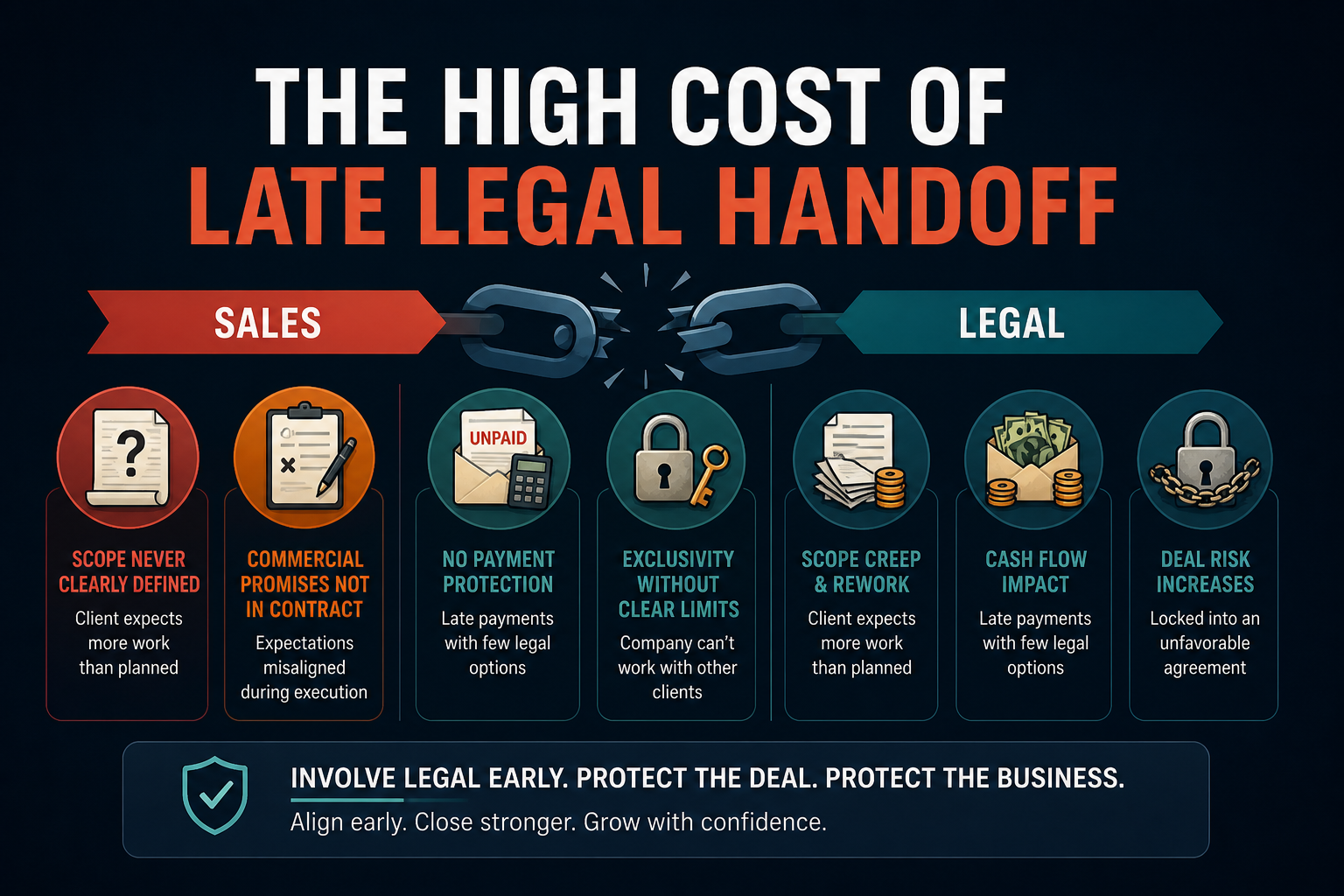
In the race to close deals and drive revenue, Sales teams are often judged by their speed and agility. The pressure to move quickly can create a natural temptation to align directly with the client, bringing Legal into the conversation only at the final stage, often with limited context on the nuances of what was actually negotiated.
After years of working with commercial contracts, I’ve seen a clear pattern emerge: this is precisely where many operational and financial risks are born.
It’s rarely about a “bad deal.” The problems arise because the foundational elements of the relationship were never clearly structured, documented, and agreed upon. When Legal isn’t involved early as a strategic partner, the handshake agreement can quickly turn into a liability.
Here are some common, yet critical, situations that unfold when Legal is brought in too late.
- The “Scope Creep” Trap
A sales representative, eager to accommodate a client, agrees to provide “ongoing support for the project” or “general assistance.”
· The Sales Perspective: This is interpreted as a limited, well-defined scope of work.
· The Client’s Interpretation: This is understood as broad, on-demand operational support.
· The Result: Months later, the company is silently funding a significant resource drain, delivering far more work than originally priced, with no contractual basis for additional fees. A clearly defined scope, drafted early, would have prevented this.
- The Problem with Verbal Promises
During the excitement of negotiations, a client may receive powerful verbal commitments: priority support, dedicated account resources, or guaranteed faster delivery timelines.
· The Risk: If these promises are never translated into the binding four corners of the contract, they become a source of profound misalignment. The client expects them; the operations team has no record of them. This creates operational tension, erodes trust, and damages the client relationship from the very first day of execution.
- Financial Exposure and Unprotected Cash Flow
Pricing is often agreed upon informally, with the contract treated as a mere formality. When payment protections are an afterthought, the company is vulnerable.
· The Consequence: When a client delays payment, the company may discover it has no contractual right to suspend services, charge late payment penalties, or tie invoices to clear, verifiable triggers. A small delay can quickly snowball into a major financial problem that could have been avoided with standard legal safeguards.
- Exclusivity Without Boundaries
To secure a “win” and lock in a key partnership, exclusivity might be offered.
· The Danger: If the exclusivity clause lacks clear definitions around duration, territory, or specific scope, the company can unintentionally restrict its own ability to work with other valuable clients or partners. What was meant to be a strategic win becomes a strategic cage.
- The Inescapable Commitment
In the rush to start, the parties often fail to define a clear path to ending the relationship. What happens if the project isn’t viable, the partnership sours, or the business strategy changes?
· The Outcome: Without a robust termination structure, the company can find itself legally locked into an agreement that no longer makes business sense, forced to continue a relationship that is draining resources and hindering growth.
These scenarios rarely arise from ill intent. They happen because two critical functions view the same deal from fundamentally different angles.
Sales is rightly focused on the immediate opportunity, the relationship, and the “win.”
Legal is focused on structuring the rules of engagement to ensure the deal can operate sustainably, profitably, and with managed risk.
The magic happens when these two perspectives merge early in the process. When Sales and Legal collaborate from the start, the contract becomes more than just a legal document; it becomes a true reflection of the business deal. It protects the company, enables the sales team, and sets the stage for a successful, long-term partnership.
That is when Legal truly functions as a business partner—supporting aggressive growth while proactively protecting the company’s future.