
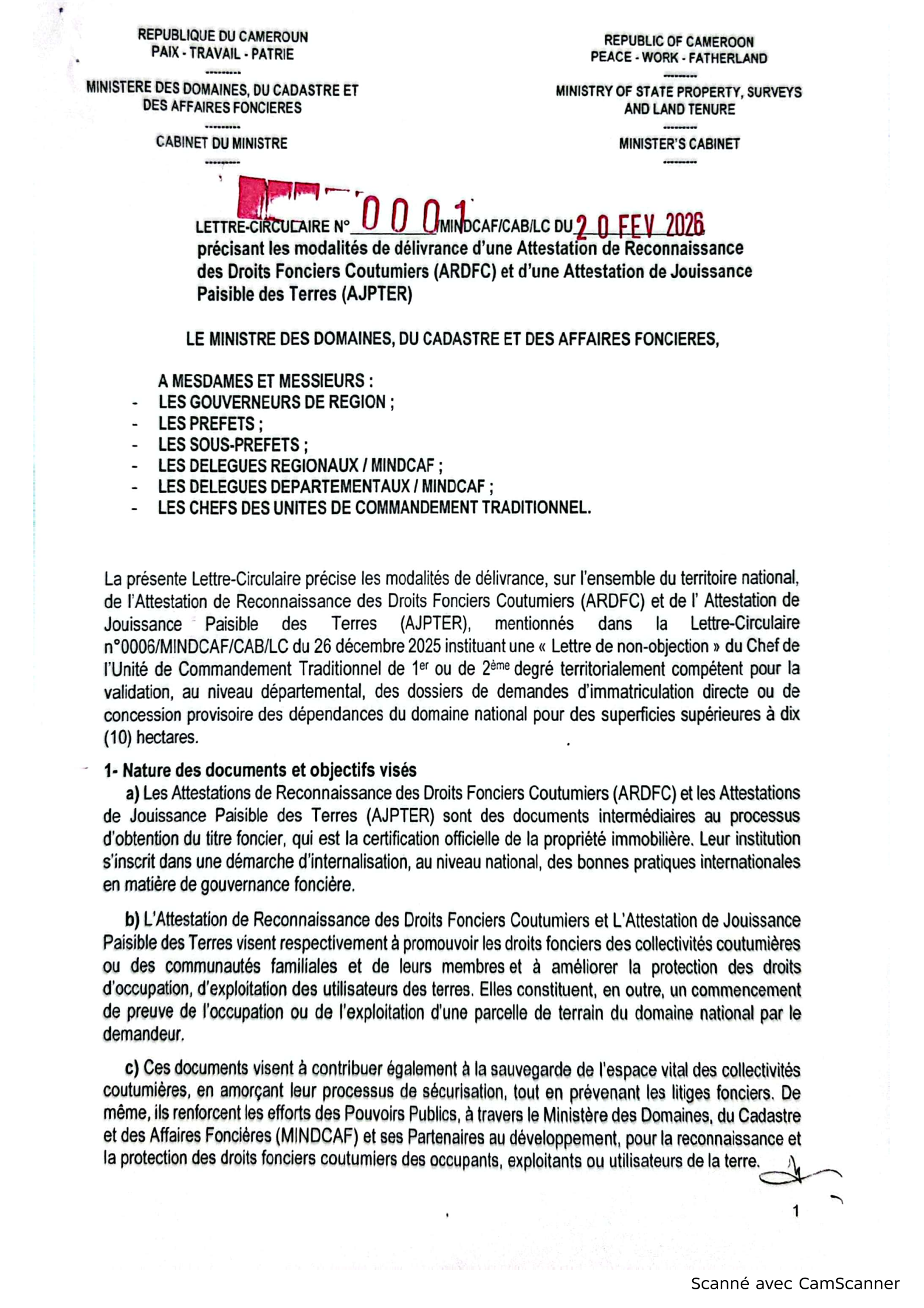
Analysis and Legal Opinion on Circular Letter No. 0001/MINDCAF/CAB/LC of 20 February 2026 — Prescribing the Modalities for the Issuance of an Attestation de Reconnaissance des Droits Fonciers Coutumiers (ARDFC) and an Attestation de Jouissance Paisible des Terres (AJPTER)
I. INTRODUCTION AND EXECUTIVE SUMMARY
On 20 February 2026, the Minister of State Property, Surveys and Land Tenure (Ministre des Domaines, du Cadastre et des Affaires Foncières — MINDCAF), Henri EYEBE AYISSI, issued Circular Letter No. 0001/MINDCAF/CAB/LC (hereinafter “the Circular”) addressed to Regional Governors, Prefects, Sub-Prefects, Regional and Divisional Delegates of MINDCAF, and Chiefs of Traditional Chieftaincy Units across the Republic of Cameroon.
The Circular establishes a comprehensive framework for the issuance, across the national territory, of two new intermediate land documentation instruments:
1. The Attestation de Reconnaissance des Droits Fonciers Coutumiers (ARDFC) — an Attestation of Recognition of Customary Land Rights; and
2. The Attestation de Jouissance Paisible des Terres (AJPTER) — an Attestation of Peaceful Enjoyment of Lands.
These instruments are intended to serve as intermediate documentary evidence in the process of obtaining a formal land title (titre foncier), while simultaneously strengthening the involvement of traditional authorities in land governance. The Circular is an amplification and operationalization of the earlier Circular Letter No. 0006/MINDCAF/CAB/LC of 26 December 2025, which introduced a “Letter of Non-Objection” from Traditional Chiefs (1st or 2nd degree) for the validation of applications for direct land registration or provisional concession on national domain land exceeding ten (10) hectares at the divisional level.
The Circular takes effect on 1 April 2026.
This memorandum provides a detailed, clause-by-clause analysis of the Circular’s provisions, their legal implications, and practical guidance for stakeholders.
II. ADDRESSEES AND SCOPE OF APPLICATION
The Circular is addressed to the following categories of officials and authorities:
– Regional Governors (Gouverneurs de Région)
– Prefects (Préfets)
– Sub-Prefects (Sous-Préfets)
– Regional Delegates of MINDCAF (Délégués Régionaux / MINDCAF)
– Divisional Delegates of MINDCAF (Délégués Départementaux / MINDCAF)
– Chiefs of Traditional Chieftaincy Units (Chefs des Unités de Commandement Traditionnel)
This broad addressee list underscores the inter-institutional character of the reform and the intention to apply it uniformly across the entire national territory. The involvement of traditional authorities at the grass-roots level is particularly significant, as it signals a formal recognition of their role in land administration within the Cameroonian legal framework.
III. NATURE OF THE DOCUMENTS AND OBJECTIVES (Section 1 of the Circular)
A. Intermediate Documentary Instruments (Section 1(a))
The Circular clarifies that both the ARDFC and the AJPTER are intermediate documents within the process of obtaining a land title, which remains the official certification of real property ownership in Cameroon. Their institution represents an effort to internalize internationally recognized best practices in land governance at the national level.
Legal Observation: Under Cameroonian law, the titre foncier (land certificate) remains the sole indefeasible proof of land ownership, as enshrined in Ordinance No. 74/1 of 6 July 1974 establishing the land tenure regime. The ARDFC and AJPTER do not displace this principle; they merely create a recognized intermediate step in the journey toward formal titling.
B. Respective Purposes (Section 1(b))
– The ARDFC is designed to promote and recognize the land rights of customary communities (collectivités coutumières), family communities, and their members.
– The AJPTER aims to improve the protection of the rights of occupation and exploitation of land users.
Both documents serve as a commencement of proof (commencement de preuve) of the occupation or exploitation of a parcel of national domain land by the applicant. This is a critical legal characterization: it means these attestations carry evidentiary weight but are not, in themselves, conclusive or definitive proof of ownership.
C. Safeguarding the Living Space of Customary Communities (Section 1(c))
The documents also aim to:
– Contribute to safeguarding the vital space (espace vital) of customary communities by initiating the process of securing their lands;
– Prevent land disputes (litiges fonciers);
– Reinforce the efforts of MINDCAF and its partners in the recognition and protection of the customary land rights of occupants, operators, and users of land.
D. Issuing Authority (Section 1(d))
The ARDFC and AJPTER are to be issued by Third-Degree Traditional Chiefs (Chefs Traditionnels de 3ème degré) over national domain dependencies situated within their territorial area of competence.
Legal Significance: This is a significant empowerment of Third-Degree Chiefs — the lowest tier of the traditional chieftaincy hierarchy — granting them a formal and recognized administrative function in land governance. The stated objectives include:
– Greater involvement of Traditional Authorities in the prevention and settlement of land disputes on national domain lands;
– Providing customary communities, family communities, and populations occupying and exploiting such lands with provisional instruments recognized by the Traditional Command attesting to their customary possession or peaceful enjoyment of the lands;
– Serving as a bridge measure pending the completion of the land title process, where applicable.
IV. LEGAL BASIS (Section 2 of the Circular)
The Circular derives its legal foundation from the following regulatory and ministerial instruments:
1. Decree No. 2008/0739/PM of 23 April 2008 — Fixing the rules of land use and construction.
2. Circular Letter No. 0001/MINDCAF/CAB/LC of 2 February 2022 — Which prohibited the recognition and admission of “attestations or certificates of abandonment of customary rights” in procedures for direct land registration or concession on national domain dependencies. This earlier circular effectively rendered null and void the traditional practice of issuing informal “certificates of abandonment of customary rights” (attestations ou certificats d’abandon des droits coutumiers) that were frequently used — and abused — in land transactions.
3. Circular Letter No. 0001/MINDCAF/CAB/LC of 9 February 2024 — Codifying the involvement of Traditional Chieftaincy Chiefs in procedures for direct land registration on occupied and/or exploited national domain dependencies, with the aim of preventing and facilitating the settlement of land disputes.
4. Circular Letter No. 0002/MINDCAF/CAB/LC of 9 February 2024 — Establishing a Certificate of Possession of Administratively Recognized Customary Land Rights (Certificat de Possession des Droits Fonciers Coutumiers Administrativement Reconnus — CPDFC-AR) for use in the procedure for processing applications for direct land registration on occupied and/or exploited national domain dependencies for the purpose of obtaining a land title.
5. Circular Letter No. 0006/MINDCAF/CAB/LC of 26 December 2025 — Establishing the “Letter of Non-Objection” from First or Second-Degree Traditional Chiefs for the validation of applications for direct registration or provisional concession on national domain land exceeding 10 hectares.
Legal Commentary: This progressive layering of ministerial circulars reveals a deliberate, incremental reform strategy by MINDCAF to formalize and regulate the role of traditional authorities in land administration, moving from prohibition of informal practices (2022) to codification and institutionalization (2024–2026). However, it is important to note that these are ministerial circulars — administrative instructions — and not legislative or regulatory instruments in the strict sense. Their enforceability depends on compliance by the administrative hierarchy and recognition by the judiciary.
V. ROLES AND PRACTICAL SCOPE OF THE ARDFC AND AJPTER (Section 3 of the Circular)
The Circular assigns the following specific roles and practical functions to the ARDFC and AJPTER:
1. To record and certify the customary land rights of a customary community or of a member thereof, or the development of a parcel of national domain land;
2. To provide the Traditional Chief (1st or 2nd degree) with the material elements for drafting a letter of objection or non-objection in the context of a land registration procedure on a national domain dependency;
3. To facilitate the work of the Consultative Commission (Commission Consultative) in the land registration procedure, by ensuring the availability of provisional or intermediate documents regarding:
– The identity of the applicant;
– The holder of customary land rights;
– The situation of the land in question;
– Useful information on the developments made;
4. To provide the Divisional Delegate of MINDCAF with the necessary elements for the issuance of the CPDFC-AR (Certificate of Possession of Administratively Recognized Customary Land Rights);
5. To initiate the securing of the land rights of vulnerable groups, including women, young people, persons with disabilities, and indigenous populations who do not hold a land title, by providing them with an intermediate document justifying customary possession or development of a national domain dependency;
6. To justify the identity of the person who has developed a parcel of land during expropriation for public utility procedures;
7. To geo-reference the relevant parcels and materialize their boundaries.
Practical Implications: The ARDFC and AJPTER thus serve a multifaceted role: evidentiary, administrative, protective (especially for vulnerable groups), and technical (through geo-referencing). Their integration into the existing land registration process is designed to streamline and improve transparency.
VI. PREPARATORY ACTIVITIES (Section 4 of the Circular)
Before any ARDFC or AJPTER is issued, the following preparatory steps must be undertaken:
(a) Information dissemination and sensitization (information et sensibilisation);
(b) Publicity to inform all neighboring landholders/riparian owners (riverains);
(c) Filing of applications with the competent Third-Degree Traditional Chief;
(d) Designation by the relevant Traditional Chieftaincy of an ad hoc Commission responsible for verifying the availability of the parcel and the non-existence of conflicts over it;
(e) Geo-referencing of the parcel and materialization of its boundaries, provided there is no conflict;
(f) Signing of a minutes of agreement (procès-verbal d’entente) by the applicant, neighbors, and witnesses, formalizing written and agreed-upon terms that clarify the boundaries of the parcels occupied or developed;
(g) Processing of the files and production of maps of the relevant parcels.
Legal Observation: The emphasis on publicity, verification, neighbor consultation, geo-referencing, and written agreements reflects an effort to minimize future disputes and ensure transparency — a notable improvement over past informal customary practices.
VII. MODALITIES OF ISSUANCE (Section 5 of the Circular)
A. Eligible Persons (Section 5(a))
For the ARDFC:
Those entitled to apply for an ARDFC on a national domain dependency are:
– Customary communities (collectivités coutumières);
– Family communities (communautés familiales);
– Their members, holders of customary land rights.
For the AJPTER:
Those entitled to apply for an AJPTER on a national domain dependency are:
– The developers (auteurs d’une mise en valeur probante) of a parcel of land;
– Who are of Cameroonian nationality;
– Who reside within a customary community, family community, or village;
– On the condition that the development dates back at least five (5) years;
– And that the occupation or exploitation is peaceful (paisible).
Key Distinction: The ARDFC is primarily for those asserting customary rights (often collective or communal), while the AJPTER is for individual developers who have peacefully occupied and exploited land for a minimum period. The five-year minimum occupancy requirement for the AJPTER is a significant condition and may exclude recent settlers or developers.
B. Competent Authorities (Section 5(b))
– The ARDFC and AJPTER are issued by the Third-Degree Traditional Chief of the locality where the land is situated, duly recognized by the competent administrative authorities.
– Exceptionally, these attestations may be co-signed by First or Second-Degree Traditional Chiefs of the locality where the land is situated, where local customs and usages so require.
Legal Observation: The default competence is vested in the Third-Degree Chief, which ensures proximity to the land and the community. The exceptional co-signing provision adds a layer of legitimacy and oversight in complex customary settings.
C. Relevant Lands (Section 5(c))
The attestations covered by the Circular are issued exclusively on occupied or exploited lands falling under the first category of national domain (domaine national de première catégorie).
Importantly, the following are excluded:
– Virgin, free, or unoccupied lands (terres vierges, libres);
– Lands that have not been the subject of any development (toute occupation ou qui n’ont pas fait l’objet d’une mise en valeur).
Legal Significance: Under Cameroonian land law, the national domain is divided into two categories: the first category comprises lands occupied or exploited by individuals or communities before the entry into force of the 1974 land tenure legislation, while the second category comprises unoccupied or unexploited lands. The Circular thus carefully limits the scope of the ARDFC and AJPTER to the first category, ensuring that the instruments do not create rights over unclaimed or virgin lands — which remain under the exclusive management of the State.
VIII. COMPOSITION OF THE APPLICATION FILE AND PROCEDURAL STEPS (Section 6 of the Circular)
A. Application File for the ARDFC (Section 6(a))
Every eligible person applying for an ARDFC must constitute a file comprising:
1. A written application addressed to the Third-Degree Traditional Chief of the locality where the parcel is situated;
2. A photocopy of the national identity card or birth certificate;
3. Where the parcel is to be carved out of a larger family community holding with customary rights, the minutes of the Family Council (procès-verbal du conseil de famille).
B. Application File for the AJPTER (Section 6(b))
Every eligible person applying for an AJPTER must constitute a file comprising:
1. A written application addressed to the Third-Degree Traditional Chief, specifying the year of occupation or exploitation of the parcel;
2. Photocopies of the national identity cards or birth certificates of both parties (the applicant and the holder of customary rights);
3. A descriptive sheet of the developments (fiche descriptive des mises en valeur) carried out by the applicant on the parcel, signed by the applicant.
C. General Conditions
– In all cases, the parcel in question must not already be legally attributed to a third party (e.g., by land title or concession) or be under State management (incorporation into the private domain of the State, classified land, etc.).
– Any incomplete application must be completed before the procedure can proceed.
– Upon filing, a receipt (récépissé) is issued indicating the date and file number.
– Upon receipt of the file, the Third-Degree Traditional Chief has fifteen (15) days to convene a session to examine the application.
D. Restricted Ad Hoc Verification Commission (Section 6(c))
After hearing the parties, the Traditional Chief constitutes a restricted ad hoc Commission (Commission restreinte ad hoc) to verify possession of customary land rights or peaceful occupation/exploitation/utilization of a national domain parcel. This Commission is tasked with:
– Conducting a field visit (descente sur le terrain) to verify the effectiveness of the customary land rights or probative developments;
– Verifying the peaceful occupation or exploitation of the land;
– Ascertaining the non-existence of any land dispute on the parcel, in the presence of neighbors;
– Geo-referencing the parcel, where applicable;
– Preparing a report (procès-verbal) of the proceedings to be transmitted to the Traditional Chief.
Composition of the Restricted Commission:
– The Quarter or Block Chief, designated as Head of Mission and representative of the Village Chief;
– Two (2) local GPS operators.
E. Enlarged Ad Hoc Commission (Section 6(d))
After receiving the report of the restricted ad hoc Commission, the Third-Degree Traditional Chief convenes a session of the enlarged ad hoc Commission (Commission élargie ad-hoc), tasked with:
– Examining the application for an ARDFC or AJPTER based on the restricted Commission’s report;
– Deliberating and issuing an opinion: either of opposition, acceptance, or requiring prior settlement of any boundary dispute before validation.
Composition of the Enlarged Commission:
– The Third-Degree Traditional Chief (Chairperson);
– The Quarter or Block Chief (Head of the verification mission);
– A notable of the village (notable du village);
– A session secretary, responsible for communication, sensitization, and drafting of minutes;
– A representative of the village women;
– A representative of the youth;
– A representative of marginalized/vulnerable persons, including persons with disabilities, where applicable;
– A GPS operator.
Legal Observation: The composition of the Enlarged Commission is notably inclusive, reflecting a concern for representation of women, youth, and vulnerable groups — aligning with contemporary governance and human rights standards. The Circular also allows the composition to be adjusted to account for the specificities of each village, while generally relying on existing traditional structures for dispute prevention and management.
IX. ISSUANCE OF THE ATTESTATIONS (Section 7 of the Circular)
A. Conditions for Issuance
– In the absence of any land dispute, and provided the applicant has produced all required documents and met all conditions, the ARDFC or AJPTER is signed and issued by the Third-Degree Traditional Chief within fifteen (15) days after receipt of the report from the restricted ad hoc verification Commission.
B. Validity Period (Section 7(a))
– The AJPTER has a validity of five (5) years, renewable according to the same procedure as its initial establishment.
Legal Observation: The Circular does not specify a validity period for the ARDFC. This omission may suggest that the ARDFC, being a recognition of customary rights (which are often of indefinite duration), is not subject to a fixed term. However, this ambiguity could benefit from clarification.
C. Cost (Section 7(b))
– The issuance of the attestations is free of charge (gratuite). However, the costs associated with their issuance (e.g., geo-referencing, transportation for the Commission, etc.) are borne by the applicant.
Practical Note: While the attestations themselves are free, the ancillary costs could still represent a financial burden for vulnerable applicants, potentially limiting access for the very groups the Circular aims to protect.
D. Information Guide (Section 7(c))
– The detailed steps for the issuance procedure are set out in an Information Guide to be made available separately.
X. RECORD-KEEPING AND FILE MANAGEMENT (Section 8 of the Circular)
A. Annual Register (Section 8(a))
– An updated annual register of all ARDFC and AJPTER issued is to be established and made available to Administrations that require it.
B. Availability of Supporting Documents (Section 8(b))
– The ARDFC and AJPTER, together with the supporting documents on which they were based, are to be made available to the Consultative Commission for use during the procedures of direct land registration on national domain dependencies, and for archiving.
Legal Observation: Proper record-keeping is essential for transparency, accountability, and the prevention of fraud. The requirement to maintain an updated register and to make files available to the Consultative Commission is a positive administrative safeguard.
XI. PERMANENT LEGAL AND REGULATORY PROVISIONS (Section 9 of the Circular)
A. Land Transactions (Section 9(a))
The Circular reaffirms a fundamental principle of Cameroonian land law:
> Only duly registered lands (terrains régulièrement immatriculés) may be the subject of private real estate transactions, in application of Ordinance No. 74/1 of 6 July 1974.
Consequently, the ARDFC and AJPTER CANNOT serve as the basis for any land or real estate transaction— i.e., they cannot be used to buy, sell, mortgage, lease, or otherwise transact in land.
This is a critical limitation. The attestations are strictly evidentiary and procedural instruments; they do not confer title and cannot be used as a substitute for a land certificate in any transaction.
B. Prohibition of Attestations of Abandonment of Customary Rights (Section 9(b))
The Circular reiterates the prohibition (first established in 2022) of the use of “attestations or certificates of abandonment of customary rights” (attestations ou certificats d’abandon des droits coutumiers) — instruments previously established and issued by Traditional Chiefs or representatives of customary communities, often ratified by administrative authorities. These documents are declared:
> Prohibited, not recognized by MINDCAF, and considered null and void (sont interdits et non reconnus par le MINDCAF… par conséquent, considérés comme nuls et de nul effet).
Legal Significance: This provision effectively eliminates a longstanding practice that was a frequent source of fraud, land-grabbing, and dispossession — particularly affecting vulnerable communities. The ARDFC and AJPTER are thus intended to replace these abolished instruments with more transparent, regulated, and verifiable alternatives.
XII. FINAL PROVISION AND LEGAL NATURE OF THE ATTESTATIONS (Section 10 of the Circular)
The Circular concludes with a critical legal characterization:
> The ARDFC and AJPTER issued by Traditional Chieftaincy Chiefs are NOT administrative acts creating rights (ne sont pas des actes administratifs créateurs de droits).
Rather, they are:
– Documentary records (documents constatifs) of factual situations; and
– Elements of proof (éléments de preuve) that may serve as the basis for administrative decisions by the competent Administrative Officer or Authority.
However, the Circular notes that their nullity may be declared (le constat de leur nullité peut être prononcé) by the competent administrative authorities or by the competent courts (juridictions compétentes).
Legal Analysis: This is a nuanced and important distinction. By classifying the ARDFC and AJPTER as non-rights-creating documents, the Minister insulates them from being treated as vested or acquired rights that could bind third parties or the State. They are, in essence, formal acknowledgments of a factual situation — occupation, exploitation, customary possession — that carry evidentiary weight but can be challenged and annulled through proper administrative or judicial channels. This protects the State’s sovereignty over national domain land while providing a measure of security to occupants and customary rights holders.
XIII. EFFECTIVE DATE
The Circular takes effect on 1 April 2026. The Minister calls for strict compliance and diligent implementation by all addressees.
XIV. OVERALL LEGAL ASSESSMENT AND OBSERVATIONS
A. Strengths of the Circular
1. Formalization of Customary Rights Recognition: The Circular creates a structured, regulated mechanism for recognizing and documenting customary land rights, replacing informal, often fraudulent practices.
2. Inclusive Governance: The composition of the verification commissions explicitly includes women, youth, vulnerable persons, and persons with disabilities — reflecting contemporary standards of inclusive governance.
3. Transparency and Accountability: The requirements for publicity, neighbor consultation, geo-referencing, written agreements, and annual registers promote transparency and reduce opportunities for fraud and corruption.
4. Protection of Vulnerable Groups: The express aim to secure the land rights of women, youth, indigenous populations, and persons with disabilities is a welcome policy objective.
5. Integration into the Formal Land Administration System: By linking the ARDFC and AJPTER to the existing procedures for land registration and the CPDFC-AR, the Circular creates a documented pathway from customary occupation to formal titling.
6. Elimination of Abusive Practices: The continued prohibition of “attestations of abandonment of customary rights” addresses a well-known source of land disputes and dispossession.
B. Potential Weaknesses and Areas of Concern
1. Legal Hierarchy: The Circular is a ministerial administrative instruction, not a law or decree. Its enforceability depends on the willingness of administrative actors to comply and on judicial recognition. It could be challenged on grounds of exceeding the Minister’s regulatory competence.
2. Ambiguity on ARDFC Validity Period: While the AJPTER has a stated validity of five years, the ARDFC’s duration is not specified. This could lead to uncertainty and disputes.
3. Costs Borne by Applicants: While the attestations are free, the ancillary costs (geo-referencing, transport, etc.) may be prohibitive for the most vulnerable applicants, potentially undermining the stated protective objectives.
4. Non-Rights-Creating Nature: The classification of the attestations as non-rights-creating documents, while legally prudent, may limit their utility and the confidence they inspire among holders. Holders of an ARDFC or AJPTER may still face dispossession through State action (e.g., incorporation into the private domain of the State, expropriation) with limited legal recourse.
5. Potential for Abuse at the Traditional Authority Level: Empowering Third-Degree Chiefs with this role introduces risks of partiality, corruption, or local power dynamics influencing the issuance process. The oversight mechanisms (enlarged commissions, administrative registers) may not be sufficient in all contexts.
6. Relationship to Existing Instruments: The interaction between the ARDFC, AJPTER, CPDFC-AR, and the Consultative Commission’s procedures could create complexity and potential for conflicting documentation.
XV. RECOMMENDATIONS
Based on the foregoing analysis, the following recommendations are offered:
1. Stakeholders, including landholders, customary communities, and legal practitioners, should familiarize themselves with the new framework and ensure compliance with the prescribed procedures.
2. Traditional Chiefs should establish the necessary administrative structures (registers, commissions) well before the 1 April 2026 effective date.
3. Applicants should be advised that the ARDFC and AJPTER do not constitute land titles and cannot be used for land transactions. They should be encouraged to pursue the formal land registration process as the ultimate means of securing their rights.
4. Vulnerable groups (women, youth, indigenous populations, persons with disabilities) should be specifically targeted for sensitization and, where possible, supported with the ancillary costs of the procedure.
5. Legal practitioners should monitor judicial treatment of the ARDFC and AJPTER, particularly regarding their evidentiary value and vulnerability to annulment, and advise clients accordingly.
6. The Ministry (MINDCAF) should consider clarifying the validity period of the ARDFC, establishing fee waivers or subsidies for vulnerable applicants, and strengthening oversight mechanisms at the traditional authority level.
XVI. CONCLUSION
Circular Letter No. 0001/MINDCAF/CAB/LC of 20 February 2026 represents a significant step in the ongoing reform of Cameroon’s land administration system. By creating formal, regulated instruments for the recognition of customary land rights and peaceful land enjoyment — and by integrating traditional authorities into the formal land governance framework — the Circular seeks to bridge the gap between customary practice and modern land law, prevent disputes, protect vulnerable populations, and improve transparency. However, the instruments remain strictly intermediate and evidentiary in nature; they do not confer ownership and cannot substitute for a land title. All stakeholders are advised to approach the new framework with a clear understanding of both its opportunities and its limitations.
By Banyong Fonyam Jonie Jr