
Enhanced Due Diligence in the CEMAC & WAEMU Regions: Advancing PEP Screening Beyond Conventional Methods
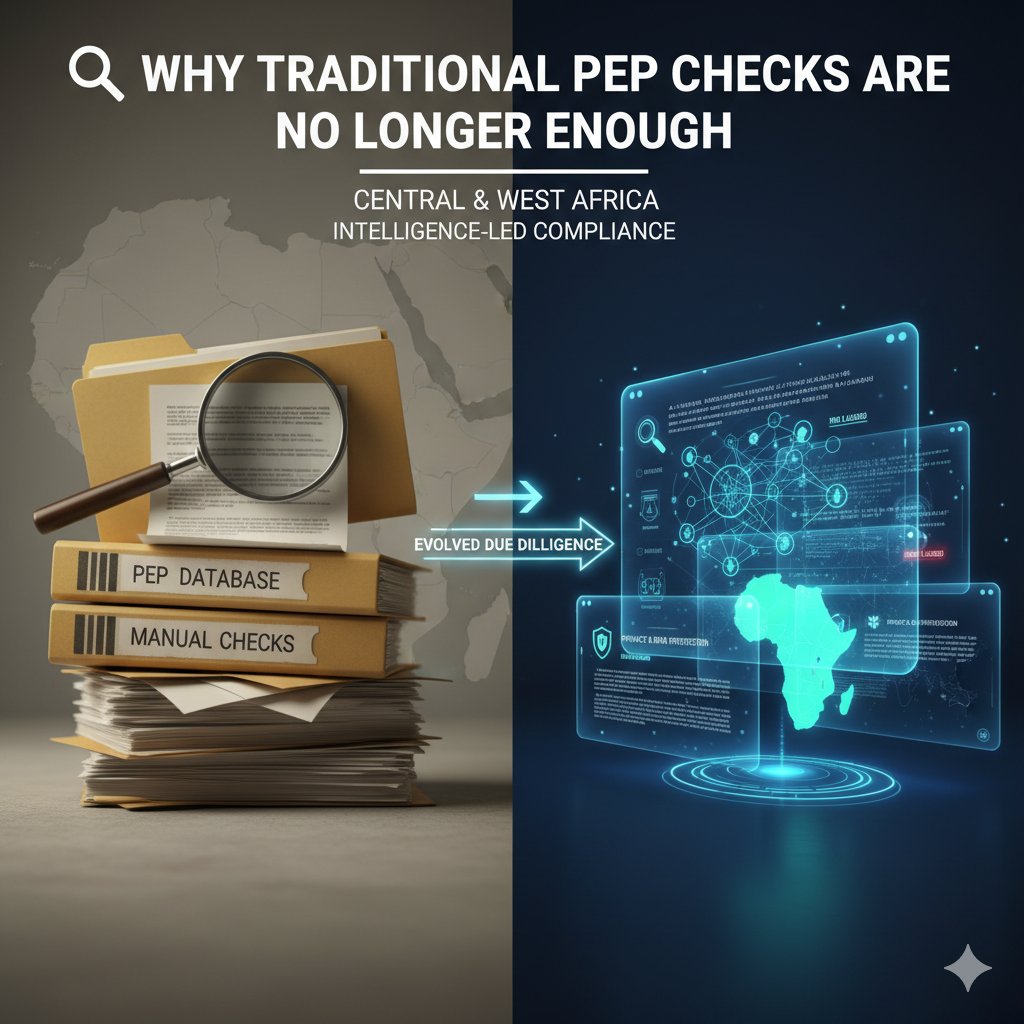
Within the Central and West African economic spheres, the effective implementation of Anti-Money Laundering and Counter-Financing of Terrorism (AML/CFT) regimes is paramount. A critical component of this is the rigorous identification and ongoing monitoring of Politically Exposed Persons (PEPs). From a legal and compliance perspective, while the elevated risk profile of PEPs—arising from their potential involvement in corruption, bribery, and misappropriation of state funds—is a well-established principle, the methodologies for their identification require continuous advancement.
Traditional compliance measures, such as client self-declarations and checks against static domestic databases, remain necessary foundational steps. However, they increasingly represent a form of reactive compliance that may be insufficient to meet the standard of enhanced due diligence as legally mandated. Financial institutions and their legal advisors must now integrate more dynamic, intelligence-led techniques to construct a legally defensible risk assessment.
The supranational regulatory frameworks governing the region—specifically the CEMAC Regulation No. 01/20-CEMAC-UMAC-CM on AML/CFT and the WAEMU Directive on AML/CFT—explicitly enshrine a risk-based approach. This legal principle not only permits but obligates regulated entities to employ methodologies that transcend conventional checks to accurately ascertain a client’s risk profile.
Advanced Methodologies for PEP Identification
The following unconventional methods are transitioning from intelligence specialties to essential components of a robust AML/CFT compliance program:
Open-Source Intelligence (OSINT): The systematic gathering and analysis of publicly available information—including judicial records, public procurement data, news archives, and corporate registries—can uncover political affiliations, associations, and sources of wealth not evident in standard PEP screening databases.
AI-Powered Screening Tools: The deployment of artificial intelligence and machine learning algorithms represents a significant evolution. These tools can process vast, unstructured datasets to identify non-obvious relationships, behavioural patterns, and complex ownership structures, thereby enhancing the accuracy of identifying potential PEPs and their close associates.
Dark Web Monitoring: As a more advanced measure, certain institutions conduct monitored surveillance of the dark web for illicit data exchanges, forums discussing corrupt practices, or leaked information that may connect individuals to politically exposed activities or illicit networks.
Social Media and Network Analytics: An individual’s digital footprint can provide compelling evidence of their associations. Analytical scrutiny of social networks, professional affiliations, and familial connections can reveal undisclosed political ties. This extends to Peer and Network Analytics, which assesses an individual’s proximate associates to identify indirect PEP risks or concealed beneficial ownership.
Navigating Legal and Ethical Imperatives
The deployment of these advanced tools must be carefully calibrated within a defined legal perimeter. The imperative to combat financial crime must be balanced against stringent data protection obligations. In the absence of a harmonized regional data protection law, entities must adhere to general principles of data privacy and relevant national laws, such as Cameroon’s Law No. 2010/012 on Cybersecurity and Cybercrime, while anticipating the implementation of more robust frameworks.
Key legal considerations include:
· Principle of Proportionality and Purpose Limitation: Data collection must be strictly proportionate to the AML/CFT objective and must not be repurposed.
· Establishing a Lawful Basis for Processing: The legal grounds for processing potentially sensitive personal data, typically ‘compliance with a legal obligation’ or ‘public interest’, must be clearly documented within the entity’s legal framework.
· Ensuring Data Accuracy and Mitigating Misinformation: The inherent risk of false positives from algorithmic analysis necessitates robust human oversight and verification procedures to prevent defamation and wrongful financial exclusion.
· Respect for Privacy and Fundamental Rights: A clear legal and ethical boundary exists between diligent investigation and undue intrusion into private life. All methods must be justifiable, transparent, and respectful of fundamental rights.
For legal practitioners and compliance officers within the CEMAC and WAEMU regions, the path forward necessitates a hybrid compliance model. This model synergizes the foundational certainty of traditional databases with the proactive intelligence garnered through advanced methods. The deployment of these tools, however, must be underpinned by a sound legal governance framework that ensures full compliance not only with AML/CFT regulations but also with evolving data privacy norms and ethical standards.
The contemporary legal question is no longer the admissibility of such techniques, but the lawful and ethical manner of their deployment to safeguard the integrity of the regional financial system.
Banyong Fonyam Jonie Jr., Managing Partner, Fonyam and Partners Law Firm.