
5 RISK RESPONSE STRATEGIES
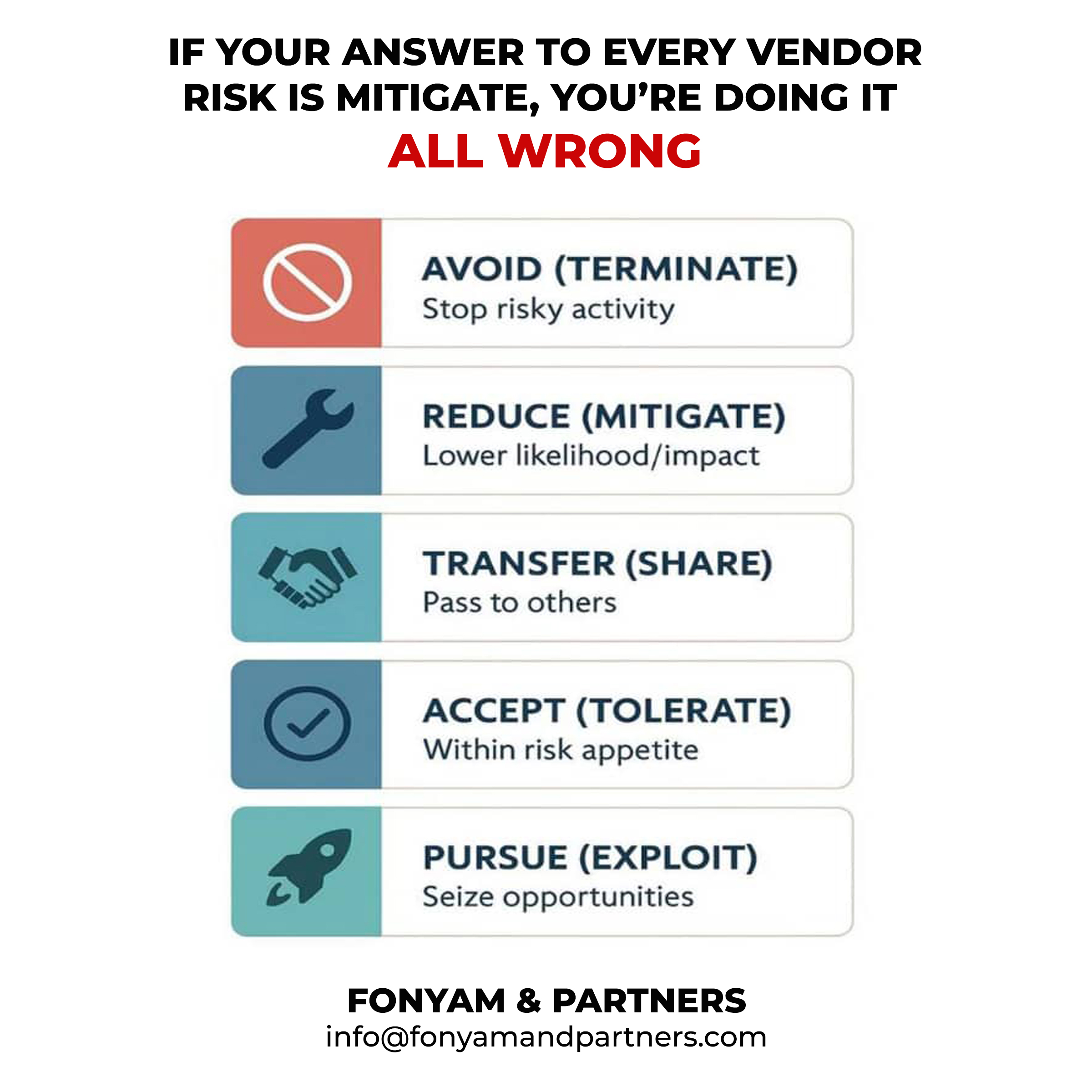
“If Your Answer to Every Vendor Risk is “Mitigate,” You’re Doing It Wrong.”
Over the years as an attorney with key practice in corporate governance and risk management, I consistently observe a critical flaw in how many organizations approach third-party relationships: the automatic default to “mitigation.” As Linda Tuck Chapman aptly states, “If every risk ends up as ‘mitigate,’ you don’t have a strategy; you have a habit.”
This is especially pertinent for businesses operating in Cameroon, CEMAC, and WAEMU, where navigating local regulatory landscapes, data protection laws, and international compliance standards requires more than a one-size-fits-all checklist. A robust Third-Party Risk Management (TPRM) strategy is not about eliminating all risk—it’s about making intelligent, defensible decisions that align with your risk appetite and business objectives.
Here is a concise breakdown of the five essential risk response strategies, reframed with a legal and regional perspective.
AVOID
· When to Use: The risk exceeds your appetite, remediation is impractical, or the exposure is structural (e.g., a vendor’s data residency cannot comply with OHADA or local data sovereignty principles).
· The Playbook: Halt onboarding or exit the relationship. Pivot to an approved provider. Document the rationale formally for your Risk Committee.
· Legal Levers: Contractual clauses for termination due to regulatory non-compliance, unacceptable subcontractors, or data location violations.
REDUCE
· When to Use: The risk is above your threshold but can be lowered to an acceptable level with specific controls.
· The Playbook: Define a clear remediation plan with dates and owners. Implement compensating controls like data minimization or tokenization.
· Legal Levers: Incorporate detailed security addendums, specific control obligations (e.g., SOC 2 Type II, encryption key ownership), and the right to audit or retest controls.
TRANSFER
· When to Use: The risk is insurable or can be contractually allocated, though not eliminated (e.g., financial impact of a data breach).
· The Playbook: Shift financial impact via cyber insurance and robust contractual protections. Require vendors to maintain insurance limits matching your exposure.
· Legal Levers: Strong indemnities for data breach or IP infringement, carve-outs to liability caps for wilful misconduct or PII loss, and ensuring subprocessor obligations “flow down” contractually.
ACCEPT
· When to Use: The residual risk is within your appetite, and the cost of further treatment outweighs the benefit.
· The Playbook: Formally record the decision, name an accountable executive, set a review cadence, and implement monitoring to detect any negative drift.
· Guardrails: Time-box the acceptance, define absolute “no-go zones” (e.g., mishandling of customer PII), and establish clear exit triggers.
PURSUE
· When to Use: There is a strategic upside to taking a managed risk—such as gaining a competitive edge, innovation, or speed-to-market—and appropriate controls are in place.
· The Playbook: Initiate a pilot program with scoped data, staged approval gates, and clear success metrics. Expand the relationship only if KPIs and control tests are passed.
· Legal Levers: Draft “safe-harbor” pilot agreements, include performance credits, and contract for “step-up” controls at each phase of expansion.
The Key Takeaway for Legal and Compliance Leaders
The quality of your risk decisions, not the length of your vendor questionnaire, drives true resilience. This strategic framework ensures that your contracts are not just legal documents but active instruments of your risk management strategy, tailored to the unique challenges and opportunities within our region.
This week, I challenge you to apply this framework to just one vendor relationship. You may find that a more nuanced approach unlocks better outcomes and stronger partnerships.